





 New Zealand were brilliant with the bat. Image Credits: AFP
New Zealand finally made the most of their batting strength against India at Eden Park. On their fourth attempt, they posted an above-par total and went on to defend it comprehensively. Against such an explosive batting lineup on a ground this small, they needed a much bigger score than they managed in the previous three games.
For a while, though, the game seemed to be following the same script. Shreyas Iyer won the toss and put New Zealand in to bat yet again. The hosts lost a few early wickets yet again. India would have also hoped to seize control after removing Daryl Mitchell, who looked in good touch once more.
New Zealand accelerate in middle overs to gain batting advantage
 New Zealand's run-scoring in the T20I series
Powerplay batting was never a major concern for New Zealand, barring the second game, which was played on a used pitch. Despite losing a few wickets along the way, they still scored at 141.28 and struck a boundary every 4.95 deliveries. It is also worth noting that their openers, Finn Allen and Tim Seifert, haven't fired consistently at the top.
Having batted first in all three previous games, New Zealand faced a tougher new-ball phase to negotiate. They made another strong start in the fourth T20I, scoring at 175.68 and hitting a boundary every 3.70 balls in the powerplay. Given the small dimensions, that was broadly in line with their returns in the first and third T20Is.
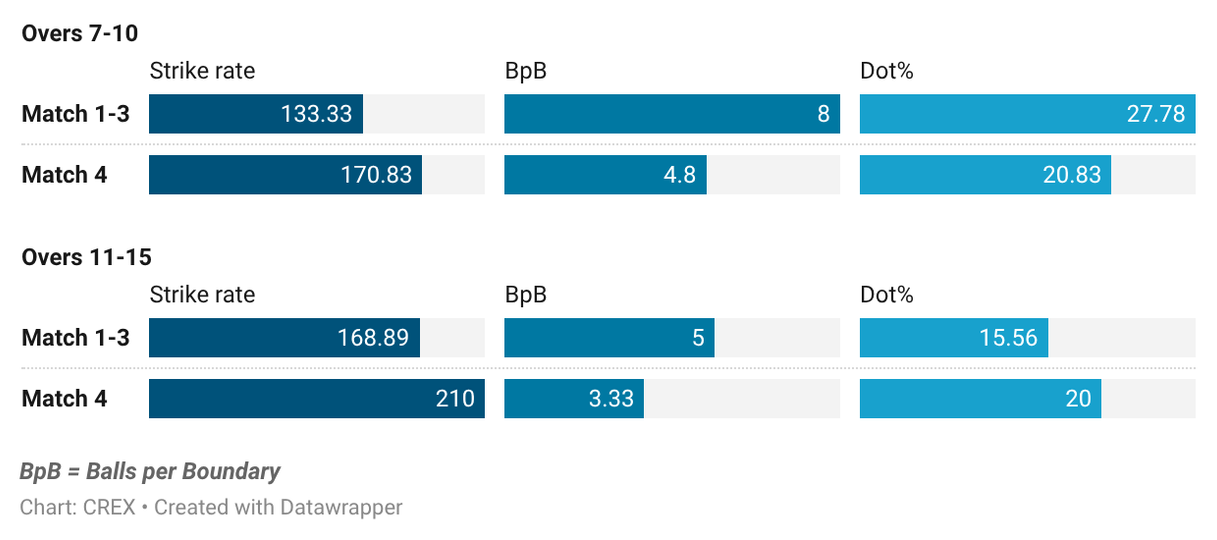
The real difference came after the powerplay. One of New Zealand's biggest problems in the previous game was their inability to maintain the momentum once the fielding restrictions were lifted. Across the first three T20Is, they scored at just 133.33 between overs 7 and 10, taking nearly eight balls per boundary. What made this slowdown more concerning was that they had lost just two wickets in this phase across the three games. They had enough wickets in hand but weren't pressing hard enough.
Their approach was more conventional, with the batters struggling to shift gears. That changed in the fourth T20I, when they scored at 170.83 and struck a boundary every 4.80 deliveries in this phase. Their dot-ball percentage also dropped to 20.83%.

Axar Patel was introduced in the eighth over, and Finn Allen took him to the cleaners straight away. He struck a boundary off the first delivery before launching the next two for sixes, eventually falling on the final ball of the over.
Nitish Kumar Reddy also conceded a maximum in the following over. Even after losing Allen and Bevon Jacobs, Glenn Phillips kept his foot on the pedal.
Early entry point for Michael Bracewell
Michael Bracewell is an underrated batter whose hitting ability often goes underutilised in T20 cricket. New Zealand's conservative approach meant he hadn't got enough opportunities to make an impact earlier in the series. Before the fourth T20I, he had faced just eight balls across two innings and didn't even get to bat in the third game.
This time, Bracewell was forced to come out in the 11th over after Bevon Jacobs fell to a short ball. Jacobs had earlier formed useful partnerships with Daryl Mitchell and Glenn Phillips, helping New Zealand maintain their momentum. But that wasn't the case this time, as the hosts consciously looked to keep pushing the scoring rate.

Bracewell didn't take any time to settle when he walked out to bat. Instead, he took Naman Dhir apart with some sublime hitting. Prince Yadav and Axar Patel were also taken to the cleaners as he continued his assault.
In the blink of an eye, Bracewell raced to a 19-ball fifty and kept going before falling for a career-best 65 off just 25 deliveries in the 18th over. At the other end, Glenn Phillips took Nitish Kumar Reddy apart. The latter proved ineffective in conditions that offered little assistance through old-ball movement.
Between overs 11 and 15, New Zealand scored at 210 and found the boundary every 3.33 deliveries. In the previous three games, they had a strike rate of 168.89 and a boundary every five balls in the same phase across the first three games.

The intent to push for more runs was evident throughout. Phillips continued to attack even after bringing up his fifty, never allowing the momentum to dip. Daryl Mitchell, on the other hand, started briskly but slowed down considerably, scoring at just 134.62 in his final 26 deliveries in Wellington.
India had shown New Zealand the way in the previous game by dismantling the Kiwi bowling attack. In Auckland, New Zealand returned the favour, registering their highest-ever total and hitting more sixes than they had ever before. In doing so, they realised they, too, could push the limits of their batting and scale unprecedented heights, much like India have been doing over the last couple of years.
.jpg)