






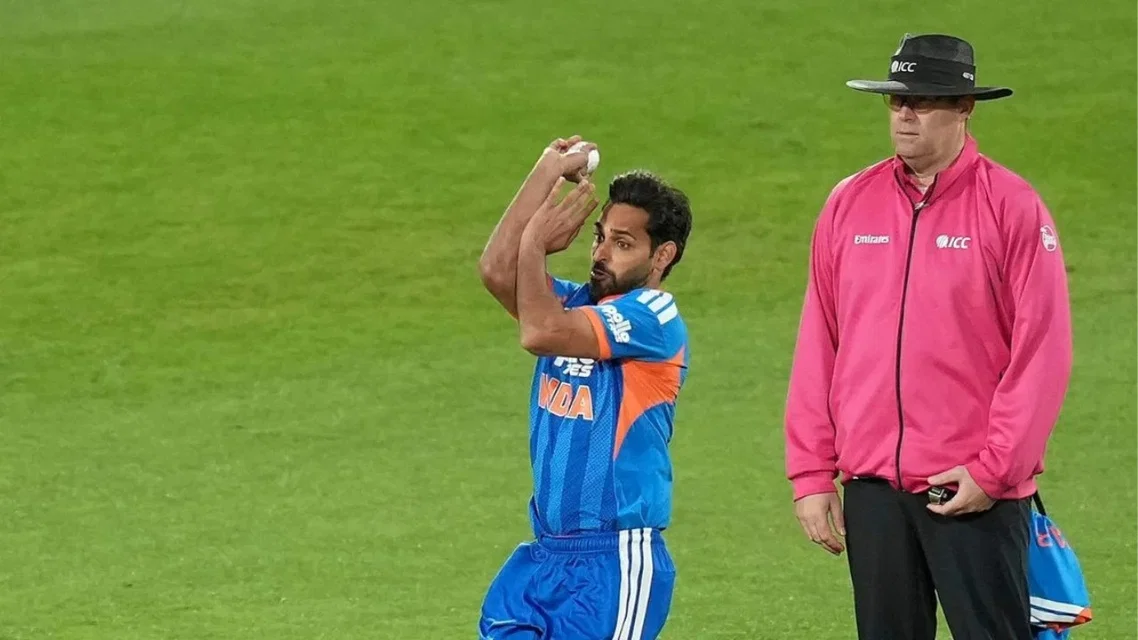
 Bhuvneshwar Kumar has not been at his best on his international comeback. Image Credits: AFP
Bhuvneshwar Kumar’s comeback to the Indian team has been anything but seamless. After being left without a chance to bowl in the final T20I against the West Indies in Bengaluru, he flew straight to New Zealand, where he finally bowled in international cricket again after nearly four years. New Zealand was also where India last dropped him, back in 2022.
But the form that earned him a comeback hasn’t travelled with him. Bhuvneshwar was among the standout bowlers in IPL 2026, but has looked like a shadow of that bowler in the New Zealand series. Three matches in, he has just one wicket and has conceded 11.58 runs per over across 12 overs.
What has gone wrong for Bhuvneshwar Kumar against New Zealand?
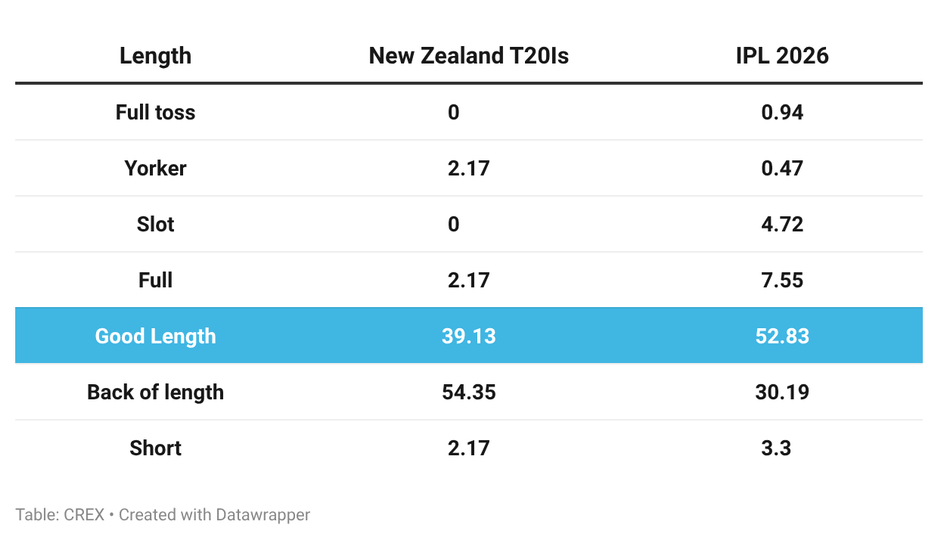 Length split of Bhuvneshwar Kumar in the first six overs
Bhuvneshwar Kumar’s biggest strength in IPL 2026 was his control over lengths. He consistently hit good lengths in the powerplay, allowing the ball to move both ways. As many as 52.94% of his deliveries in the first six overs landed in the 6-8 metre range.
In New Zealand, however, he has been consistently a touch too short. He has landed only 39.13% of his powerplay deliveries in the good-length area, which has also been his most effective length on tour. Those deliveries have cost him just 6.67 runs per over and also earned him his only wicket in the series.
Yet Bhuvneshwar hasn’t persisted with that length enough. Instead, 54.35% of his powerplay deliveries have landed in the back-of-a-length area between 8 and 10 metres. They have proved far more expensive, going for 11.18 runs per over and a boundary every 3.67 balls.
In the second T20I in Christchurch, he had just dismissed Daryl Mitchell off a good length on the final delivery of the third over. Yet in his next set, Bhuvneshwar started with short deliveries to Finn Allen, who used the angle and pace to scoop behind the wicket. He stuck with short lengths, and Glenn Phillips also found an early boundary with a pull shot behind square, mitigating the early advantage India earned with two quick wickets.

Compare that with his spell in the league stage game against Gujarat Titans (GT) in Ahmedabad. Shubman Gill hit him for a four and a six in the opening over, but Bhuvneshwar stuck to his good length and squared the batter up on the very next delivery. Sai Sudharsan also began his innings with a boundary off Bhuvneshwar’s next over; still, the veteran pacer didn’t stray from his preferred length and eventually dismissed him off the final ball.
Bhuvneshwar Kumar, then, has moved away from his greatest strength far too readily in New Zealand. The conditions have offered more assistance than the surfaces he bowled on in IPL 2026. That makes his lack of consistency with length all the more surprising.
Does Bhuvneshwar have a reason to bowl short?
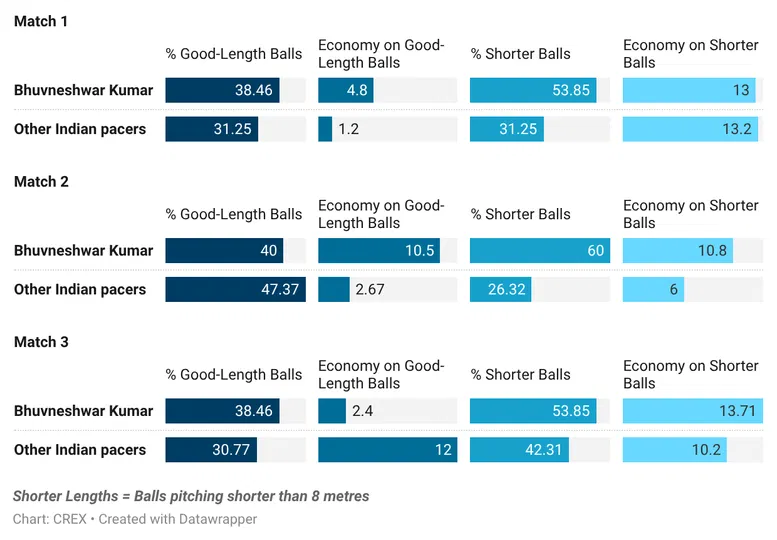 Length breakdown in the first six overs against New Zealand
Ground dimensions play a significant role in how pacers adjust their lengths in New Zealand. In Christchurch, for instance, the square boundaries are considerably bigger than the straight ones. Wellington, where the third T20I was played, offered opposite dimensions, with shorter square boundaries.
In Christchurch, Bhuvneshwar Kumar might have been tempted to bowl slightly shorter to prevent New Zealand’s batters from hitting him straight down the ground. But that’s a defensive approach with the new ball, especially when fresh pitches offer some early movement for the quicks.
The other Indian pacers collectively bowled 40% of their powerplay deliveries in that area, conceding just 2.14 runs per over. So, New Zealand weren’t finding it easy to hit those lengths down the ground. In fact, back-of-a-length deliveries proved far more expensive, leaking 9.33 runs per over.
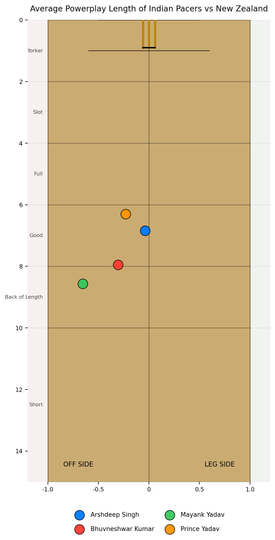 Average Length of each Indian pacer in powerplay against New Zealand
The case for bowling fuller was even stronger in Wellington, where the shorter square boundaries made it harder to control runs from shorter lengths. Yet Bhuvneshwar bowled 53.85% of back-of-a-length deliveries, leaking 13.71 runs per over and a boundary every 3.50 balls. Whenever he did go back to a good length, the returns were far more economical.
Bhuvneshwar had already troubled Tim Seifert and Finn Allen with movement off a good length in his opening over. But he reverted to shorter deliveries in his next, conceding two sixes before Shreyas Iyer had to take him out of the attack.
Even if Bhuvneshwar deliberately held back on his lengths in the first two games, there was little justification for doing so in the third. The pattern points to something beyond tactical choices: he is missing his lengths too often and, for now, lacks the control that made him so effective in the IPL.
Bhuvneshwar sweats to adjust to New Zealand conditions
Bhuvneshwar Kumar hasn’t quite found his rhythm yet. His pace has also been down both with the new ball and overall. Against New Zealand, he has averaged 128.11 km/h in the powerplay wherever speed data is available, compared to 133.12 km/h in IPL 2026. He has also bowled three no-balls in the rubber.
It’s hard to pinpoint the reason, but his age and the nature of his schedule in recent years could have played a part. Since being dropped from the Indian team, Bhuvneshwar has largely played T20s, with a relatively settled workload. He has also had the luxury of preparing for those tournaments well in advance, both mentally and physically.
His last assignment was the UP T20 League in August and early September, while his next domestic commitment would have been the Syed Mushtaq Ali Trophy from mid-November. The New Zealand series, then, has fallen between what would otherwise have been a fairly predictable schedule.
Unlike many other fast bowlers, Bhuvneshwar hasn’t had the demands of longer formats to contend with either. His last First Class appearance was in 2024, and he hasn’t played List A cricket since 2023. Without regular competitive cricket across formats, it could be harder to stay in the playing groove and keep the body primed for the demands of an overseas tour.
The turnaround before this series hasn’t helped either. India travelled to New Zealand and played their first match within three days. At 36, Bhuvneshwar was always likely to need some time to find his feet in unfamiliar conditions after such a quick transition.
The conditions themselves present another challenge. Since his international career went on pause, Bhuvneshwar hasn’t played outside India. His domestic and franchise assignments have all come at home, where the conditions are familiar, and the adjustment required is relatively limited.
New Zealand, by contrast, brings a different combination of weather, pitches and ground dimensions. Adapting to those demands can take time, particularly when a bowler hasn’t had much recent exposure to overseas conditions. That could partly explain why Bhuvneshwar hasn’t looked quite like himself so far.
Whatever the reasons, India will want him back to his best. The series now moves to two of New Zealand’s smallest grounds, where containing the batters will be an even tougher challenge for every bowler. Bhuvneshwar needs to put his IPL hat back on, and quickly.
.jpg)