








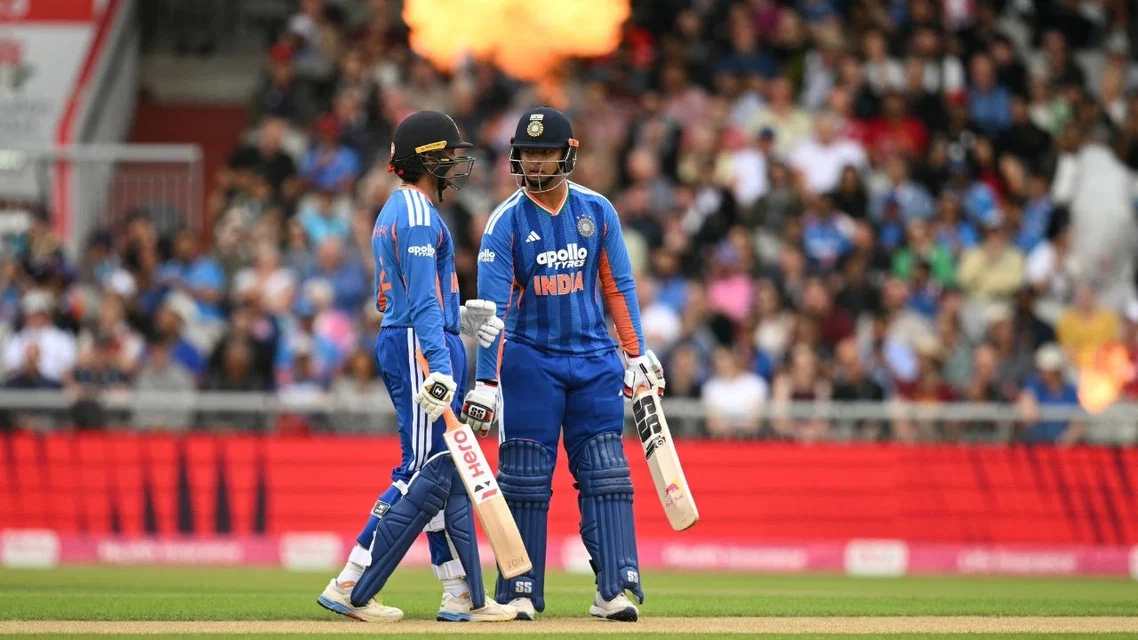
 India were ruthless in Wellington. Image Credits: AFP
‘Let’s show them why we are the World Champions.’ That was Abhishek Sharma’s rallying cry in the final huddle before the start of the New Zealand tour. What prompted the statement is open to interpretation.
Perhaps it was a tongue-in-cheek attempt to fire up his teammates when asked to deliver a motivational message. Or perhaps there was more to it than met the eye. Whatever the intent, India had plenty of reasons to make a statement, and not just as the reigning world champions.
For one, this was the first overseas assignment outside the subcontinent for India’s full-strength T20I side since the bruising UK tour. Ireland and England had exposed familiar cracks in their batting, using pace and bounce to unsettle them and forcing them to target longer boundaries. Indian batters eventually found answers to most of those questions, but negotiating them in New Zealand was an entirely different proposition.
India’s resilience in the first two games
The vastly different pitches left little room for complacency, and the quality of the attacks they faced presented a challenge of its own. The opening game in Christchurch threw them straight into the deep end, asking them to chase their highest-ever T20I total in the biting cold.
Sanju Samson set the tone with a blistering start in the powerplay, giving India the early momentum they needed. A mid-innings wobble threatened to derail the pursuit after New Zealand spinners tightened their grip, but India held their nerve to cross the line. It was an early test of their temperament, and one they passed.
The second T20I demanded even more. New Zealand had India reeling at 70/5 in the 11th over, having dismantled their prized top four on a used pitch. Ishan Kishan, their most consistent T20I batter this year, was unavailable too. With the innings threatening to unravel, India needed someone to take charge. Instead, they found two, or three if you include Tilak Varma too.
Tilak first stitched together a timely 42-run partnership with Naman Dhir, steadying the innings without letting the required rate spiral out of control. Nitish Kumar Reddy then joined the rescue act, turning a seemingly lost cause into a memorable chase. Just when New Zealand appeared to have them cornered, the lower order found a way out.
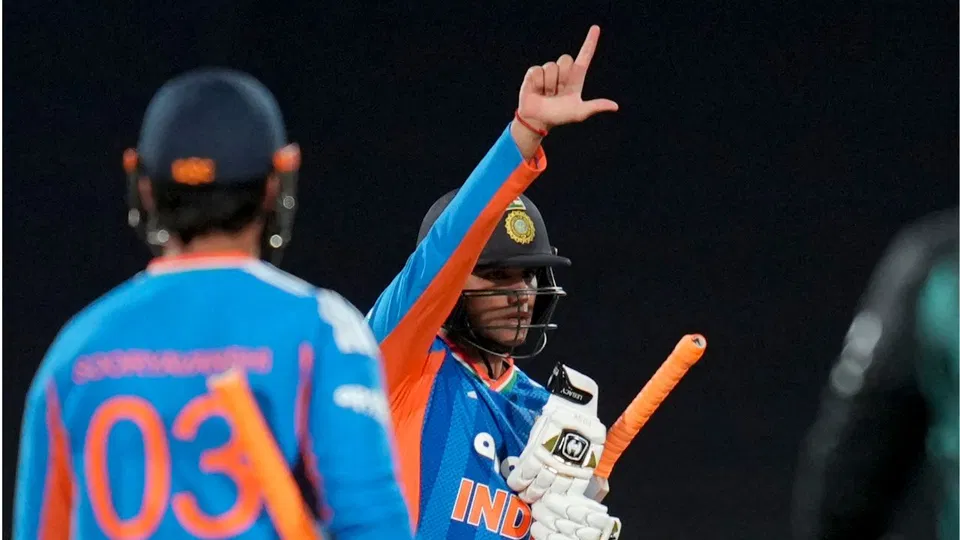
Across the first two games, India had confronted contrasting challenges and found different solutions, often with players who had little experience of these conditions. They had absorbed the pressure, adapted on the fly and refused to let difficult situations dictate the outcome.
These were not the sort of victories that came from everything falling into place. They were built on finding a way when it seemed there wasn't one.
Isn't that what world champions are supposed to do?
Perhaps. But if the first two games were about showing their resilience, India were about to offer a far more ruthless reminder of what makes them world champions. The third T20I in Wellington would take Abhishek’s statement to an entirely different level, as they set about sealing the series in the most emphatic fashion imaginable.
Abhishek Sharma Backs Up His Words with a Ruthless Display
The Wellington surface offered a different kind of challenge, with extra bounce and seam movement making life difficult for batters. A stiff breeze only added to the discomfort, bringing another variable for an Indian batting unit largely unaccustomed to such windy conditions.
Then came the familiar tormentor. Daryl Mitchell, India’s nemesis, had powered New Zealand to an imposing 198/3, a total that looked well above par on a surface offering plenty to the bowlers. He was ‘really, really happy’ with the score, and even after watching his side suffer a mauling and a half, Mitchell Santner believed they had enough runs on the board. New Zealand had every reason to fancy their chances.
It was only fitting, then, that Abhishek Sharma, the man who had called on India to behave like world champions, took centre stage in the most challenging batting conditions of the series. Vaibhav Sooryavanshi joined him at the top, pushing Sanju Samson down to No. 3. What followed was an assault so merciless that New Zealand might spend the days before the next game recovering.

Vaibhav opened with a boundary and a six off the first three deliveries. Abhishek then announced himself with a maximum off his very first ball. Jacob Duffy suddenly seemed to forget how to bowl, sending down a wayward wide that raced away to the boundary. India had plundered 26 runs from the opening over.
New Zealand barely had time to settle before the damage had begun. Abhishek, meanwhile, was only getting started.
Adam Milne tried to use the conditions, sending down an away-swinging length delivery with a fielder stationed at deep point. Abhishek hardly cared for it. He threw his hands at the ball and cleared the fielder to his left for a maximum, making the protection look almost pointless.
Milne responded by shortening his length. Abhishek responded by launching him over the leg-side boundary in front of square. On the next delivery, he threaded the gap between cover and point, placing the ball precisely between the two regions he had targeted on the previous two deliveries. This set underlined why Abhishek is arguably the most devastating off-side player in T20 cricket right now.
Michael Bracewell, and off-spin more generally, had troubled Abhishek in the past. The New Zealand spinner had also dismissed him in the series opener in Christchurch. But if this series was about India answering familiar problems, Abhishek was determined to make his own statement.
Bracewell began with a hard length, only for Abhishek to move away and carve him through cover for four. The next delivery was even more audacious. The spinner tried to cramp him for room by attacking his body, but Abhishek stepped forward, manufactured just enough space and opened up the same region again, this time driving the ball all the way through.
By now, the contest had begun to reverse itself. The bowlers were no longer dictating where Abhishek could play; he was dictating where they had to bowl. He moved across the crease to plant a false impression in Bracewell's mind, inviting the predictable delivery into his legs.
The spinner took the bait, only for Abhishek to slice the ball over backward point for another boundary. It scarcely mattered whether the ball was directed at his body, pushed across him or fired into his pads. Abhishek kept finding the same avenues through cover and point, turning a supposedly difficult batting surface into his own personal scoring zone.
New Zealand turned to a fourth new bowler in as many overs, bringing Kyle Jamieson into the attack. He, too, found himself on the receiving end of the same merciless treatment. Abhishek first dispatched him over mid-on for four before backing away to carve another maximum over cover. By this point, he also stopped accounting for the breeze altogether. The conditions that had threatened to complicate India’s chase were barely registering in his calculations. Two audacious flicks brought another couple of boundaries to close the over, taking Abhishek to a 15-ball half-century.
Even Vaibhav Sooryavanshi, who was scoring at more than twice a run a ball, was struggling to keep pace with his opening partner. Vaibhav finally seized the spotlight in the last over of the powerplay, plundering 18 runs to propel India to the highest-ever powerplay score in T20Is.
The chase was as good as over before New Zealand could comprehend the carnage. Vaibhav eventually departed after a blistering cameo, but it did little to rein Abhishek in after the field restrictions were lifted.
Matthew Fisher, playing only his second T20I, had just dismissed Vaibhav with his first delivery of the innings. Abhishek barely seemed to register the breakthrough, let alone the threat posed by the bowler. He launched two more sixes before Sanju Samson, perhaps left wondering how many opportunities he would get once Ishan Kishan returned, brought the over to a close with another boundary.
Abhishek raced to a 35-ball century before finishing on 113 to play one of the most extraordinary innings of his career. This was hardly uncharted territory for him. He had produced breathtaking assaults before and already had three T20I centuries.
Yet, somehow, this one stood apart. The audacity of the strokeplay, the sheer range of his hitting and the conditions in which he produced it combined to make this perhaps the most breathtaking knock of them all.
.jpg)
“Absolutely stunning. It was pleasing to the eyes the way they played strokes. Also, when Sanju and I went to bat, the ball was seaming, and I was like, how did they manage this? It was simply mind-boggling,” Shreyas Iyer said after the chase.
It is difficult to pinpoint what was most mind-boggling about the innings. Was it the audacity with which Abhishek and Vaibhav dismantled the attack, the ease with which they found gaps, no matter the lines and lengths bowlers bowled, or the sheer indifference with which they treated conditions that should have made batting considerably harder?
Perhaps the truly astonishing part was how effortlessly they made the extraordinary look routine. And that, in itself, is mind-boggling on so many levels.
India’s T20 Batting Depth Sets Them Apart from the Rest
Skill-wise, India are operating in a league of their own. No T20 side in the history of the game has boasted this kind of depth. The remarkable part is that the quality has never dipped despite the sweeping changes the setup has undergone over the last couple of years.
When Rohit Sharma and Virat Kohli retired from T20Is, India didn't just find replacements. They unearthed one of the most destructive opening combinations in Abhishek Sharma and Sanju Samson. Ishan Kishan then returned to the fold in the best version of himself yet. And just when the batting lineup seemed to have more than enough firepower, along came Vaibhav Sooryavanshi.
The talent pool is so absurdly deep that a player of Sooryavanshi's calibre has had to wait for his opportunities. Yashasvi Jaiswal and Rajat Patidar, meanwhile, are not even part of the setup. Then there is Suryakumar Yadav, one of the finest T20 batters the game has ever seen, who was dropped after leading India to their second consecutive T20 World Cup title. India have barely missed him.
The bowling department tells a similar story, even if the depth isn't quite as overwhelming. Jasprit Bumrah and Hardik Pandya have missed games along the way, yet their absence hasn't hurt India to the extent many might have anticipated. Prince Yadav and Nitish Kumar Reddy have slotted into the setup seamlessly, while Naman Dhir has offered solutions to problems further down the order.
And if any doubts had somehow survived India's UK ordeal, Wellington provided the final blow.
New Zealand arrived armed with 198/3, favourable conditions and the conviction that they had posted enough runs to make a game of it. India systematically dismantled all three. What was supposed to be their toughest challenge became a demonstration of how little the opposition's plans mattered when India's batters were firing on all cylinders.
Simon Doull and Ian Smith, the home team's commentators, had taken subtle digs at India over the unfamiliar conditions, even in games they went on to win. India showed that they could render conditions irrelevant, or perhaps bring Bengaluru to every corner of the world with their sublime skills. It was only right that India sealed the series before the home side could even make it a contest.
India didn't just chase down 199. They turned a potentially tricky contest into a procession, backing up Abhishek’s words with a performance that laid bare the gulf between them and the opposition.
This is a world champion side with a frightening amount of firepower, and perhaps the most ruthless T20 team the game has seen. In Wellington, the ghosts of the UK tour were buried, and every lingering doubt about India's ability to dominate beyond familiar conditions went with them.
.jpg)
.jpg?type=mq "Prasidh Krishna fitness update")