












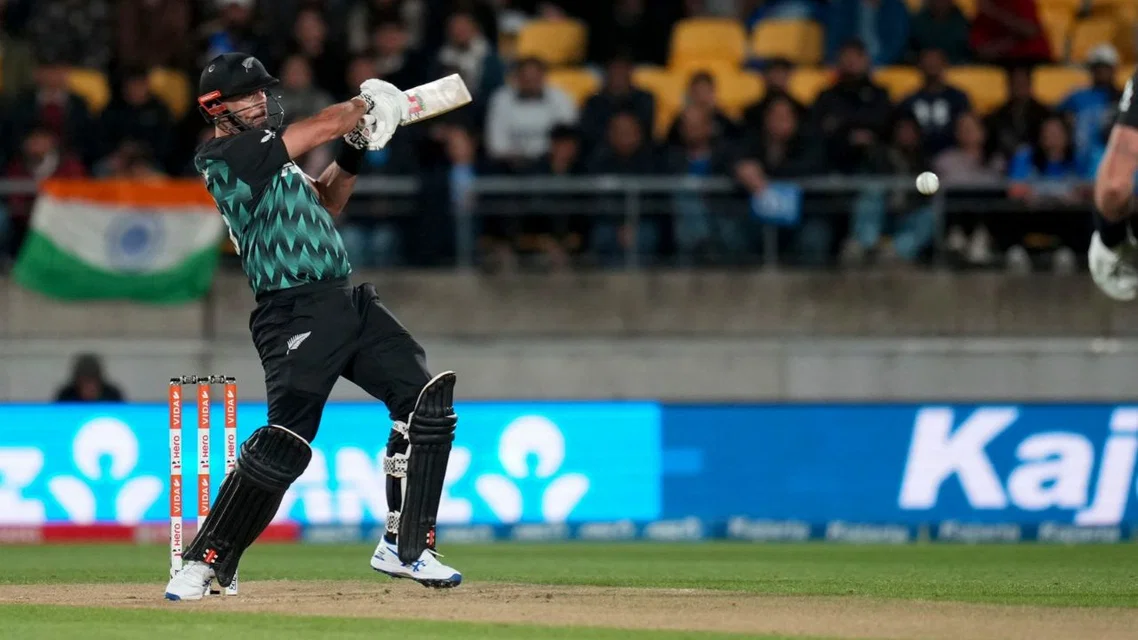
 Daryl Mitchell in action vs IND [Source: AFP]
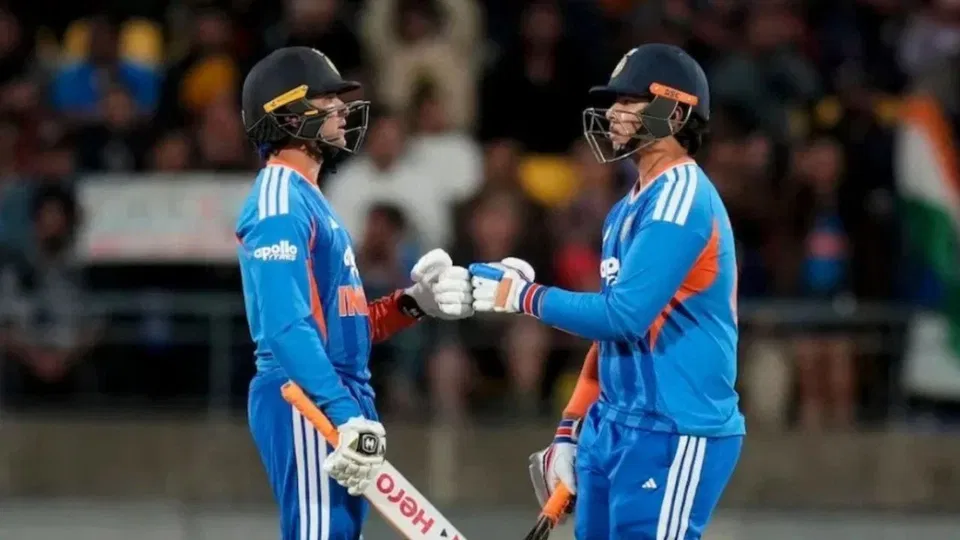
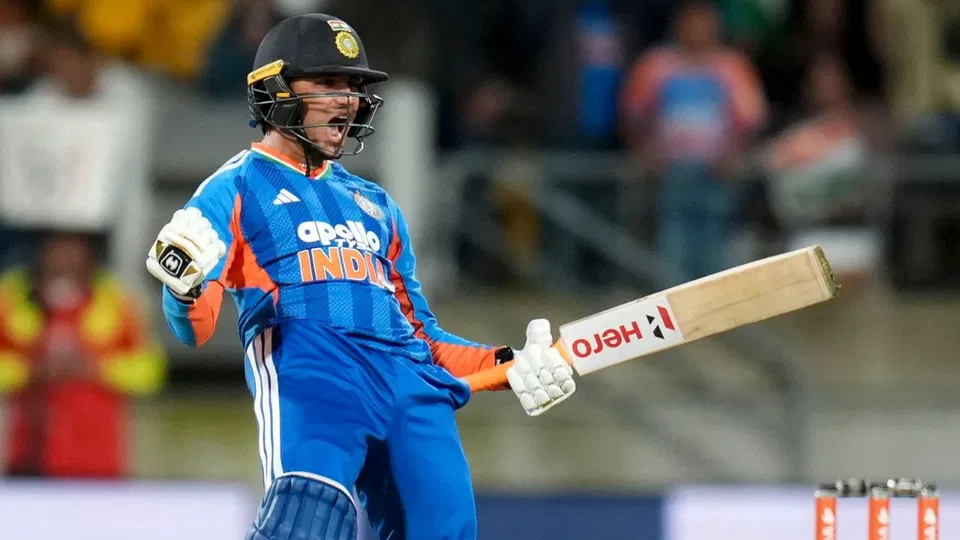
It’s not hard to forget what New Zealand did amid the carnage Abhishek Sharma and Vaibhav Sooryavanshi unleashed in Wellington. They batted so outrageously that every other batter on both sides looked ordinary. Among them was India’s scourge, Daryl Mitchell.
Even if no one noticed, Mitchell had already played a couple of decent knocks, including his career-best 89* right before Abhishek and Vaibhav hijacked the game. As if he would always score runs against India, no matter the format or conditions. In this series, he’s found reasonable success despite not batting in his preferred No.5 spot.
Daryl Mitchell steps up against India yet again
New Zealand have been without key batters Rachin Ravindra and Mark Chapman throughout the T20I series. Rather than slotting another left-hander, Devon Conway, at No.3, they have opted for a makeshift solution by promoting Daryl Mitchell. Bevon Jacobs, meanwhile, has moved up to No.5, Mitchell’s usual T20I spot.
Before this India series, Mitchell last batted at No.3 in 2023, having occupied the position in just four innings. Adjusting to an unfamiliar role, therefore, was never going to be straightforward.
Yet, Mitchell hasn’t looked entirely out of place. After a decent cameo in the series opener, he made a bigger impact in the third T20I on a tricky Wellington surface that offered considerably more seam movement and bounce than the Christchurch pitch. Tim Seifert’s early dismissal also meant Mitchell had to walk in early in the second over.
Rather than taking his time to settle, however, he went straight at the bowlers, looking to maximise the powerplay field restrictions. He began by slogging Arshdeep Singh, who was attempting to shape the new ball away from right-handers.
Mitchell soon picked up on India’s plan to attack with short lengths and hit the deck hard during the powerplay. He responded by bringing his unconventional shots behind square into play, using the pace of the ball to his advantage. Wellington’s relatively short square boundaries on either side only made that approach more rewarding.
On the final delivery of the fourth over, Mitchell moved across towards fine leg and scooped a back-of-a-length delivery from Arshdeep. When the left-armer returned for his third over in the powerplay, Mitchell pulled a short ball over deep square leg for a maximum.

That prompted an adjustment from the bowler, and Mitchell was quick to respond.
Having been struck for a six off a short delivery, Arshdeep predictably switched to yorkers. Mitchell, though, anticipated the left-armer would keep the ball wide, as he typically does when attempting yorkers. Since 2025, around 59.53% of Arshdeep’s yorkers and attempted yorkers in T20Is have been directed outside off stump or wide of it.
Mitchell therefore deliberately stood outside his crease, slightly across the off stump, to give himself greater access to the ball. Arshdeep narrowly missed his length, and he drove it over mid-off with just enough power to find the boundary.
New Zealand had their powerplay platform, despite Seifert’s early departure and some excellent bowling from India.
Mitchell continued his mastery with the old ball
Daryl Mitchell continued to trouble India with his unconventional methods even after the fielding restrictions were lifted. Prince Yadav naturally angles the ball into right-handers on traditional lengths, with his deceptive pace making it skid through. India, therefore, had two deep fielders at square leg and mid-wicket, while fine leg remained inside the circle.
Mitchell immediately targeted that gap, clearing the fine-leg fielder for a maximum. The angle and pace worked in his favour as he crouched low to get on top of the bounce and connected sweetly enough to send the ball all the way.
Later in the over, Mitchell stayed deep in his crease, almost anticipating another short delivery. Prince obliged, dropping one short and wide outside off. Mitchell dragged it towards the deep square-leg boundary for another maximum. With the square boundaries relatively short, he had the percentages in his favour and could afford even a slight mishit.
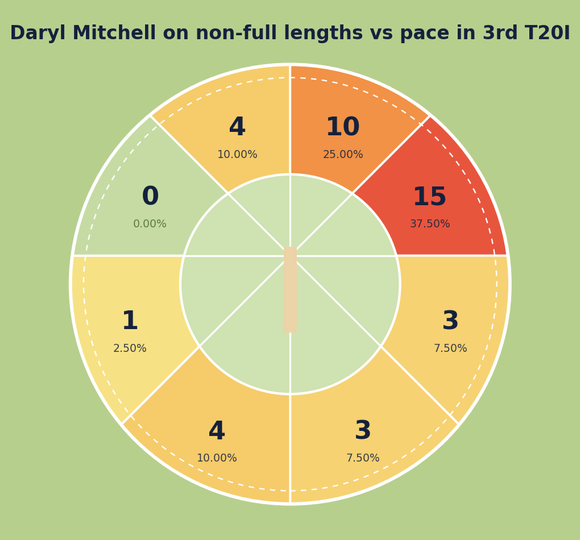 Daryl Mitchell on lengths >= 6 metres vs pace in third T20I
He struck at 266.66, hitting a boundary every 2.50 deliveries, on non-fuller lengths shorter than six metres against pace. Around 72.50% of his runs came square of the wicket or behind it, at a strike rate of 362.50. He was quick to capitalise on anything even marginally short, showcasing the range of his strokeplay.
India eventually responded by bowling fuller in the second half, recognising that forcing the batters to hit straight was their best chance to contain scoring. With the longer boundaries down the ground, they managed to stem the flow of runs and slightly rein in Mitchell as well. Yet, he continued to find the occasional boundary.
In the 11th over, for instance, Mitchell first powered a fuller delivery down the ground, to the left of long-on. Off the next ball, he stayed deep in his crease and turned another full delivery into a slot ball, launching it wide of long-on for six to bring up his half-century. If the earlier overs had showcased his craft, this sequence highlighted his raw power.
Mitchell continued to find a few boundaries in the slog overs, too, like scooping one over fine leg in the 16th over before lofting another down the ground in the penultimate over. He remained unbeaten, helping New Zealand post 198/3.
Given how the surface played for most of the innings, 198/3 was a competitive total, with only Abhishek and Vaibhav making run-scoring look effortless. Even after all the carnage, when Shreyas Iyer and Sanju Samson came to the crease, New Zealand’s pacers continued to extract seam movement. In that context, Mitchell’s knock stood out for its calculated aggression, as he took measured risks and picked his scoring areas with precision.
Daryl Mitchell shows his T20I evolution
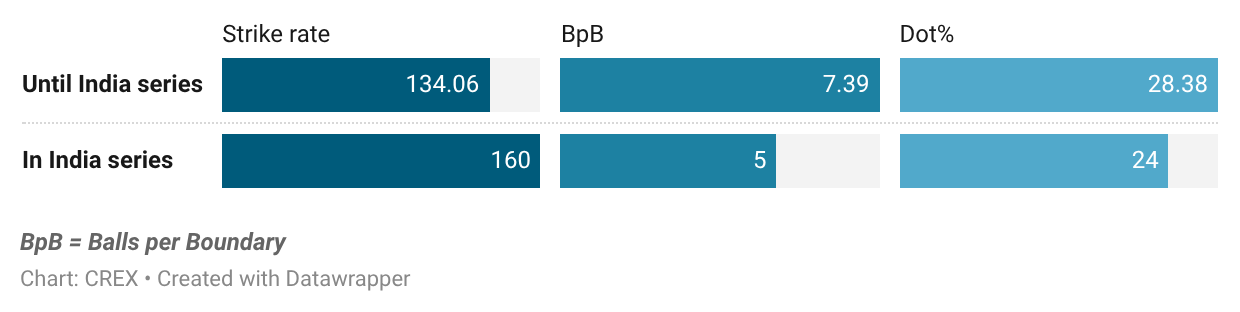 Daryl Mitchell in first 10 balls in T20Is since 2025
Daryl Mitchell’s career has been defined by his ability to adapt. He may not be the most naturally gifted batter, but he has consistently found ways to overcome his limitations and make an impact. Now, having been asked to take on an unfamiliar role in tricky conditions, he has once again found a way to score runs.
A major part of that adjustment has been his proactive approach throughout this T20I series. Mitchell is usually an innings-builder in the format, often starting cautiously before shifting gears once he has spent some time at the crease.
Between the start of 2025 and this India series, Mitchell struck at 134.06 in his first 10 balls in T20Is. He hit a boundary every 7.39 deliveries while playing out 28.38% dot balls.
This series, however, has presented a different challenge. Mitchell has walked in during the powerplay in all three matches, forcing him to shelve his natural approach and make the most of the fielding restrictions. The adjustment has come immediately.
He has struck at 160 in his first 10 balls this series, finding a boundary every five deliveries. He has cut his dot balls to 24%. That early aggression has kept the scoreboard moving without forcing his teammates to do the heavy lifting.
In the first T20I, Mitchell arrived in the final over of the powerplay and launched Axar Patel for six off his very first ball. He later struck Mayank Yadav for a couple of boundaries, making his intent clear from the outset. Even in the second game, he began with a boundary off Bhuvneshwar Kumar before losing his wicket.
When he arrived even earlier in the third T20I, Mitchell simply carried that approach forward, ensuring Seifert’s early dismissal did little to disrupt New Zealand’s momentum. This latest adjustment is another example of his ability to find solutions, regardless of the situation or role.
And when it comes to India, Mitchell has often found a way to make his presence felt. In Wellington, the Indian openers understandably hogged the headlines with their breathtaking batting display. Away from the spotlight, though, Daryl Mitchell went about his business as he so often does, grinding out valuable runs for New Zealand.