







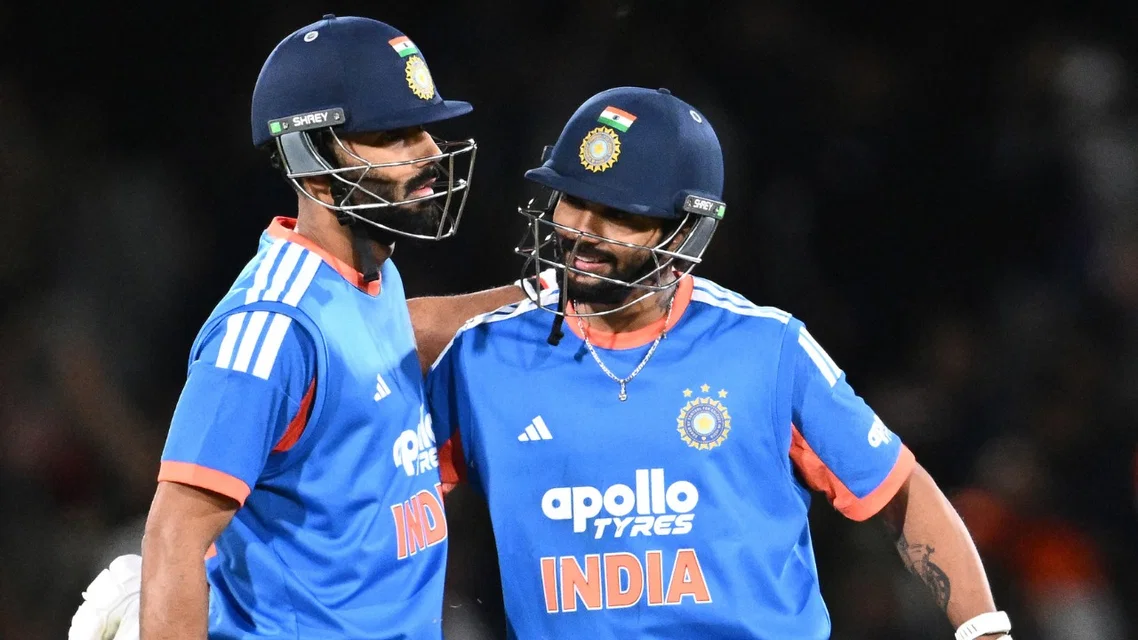
 Naman Dhir and Nitish Kumar Reddy provide the depth India need. Image Credits: AFP
Batting depth has been a priority under India’s current team management. Across formats, they have consistently played all-rounders over specialist bowlers, even if that has reduced their bowling strength. At No.8, India always want someone who can bat.
For India, injuries to key all-rounders, including Hardik Pandya, have been the issue. So, their temptation to play multi-skilled players hasn’t always ended with suitable options. They’ve tried Suryansh Shedge, who’s far from developed, and even Washington Sundar had an extended run despite not being suited to T20s.
India finally playing the right options to maintain their batting depth
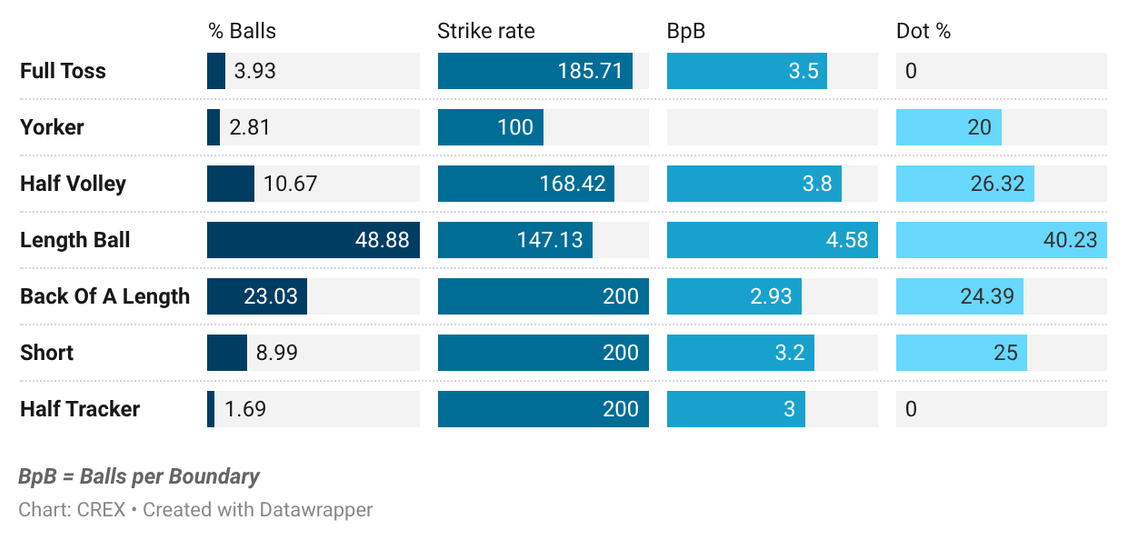 Naman Dhir vs pace since IPL 2026
After a couple of years, India have finally found ideal players to maintain their batting depth without greatly compromising their bowling strength. Naman Dhir and Nitish Kumar Reddy are the best options available. Naman is possibly the best pace-hitter who can also bowl useful off-spin, while Nitish is the country’s second-best pace-bowling all-rounder.
When India stuck with Washington Sundar, they wanted a matchup spinner who could take the ball away from LHBs. But under Gautam Gambhir’s management, he bowled just 2.34 overs per innings. The issue is that Sundar doesn’t contribute enough with the bat to under-bowl every game.
He played just 9.83 balls per innings on average, averaging 21.71 and striking at 128.81. The southpaw has worked on his batting and improved against pace, but remains far from ideal. He can’t be promoted consistently, while his value as a pace-hitter remains limited.
He has averaged just 15.66 and struck at just 134.28 against pace during this period. He has hit a boundary every 6.36 deliveries.

Naman Dhir, meanwhile, offers as much with the ball, but with way better value as a batter. His strike rate against pace stands at 287, and his balls-per-boundary ratio at 2.09. More importantly, Naman is equally capable against hard lengths and starts quickly.
On back-of-a-length and short deliveries, Naman has struck at a whopping 362.50 against pace in T20Is. Even in IPL 2026, he struck at 172 and hit a boundary every 3.57 balls on these lengths.
In the second T20I in Christchurch, Naman Dhir came to bat when India were reduced to 71/5 in the 11th over. He didn’t take any time under pressure and whacked Lockie Ferguson’s back-of-a-length delivery for a maximum on his second ball. Later, he also took Mitchell Santner and Michael Bracewell down, which eased the pressure on Tilak Varma.
He had played a similar cameo even in the first game. With the ball, Naman has shown reasonably encouraging defensive skills despite playing on flat pitches. His spell against the West Indies in Lucknow was a classic example, where he varied his pace and also altered lengths unpredictably.
Sundar was never a massive threat with the ball in T20s. On flat pitches, there is hardly any noticeable difference between the two. Naman at least provides higher batting value and can also be promoted to take down spin if needed.
Nitish Kumar Reddy’s all-round value
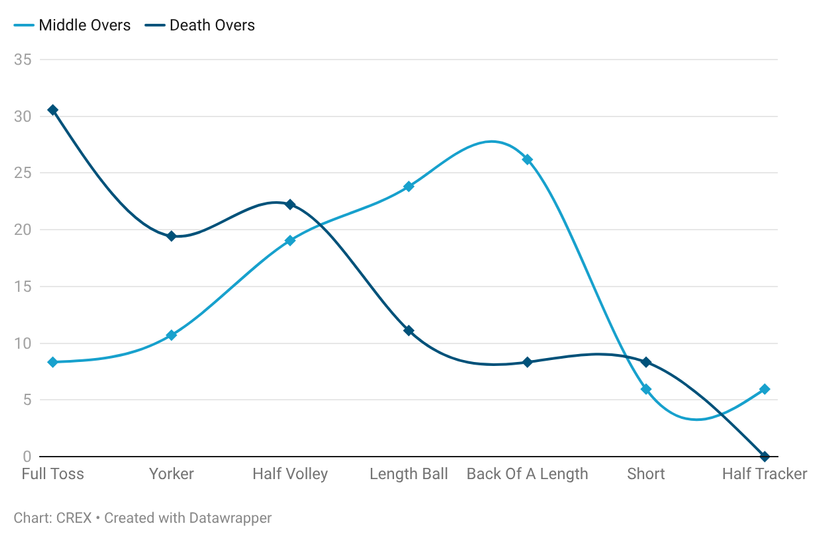 % balls by Nitish Kumar Reddy since Afghanistan T20Is
Then there’s Nitish Kumar Reddy. If there is ever any suitable alternative to Hardik Pandya, it’s Nitish. After recent work on increasing his pace, he is now a more all-round bowler.
India’s usage has been interesting too. They have used him extensively in the middle overs and haven’t shied away from using him in the slog overs too.
Around 66.66% of his total balls since the Afghanistan rubber have been between overs 7 and 15, where he has taken five wickets at 23.80 runs apiece and conceded just 8.50 runs per over. Nitish has tried to act as an enforcer in this phase. He’s consistently bowled into the pitch, and his high pace has further given him more dimensions outside the new ball.
Around 26.19% of his middle-order deliveries have been back of a length, fetching him three scalps at 8.33 runs apiece and an economy rate of 6.82. Another 5.95% have been short.
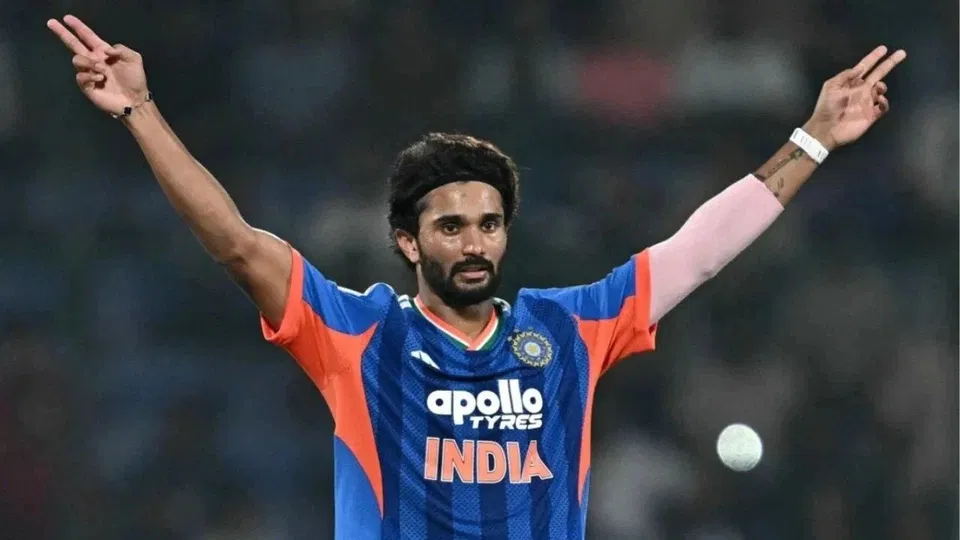
In the second T20I against Afghanistan in New Delhi, Nitish came in the ninth over after the opponent had begun stitching a slow second-wicket stand. He immediately started hitting the deck with his back-of-a-length deliveries, removing Ibrahim Zadran and Gulbadin Naib in consecutive overs. Afghanistan batters took him a bit lightly as a medium pacer, but his deliveries tend to come a tad quicker after his increased pace.
Meanwhile, in the slog overs, Nitish Kumar Reddy has focused mainly on yorkers and has shown reasonably good control at times. He has attempted yorkers on 72.22% of deliveries in this period, nailing them on around 26.92% of the time. They have gone for just 8.57 runs per over.
Another 30.76% of yorker attempts have converted into half-volleys. They have leaked 9.75 runs per over. Only full tosses have been a touch too expensive whenever he’s attempted yorkers.
He mixes his lines more in the slog overs, with more stress on keeping balls away from the hitting arc on wider lines. That’s also why Nitish’s attempted yorkers have worked even when he’s missed his mark. Around 27.78% of deliveries have been wide outside off stump and another 27.78% outside off stump.
They are hard to hit since they keep going away from the batters, with fielders in the deep point and third-man regions. In New Zealand, Nitish has been asked to bowl the penultimate over in both matches so far. He’s given a few boundaries here and there, but stuck to his process of bowling fullish lengths on varying lines.
Then, he’s also mixed in occasional slower short balls to keep himself unpredictable. He has good bowling smarts and is on an improving curve, so he has been backed in the slog overs, even after mixed returns.
If he remains fit and contributes with the old ball, India’s pace options will be sorted even if Hardik Pandya doesn’t play. Then, Nitish also knows how to swing the new ball and can always be tried for an over or two in the powerplay.
Nitish is a more complete package than Shivam Dube
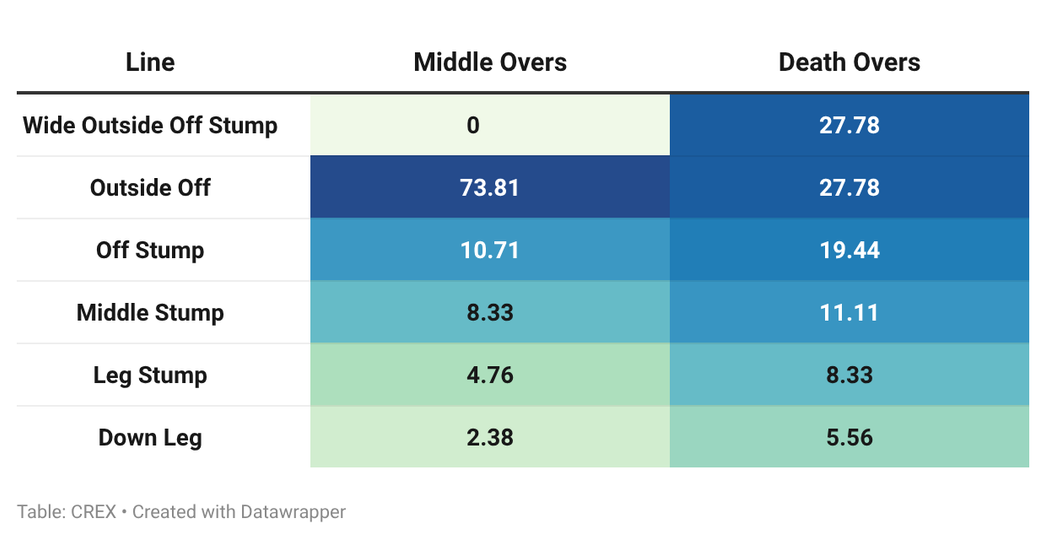 % balls by Nitish Kumar Reddy since Afghanistan T20Is
Nitish Kumar Reddy is an upgrade over Shivam Dube in every department. As a bowler, he’s miles better and has higher attributes to remain relevant in white-ball formats. Dube has worked on his bowling and shown encouraging signs at times, focusing on hitting the deck with his high-arm release.
But he doesn’t have the pace to survive on flat pitches. His slower balls also won’t grip enough on most venues for the same reason. There’s a reason Chennai Super Kings (CSK) haven’t used his bowling capabilities in the IPL over the years.
Even as a batter, Shivam Dube has certain limitations, especially against pace. After some improvements, his ability on hard lengths has become limited again. Teams have restricted him by angling their deliveries away from shorter lengths.
On large square boundaries, Dube’s issues will become more pronounced. The next T20 World Cup will be played in Australia, where surfaces naturally have more bounce and boundaries are large on either side. India need a better pace-hitter for the lower-order hitting role.
Nitish Kumar Reddy has shown improvements in that direction. Since the Afghanistan series, he has struck at 187.50 and found a boundary every 4.44 deliveries vs pace. He’s always been capable against spin.
Another thing is the RHB variety Nitish and Naman bring to the batting unit. Whenever Shivam Dube plays, India become one-dimensional, with multiple LHBs throughout the order. During the England tour, India had to promote Harshit Rana at one stage to spread LHBs more evenly.
Moving forward, India will clearly prefer multi-skilled players in T20Is, whose merits have now been proven several times. So, they need players who actually fit the role rather than shoehorning players with limitations. Naman Dhir and Nitish Kumar Reddy are clearly the best candidates possible at this stage.
.jpg?type=mq "Hunt for Mumbai Indians Assistant Coach")
.jpg?type=mq "Kieron Pollard Rejects Joburg Super Kings Stint")