 Glenn Phillips showed his consistency in Christchurch. Image Credits: AFP
New Zealand’s openers get the most limelight in T20Is. Tim Seifert and Finn Allen are among the most destructive batting pairs and put pressure on bowlers almost immediately. Then there’s Daryl Mitchell, arguably New Zealand’s most consistent batter in recent times, and his status as India’s chief tormentor only enhances his reputation.
Then there’s Glenn Phillips, who also gets his share of the limelight, though not necessarily for his batting. He’s among the sport’s finest athletes and has a knack for plucking seemingly impossible catches that usually make for great highlight reels. And he can also bowl handy off-spin.
As a result, his batting, his primary strength, often goes underappreciated. Many might not have even noticed how consistent he’s been in T20Is this year, at least until his latest knock against India.
Glenn Phillips comes up with a timely knock
By the time Glenn Phillips walked in during the eighth over, those explosive openers had already given New Zealand a flying start. In doing so, they had blunted the early threat posed by Bhuvneshwar Kumar and Arshdeep Singh in swinging conditions. At the other end, India’s tormentor was settling into his innings once again.
Phillips had two immediate tasks. He needed to keep the momentum going without consuming too many deliveries, while also preserving his wicket and building another partnership.

New Zealand were without the injured Rachin Ravindra and Mark Chapman. Turning to Devon Conway for some stability and a left-handed variety at No.3 was a straightforward move. They instead opted for Bevon Jacobs and pushed Daryl Mitchell up the order as a makeshift solution.
Michael Bracewell and Mitchell Santner are both capable batters, but they need a delayed entry point to make the most of their hitting. That left the batting lineup short on depth and experience. Phillips couldn't afford to take too long to get going, but he couldn’t risk throwing his wicket away either.
The Axar Patel takedown and panache against pace
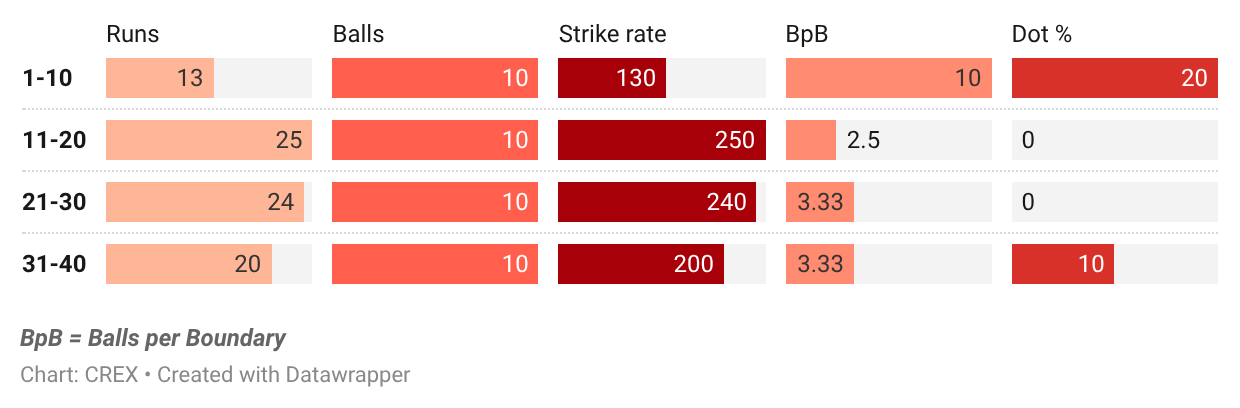 Glenn Phillips' innings breakdown by 10-ball blocks
After initially manoeuvring the field for a few singles, Phillips soon shifted gears. His first major test was Axar Patel, who had dismissed him four times in 24 balls before this game. Axar had also begun varying his pace cleverly and had just removed Allen after taking some early punishment.
Phillips countered Axar’s straight lines by stepping out, accounting for the bounce and lofting through the line for a maximum down the ground. When the left-arm spinner returned for his next spell, Phillips took the contest up a notch, producing a masterclass against one of the finest defensive spinners around.
On the fourth ball, Axar went with his customary hard length at the stumps, looking to cramp Phillips for room. But the batter had read the length before the ball pitched. He rocked back and pulled it fiercely between deep midwicket and square leg.
Axar went a touch shorter again off the next delivery, and Phillips was ready for that too. This time, though, the line was wider. Phillips adjusted in a flash, executing a flat-batted cut over deep cover. Prince Yadav fumbled in the deep, allowing the ball to race away for a second consecutive boundary.
A fuller delivery was almost predictable, but Axar overcompensated with a full toss. Phillips could have hit it anywhere, yet still chose to place it in the safest part of the ground, sending it over the bowler’s head into the gap for a third successive boundary. By this moment, he was dictating the terms.

There was plenty of panache to go with the power, particularly against pace. When Nitish Kumar Reddy tried to deceive him with a slower ball in the 12th over, Phillips picked it up from the hand, bent his knee and used the angle to slog-sweep it over deep square leg for a maximum. Four overs later, Mayank Yadav tried the short-ball route, only for Phillips to wait deep in his crease and pull it over deep midwicket for another six.
And he was only getting better. Arshdeep Singh angled one across him, but Phillips needed little more than a subtle adjustment of his bat face to slice it over deep backward point. He placed it with just enough finesse to spare the delivery the indignity it didn’t deserve.
Nitish missed his mark with a wide yorker in the penultimate over, but the ball was still moving away from Phillips. He hung back, opened the face at the last possible moment and somehow launched it over extra cover for an outrageous boundary. Phillips has among the quickest hands, but pulling off that shot was extraordinary even by his own lofty standards.
And just when it seemed he had exhausted his repertoire, Phillips saved the best for last. Bhuvneshwar Kumar had been doing a decent job in the final over before Phillips sprang a switch hit on him. Switching his grip and stance to bat left-handed, he generated enough power to whip the ball over extra cover, or perhaps midwicket, depending on how you looked at it.
This was an innings where Phillips hardly took a break. He cut down dot balls and kept finding boundaries even before India could apply any pressure. His unconventional methods were simply too good for India to restrict.
Phillips extends his consistent T20I run
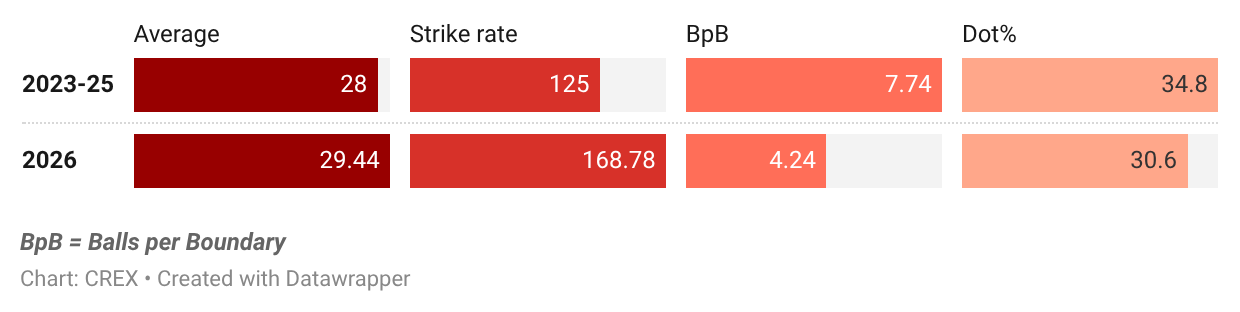 Glenn Phillips vs spin in T20Is
This year, Glenn Phillips has scored 439 runs at an average of 43.90 and a strike rate of 162.59 in 12 T20I innings, including three half-centuries. Only in 2022 has he scored more runs in a calendar year, although he played seven more innings that year. There’s every chance he would have gone past that tally had he played more this year.
His game against spin, in particular, has come on leaps and bounds, which helps explain why he took down Axar Patel with such ease in Christchurch. Phillips has averaged 29.44 and struck at 168.78 against spin in T20Is this year. He has hit a boundary every 4.24 deliveries while playing just 30.6% dot balls.
The improvement has been just as striking against some of the finest spinners around. In the Nagpur T20I earlier this year, Phillips took on Varun Chakaravarthy, who was in peak form at the time, with remarkable ease. He launched him for two sixes and later forced the spinner to switch to around the wicket.

He was equally comfortable against Afghanistan’s spin duo of Mujeeb Ur Rahman and Rashid Khan at the 2026 T20 World Cup in Chennai. Mujeeb had struck twice early to put New Zealand under immense pressure on a pitch offering some grip in the sunlight.
Phillips, however, comfortably took the spinners down to erase Afghanistan’s early advantage. His efforts helped New Zealand recover with a 74-run third-wicket stand and steer the innings to safer shores.
That marks a significant departure from his numbers in the preceding three years. Between 2023 and 2025, Phillips averaged 28 and struck at just 125 against spin, taking around 7.72 deliveries to find a boundary.
He has always been capable against pace, with the power to take on quicks. But this improvement against spin has made him a more complete T20 batter, giving him greater control over the tempo of an innings. That, in turn, has played a direct role in his consistency this year.
In Christchurch, Phillips brought all those improvements together to kick off New Zealand’s home summer in the best possible fashion. More encouragingly for the hosts, he paired his assault against spin with the ability to build an innings around the situation. If he can sustain this form, Phillips might finally get more spotlight for what he does with the bat, rather than what he pulls off in the field.