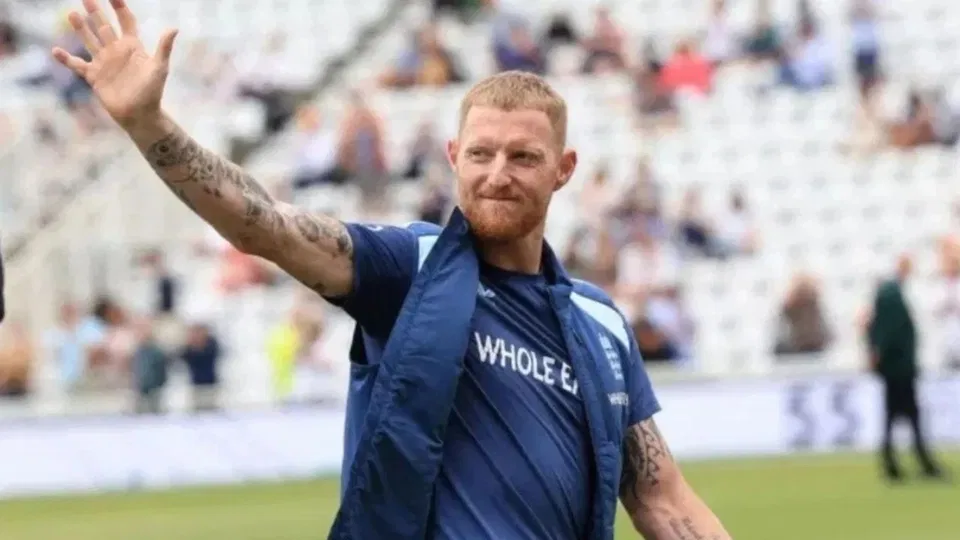
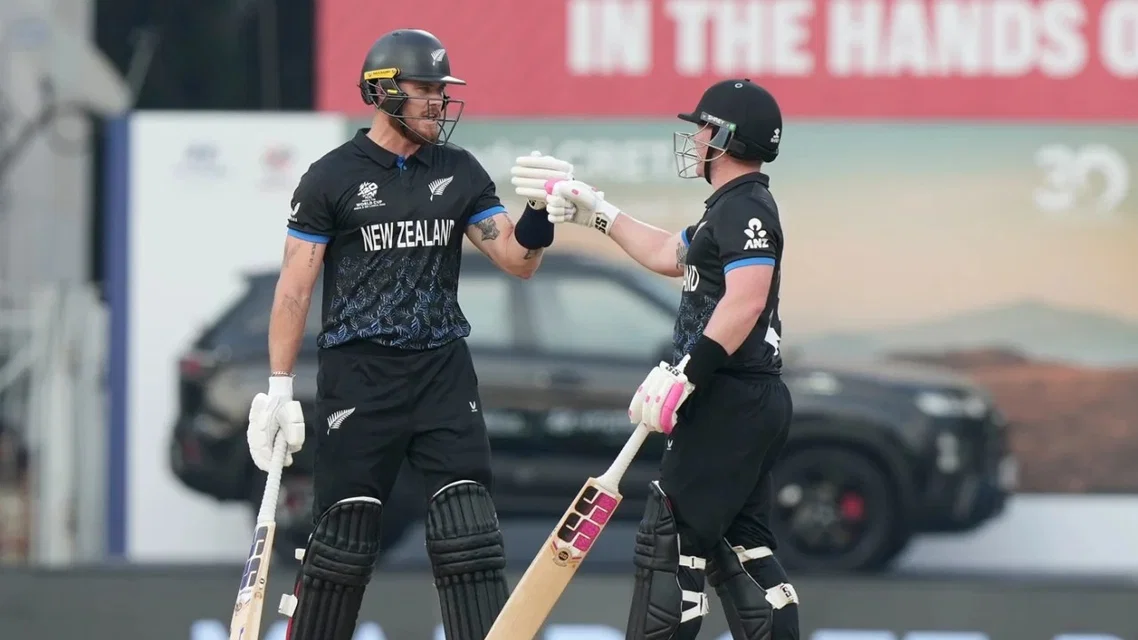
 Tim Seifert and Finn Allen have been the most explosive opening pair. Image Credits: AP
Few pairs have been as explosive as New Zealand’s Tim Seifert and Finn Allen in the past couple of years. Opening the innings, the duo have consistently provided rapid starts and decimated bowling attacks in any conditions. They complement each other really well too.
New Zealand have had multiple opening pairs at times when either or both have been away for various reasons. But none have even come close to what they bring together.
New Zealand’s opening pair set to pose biggest threat to India
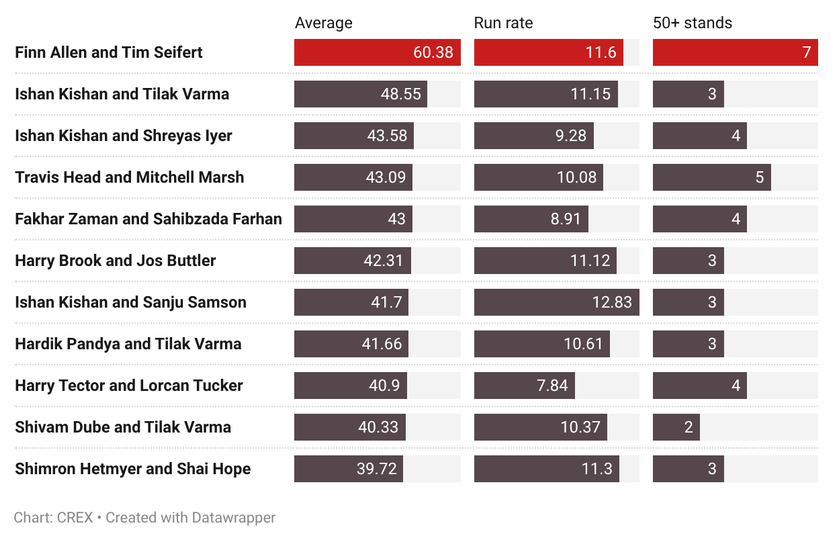 Best performing pairs in T20Is since 2025 minimum 10 innings
Since 2025, Tim Seifert and Finn Allen have collectively accumulated 785 runs at an average of 60.38 across 14 T20I outings. That average is the highest among all batting pairs from full-member nations with at least 10 innings. Additionally, the run rate of 11.60 is the second-highest.
The pair have hit a boundary every 3.33 deliveries, only marginally behind two Indian batters in this period. More importantly, Seifert and Allen have added seven 50+ stands together, the joint-most among all pairs. That’s actually an underrated aspect of this batting stand; they bat deep without compromising the scoring rate.
Most dashers don’t last past the powerplay these days, but not with these two. On average, Seifert and Allen face 29.21 balls per innings, the highest among all pairs since 2025.
Take their magnificent partnership at the T20 World Cup 2026 semifinal, for instance. The two added 117 in 9.1 overs for the opening wicket and ended the chase before South Africa had any chance of a comeback. New Zealand chased down 170 in 12.5 overs.
In the powerplay, New Zealand have the best average (37.53) and second-best strike rate (148.49) since last year. These two have played a crucial role in their instant success.

In one way, it’s fitting to have such an explosive opening pair against India, who have some of the most dangerous batting stars in their XI. That includes a marvellous opening pair of Abhishek Sharma and Sanju Samson. These two have scored 11.37 runs per over and stitched six 50+ stands since last year.
Few opening pairs can match the explosiveness that Abhishek and Samson bring to the table. But if there is a combination capable of going toe-to-toe with them, or even outdoing them on their day, it is Seifert and Allen. The battle between these two pairs could well become one of the defining subplots of the T20I series, with both teams possessing the firepower to seize control before the middle order even gets a look-in.
These two batting pairs haven’t exactly had enough contests together. A couple of instances came earlier this year in India. The two pairs met in the final T20I of India's home series against New Zealand earlier this year, in the build-up to the T20 World Cup, but neither managed to provide a particularly productive start. Allen raced away to 80, but without the support of Seifert in a tall run chase.
The T20 World Cup final that followed offered a more decisive result. India's opening pair got the better of their New Zealand counterparts, denying the Kiwis an early foothold in the contest. Allen couldn’t reproduce his earlier heroics, and although Seifert struck a brisk half-century, India's early breakthroughs had already left New Zealand with too much to do.
From that perspective, there is a sense of unfinished business. Seifert and Allen will want to replicate at home what Abhishek and Samson did to New Zealand in India earlier this year.
What works against Seifert and Allen
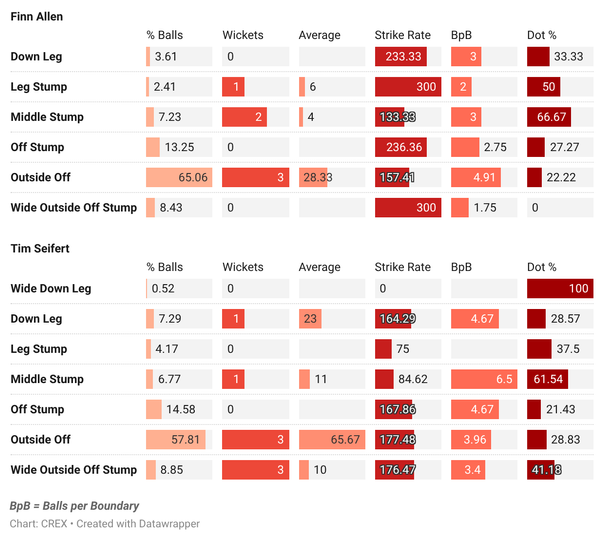 Finn Allen and Tim Seifert vs spin in T20Is since 2025
India will start with pace in the powerplay, and rightly so. There will be some early movement, and Bhuvneshwar Kumar could threaten the opening pair upfront. He also has a nice little record against both Tim Seifert and Finn Allen in T20s, dismissing each twice.
Meanwhile, Arshdeep Singh has also removed Seifert twice this year. However, India might want to use spin at some stage in the powerplay too. Both Kiwi batters have struggled against spin at times.
As a pair, they have averaged just 22.29 and lost their wicket every 14.71 deliveries against slow bowlers since last year. Their strike rate and boundary frequency also take a major hit.
In the powerplay, their average and strike rate reduce further to 21 and 147.89, respectively, against spin. In contrast, they average 103.20 and strike at 202.35 against fast bowlers during the field restrictions. So, India might be tempted to use their premium powerplay spinner, Axar Patel.
Axar has removed Allen twice this year. One of them came in the summit clash at the T20 World Cup 2026 in Ahmedabad.

The straighter lines on the stumps work against Finn Allen, who swings through the line on almost everything. On such deliveries, he has averaged just 6.33 and lost his wicket thrice in T20Is since last year. He’s a perfect batter for Axar, whose hard lengths always end up in the stumps.
Meanwhile, Seifert can be restricted on wider lines away from his hitting arc. On deliveries wide outside off stump, he has lost his wicket thrice and averages just 10 against spin since last year.
He sets himself up with an open stance, positioning himself on leg stump with a high backlift. So that gives him enough range to power anything around his body by giving himself room or backing away. He also has sweeps and reverse sweeps to access square boundaries on either side.
By bowling wider lines, spinners can force Seifert to reach for the ball and miscue at times. That also neutralises his sweeps. The lengths will still need to be slightly short.
India’s task will be cut out against the two explosive Kiwi openers. They will be their biggest threat throughout the T20I series. But if they can get the better of them early in the innings, a lot of other things will become easier on a daunting tour.