 Shivam Dube's pace issues are getting worse lately. Image Credits: AFP
Shivam Dube has done almost everything for India in T20Is. From a spin-hitter to a lower-order batter to powerplay bowling to death-overs bowling, he’s done it all over the last couple of years and beyond. Dube has been as instrumental as other players in India’s consecutive T20 World Cup triumphs.
Few players have overcome their limitations as significantly as him. And yet, as India prepare for the T20 World Cup 2028 in Australia, they will need to consider his limitations more seriously. He won’t get away as often as he has so far in other conditions, which, more or less, suited him.
Shivam Dube’s issues with good and hard lengths
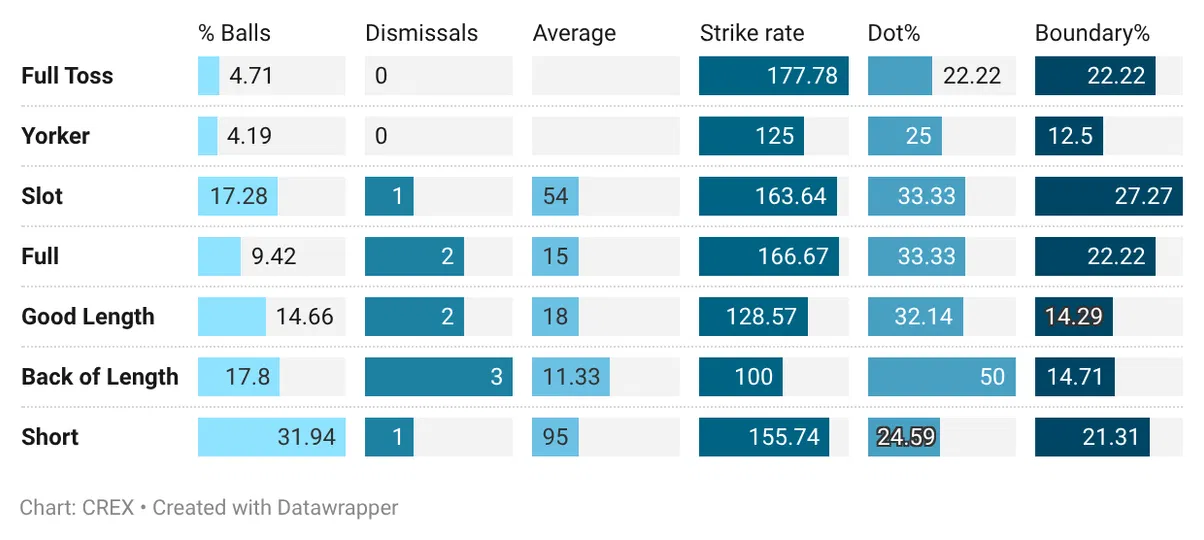 Shivam Dube has had issues with good and hard lengths against pace
Shivam Dube has made notable progress against pace bowling, but his limitations have always been there. Against good and back-of-a-length deliveries, Dube has found himself uncomfortable for some time now.
Since IPL 2026, the southpaw has struck at just 128.57 and lost his wicket every 14 balls on good lengths between 6 and 8 metres against pace. He plays 32.14% dot balls and takes around seven deliveries for every boundary.
Further, Dube’s numbers against back-of-a-length deliveries between 8 and 10 metres are even worse. His average and strike rate hover around 11.33 and 100, respectively, in this period. The dot balls climb to 50%, while the balls-per-boundary ratio stands at 6.80.
The balls directed into his body cramp him for room, and Dube ends up miscuing a lot of them. He’s always had issues with these lengths, but teams have shifted their lines a lot straighter lately. And when he’s no room to free his arms, his scoring options get limited.
Also Read: Hardik Pandya 2.0 At 2027 World Cup: All-Rounders India Have In The Pool
Notably, Shivam Dube does a decent job on out-and-out short balls (shorter than 10 metres), striking at 155.74 and hitting a boundary every 4.69 deliveries. That’s because pacers often err on lines, spraying wide on both stumps and opening the door to hit a few shots.
Around 67.21% of balls from these lengths have been either down leg or wide outside off stump, compared to just 30.64% from good and hard lengths. But teams have now stopped bowling him short and instead control him with those in-between lengths.
Dube’s issues likely to be exacerbated in Australia
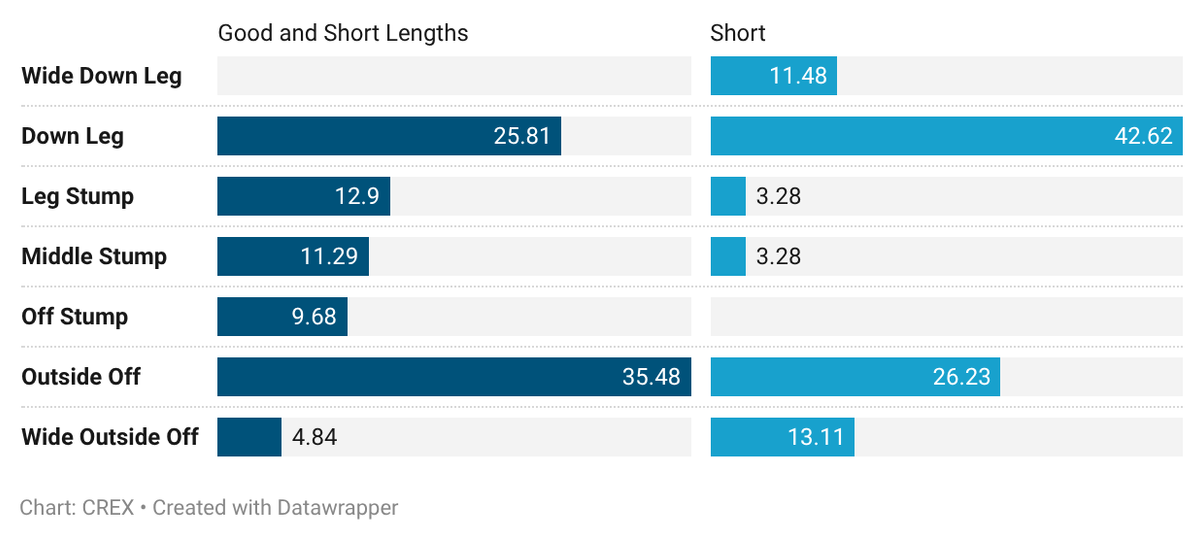 The straighter lines have troubled Shivam Dube
In IPL 2026, the pitches were generally flat and conducive to shot-making, yet Shivam Dube still struggled to make the most of them. Ireland and England then presented different challenges on surfaces that were not outright flat. In Ireland, the pitches were slightly tacky, while in England, they were quicker and offered more bounce.
In both countries, Dube struggled to unleash his power and adapt to the conditions. England, in particular, were meticulous in their planning and rarely allowed him to use their pace to his advantage.

In Australia, where the pitches are likely to offer more assistance to the pacers, Dube’s problems could be exacerbated. If he couldn’t consistently score on the better batting surfaces at home, conditions in Australia could make things even tougher. Not every pitch will produce significant extra bounce, but most are likely to have considerably more bounce than those in India, while all of them will be quicker.
From good lengths, the ball will climb higher and travel faster, which could make it difficult for Dube to adjust. He has a high backlift, and when the ball arrives higher and quicker, he could find himself getting late on it. At times, the ball reaches him before he has even completed his downswing.
With his legs often glued in place, Dube tends to twist his hips prematurely, preventing him from getting into a strong position for the pull shot and leaving him squared up at times. He has started staying leg side of the ball to maximise the power generated through his forearms, but that approach may not be as effective in Australia, where the square boundaries are bigger. Mistimed slashes towards cover or point could easily carry to the boundary.
Dube also lacks unorthodox options such as the scoop to access the area behind square against pace. Much of his work against fast bowling relies on his hands, and that approach is unlikely to be enough in Australia, particularly against stronger pace attacks.
Why India can’t afford Shivam Dube’s limitations
It’s not that Shivam Dube is completely unusable for the T20 World Cup in Australia. He still offers plenty and, notably, has found ways to contribute despite his limitations. He often steps up for India in precarious situations.
The issue is that India may not be able to accommodate him alongside the other players in their current T20 setup. Most of the lower-order batters India have trusted recently have issues against pace. Hardik Pandya has a perennial problem with hard lengths and short-pitched bowling, while Axar Patel has regressed considerably after making some improvements against pace.
Washington Sundar, meanwhile, has improved but cannot quite operate as a finisher and generally needs more deliveries to make an impact in T20s. His stint with Gujarat Titans (GT) underlined the same issue. Shreyas Iyer himself is susceptible to short bowling and has recently developed problems against good-length deliveries.
When Ireland and England kept them quiet, India’s lower order failed to make a substantial impact, leaving them without much impetus in the slog overs. In the final five overs, the Men in Blue lost a wicket every 7.86 deliveries while striking at just 138.15. They hit a boundary every 6.40 deliveries and played around 35.26% dot balls.
Hence, India cannot afford to have all of them and Dube in the same setup in Australia. They clearly need a couple of pace-hitters in the middle and lower order. The likes of Rinku Singh and Ashutosh Sharma need to get more opportunities because their bases are far more stable against hard lengths.

Sure, Dube has improved significantly as a bowler and can potentially provide a couple of overs, but that alone is not enough to warrant a place in the XI. His bowling remains vulnerable on non-tacky pitches, even though he has worked on bowling shorter lengths more effectively of late.
In most other conditions, Dube remains a workable option and can add depth in both batting and bowling departments. But in Australia, India cannot afford to compromise their lower order with too many batters who have issues against pace. Iyer, Hardik and Axar are undroppable for several reasons of their own, and Dube may have to make way for a pace-hitter if India are to address their current problems against fast bowling.
Also Read: BCCI Rules Out VVS Laxman's Appointment, Ajit Agarkar Kept Hanging