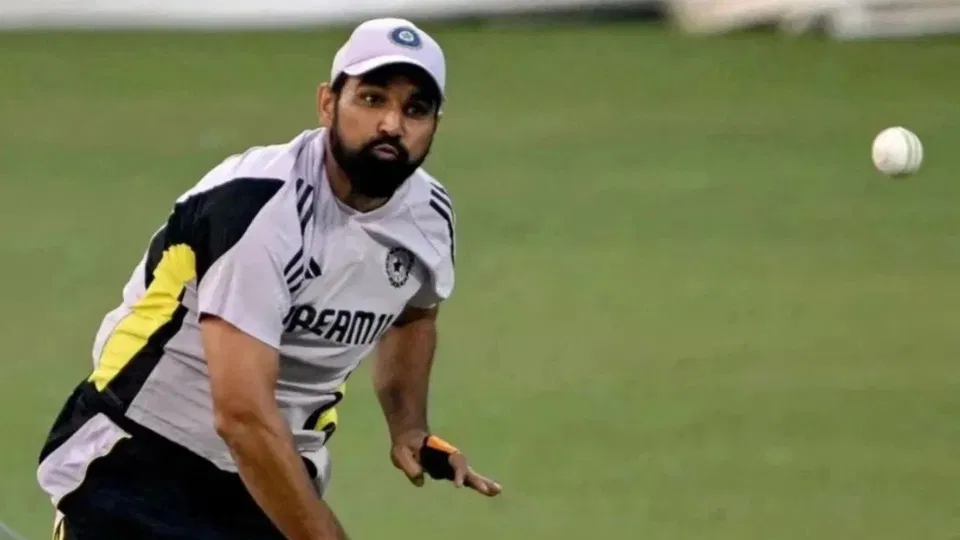





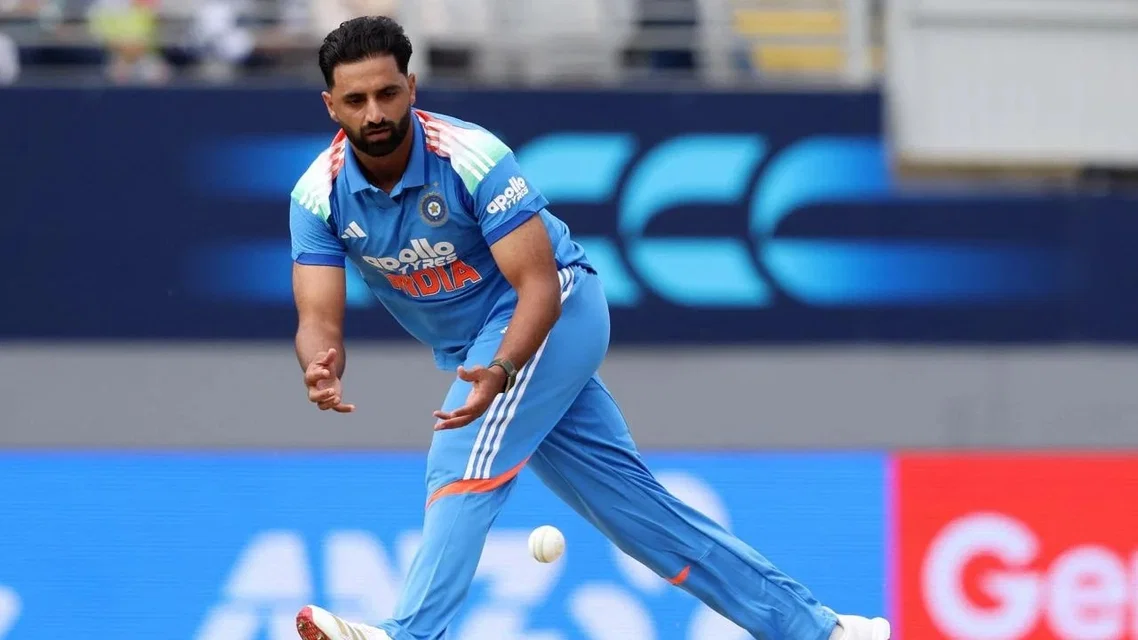
 Auqib Nabi finally got his maiden international wicket in Wellington. Image Credits: AFP
India ticked most boxes with the ball in the opening ODI. Pacers dominated the New Zealand batting lineup in Auckland and showed how effective they can be in favourable conditions. The only fast bowler who failed to make a significant impact was Auqib Nabi, who went wicketless as other pacers ruled the proceedings.
Fittingly, he joined his counterparts in another tricky batting condition. In Wellington, Nabi made the most of early moisture and movement, causing substantial damage with the new ball. Notably, he made a slight tweak that helped him take some wickets.
How Auqib Nabi was ineffective in Auckland
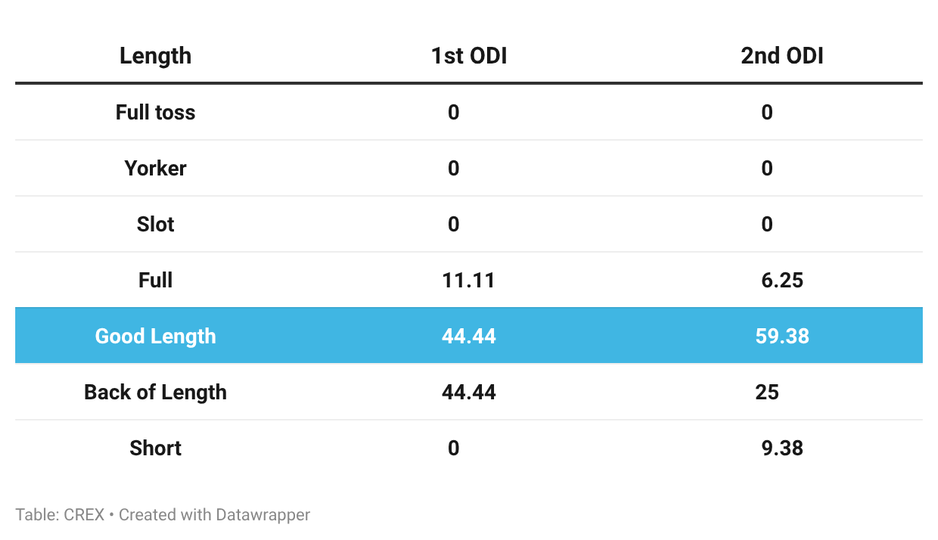 Auqib Nabi's length distribution in the first 10 overs against New Zealand
It’s hard not to get carried away with the bounce on most New Zealand pitches. The one in Auckland, in particular, is among the bounciest decks. Pacers from visiting sides, especially from the subcontinent, can often err on the short side.
In one way, Auqib Nabi made the same mistake in the first match, where he often bowled a bit short between his overs. After starting with full and good-length deliveries, he shortened his length a touch and bowled several back-of-a-length deliveries in the next couple of overs.
Around 44.44% of his deliveries were shorter than eight metres in the powerplay. While they were economical, Auqib wasn’t really threatening to take wickets with these lengths. The bigger issue, however, was his lines.
At times, Nabi gave too much width and couldn’t control excessive movement up front. In such conditions, the initial lines need to start a touch straighter, so they don’t end up too wide by the time they reach the stumps. But Nabi started from the corridor and gave just enough width outside off stump to enable the batters to free their arms.
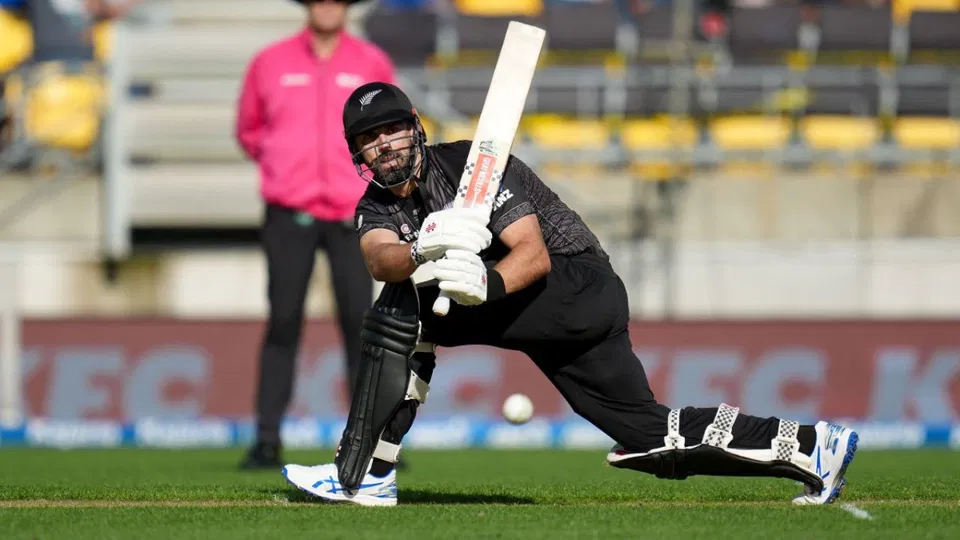
On the very first ball, for instance, Auqib Nabi seamed one away from Tim Seifert but gave enough width to drive past cover-point. Then, in his third over, he again sprayed too wide a couple of times. The first one was driven aerially over cover, while the second one was placed a tad squarer through sweeper cover.
Around 83.33% of Nabi’s deliveries were outside off stump, several wider than the channel line, while another 11.11% were wide outside off stump in the first 10 overs. Seifert often stays upright with an open stance to access off-side, and even the slightest bit of width allows him to extend his hands on the up. In the powerplay, pacers have even less margin for error with just two fielders on the ropes.
India needed to maximise the early movement, and with boundaries flowing consistently, it could have disappeared rather quickly. So, Nabi was taken out of the attack immediately after his third over.
The correction in Wellington
The Hnry Stadium in Wellington could be a double-edged sword for seamers. While there’s always some movement and breeze, short square boundaries often let batters get quick runs even with mistimed shots. New Zealand found it firsthand when Abhishek Sharma and Vaibhav Sooryavanshi unleashed carnage during the T20I rubber.
However, Auqib Nabi consciously tried to bowl good lengths this time, with around 59.38% of deliveries between six and eight metres, and another 6.25% even fuller in the first 10 overs. He couldn’t afford to err on the short side this time, with pocket-sized boundaries on either side. Bowling fuller forced the batters to target bigger boundaries down the ground.
The Wellington pitch was also slightly two-paced, apart from offering seam movement. So, fuller lengths were the right choice to bring edges into play with the new ball. More importantly, Nabi kept stumps in play more often this time.
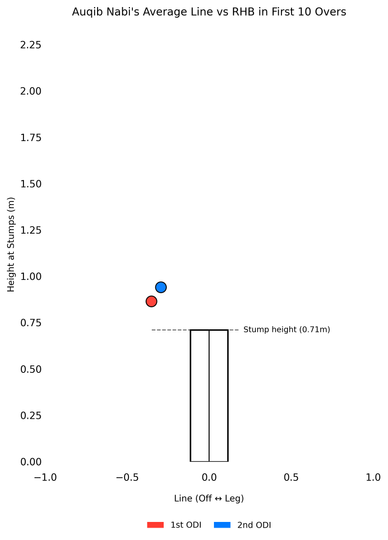 Auqib Nabi's line vs RHBs against New Zealand
Around 18.75% of his deliveries ended within the stumps, while the corridor lines fell to 68.75%. So when the ball moved away, the edges were more often in play early in the innings.
Take Tim Seifert’s wicket, for instance, which was also Nabi’s maiden international scalp. It was just on the middle-and-off-stump line, and Seifert mistimed his aerial punch straight to the mid-on fielder. He tried to place it a tad straighter down the ground, but he was into his shot early after the ball stopped a bit.
Against Will Young, Nabi used the width of the crease to create an angle. He went wider to release and angled the ball into the batter before it straightened just enough to take the outside edge. It was also outside off-stump, but only marginally and didn’t allow Young to drive through the line.
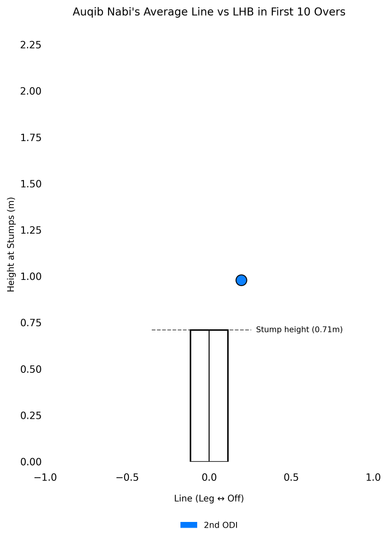 Auqib Nabi's lines vs LHBs against New Zealand
Early blows allowed him to bowl an extended new-ball spell, unlike in the last game. In Wellington, Arshdeep Singh was slightly unlucky not to get wickets despite being frugal. This time, Auqib Nabi covered for him by removing openers and again putting New Zealand in early trouble.
For someone with a reputation for taking wickets in bulk, Nabi had a rough start to his ODI career, going wicketless and conceding too many in his initial two matches. But he finally found the right conditions and areas to make his first real impact in international cricket. He’d be expected to do the same from here on, at least in conditions he won’t usually get anywhere else.
.jpg)