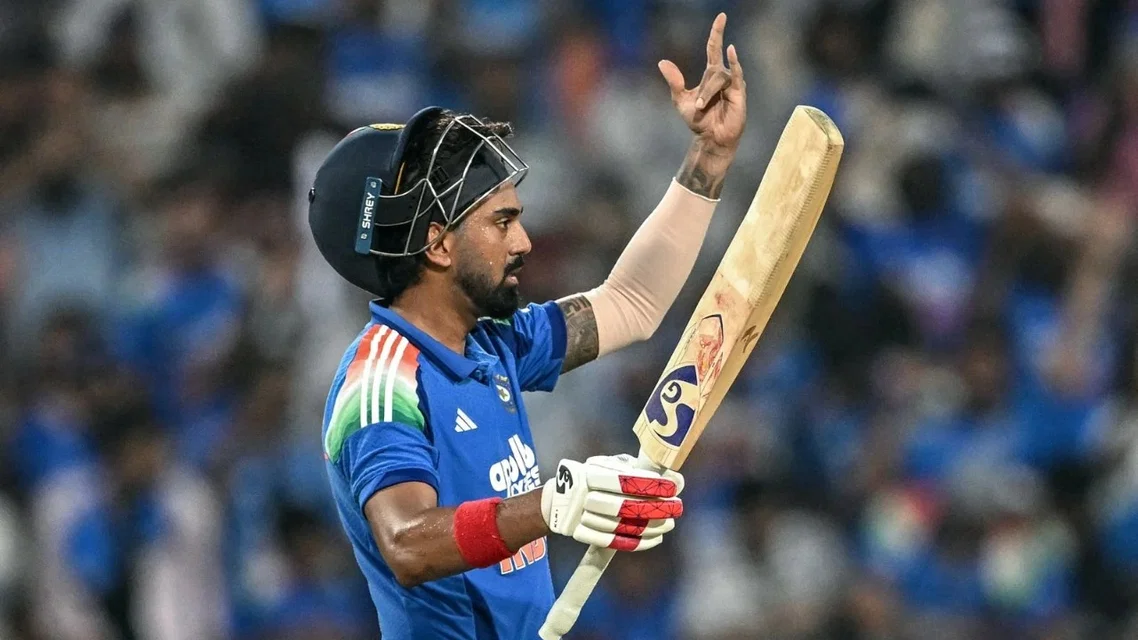
 KL Rahul has been sublime in the middle order. Image Credits: AFP
KL Rahul’s middle-order credentials were never in doubt in ODIs. Ever since moving out of the opening spot, he has only improved and given India much flexibility. No other batter has been as consistently explosive.
But with only one ball used from the 35th over onwards, bowlers are now expected to come into the game more often. So, Rahul’s ability was slightly under the scanner after the change in ODI rules. After all, he struggled against reverse swing on an abrasive Ahmedabad surface in the 2023 World Cup final.
But while he was still a magnificent ODI batter back then, KL Rahul’s hitting and intent have risen significantly since then. Unsurprisingly, he hasn’t shown signs of slowing down even after the one-ball rule. In fact, he’s only improved and now bats at a better rate against the reversing balls.
How KL Rahul has shown tremendous form despite facing the old ball
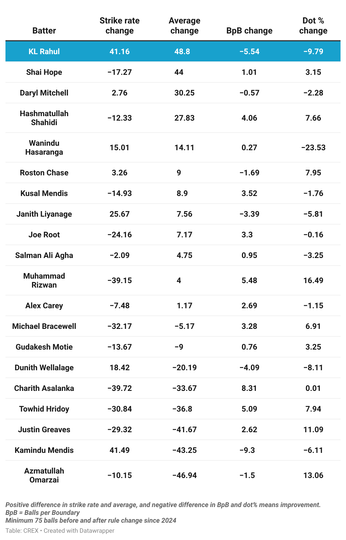 KL Rahul and other batters before and after one-ball rule in ODIs since 2024
Since the rule came into effect last year, KL Rahul has scored 348 runs at an average of 87 and a strike rate of 144.40 in the final 16 overs. He hits a boundary every 6.03 deliveries and plays just 26.97% dot balls. Among all batters with at least 100 balls in this phase, Rahul has the best average and third-best strike rate, while his dot% is second-lowest.
His numbers were magnificent before the one-ball rule came. But it’s a testament to his quality that Rahul has been even better after a rule change specifically designed to tame middle-order batters.
A comparison of the numbers before and after the rule change highlights Rahul's mastery. Since the change, his average and strike rate have increased by 48.80 and 41.16, respectively. Meanwhile, his balls per boundary and dot-ball percentage have decreased by 5.54 and 9.79, respectively.
.jpg)
Among the 20 batters who faced at least 75 balls both before and after the rule change, from the 35th over onwards since 2024, only two others have improved across all four parameters. Daryl Mitchell's gains, particularly in strike rate, have been minimal. Janith Liyanage is the only other batter to have made significant strides, but he’s still nowhere near Rahul.
Most other batters have had to sacrifice one aspect of their game to improve another. Kamindu Mendis, for instance, has improved his strike rate by 41.49, but his average has dropped by 43.25.
Roston Chase, meanwhile, now plays more dot balls. Meanwhile, quality batters like Joe Root, Azmatullah Omarzai and Shai Hope have slowed considerably since the rule change came into effect.
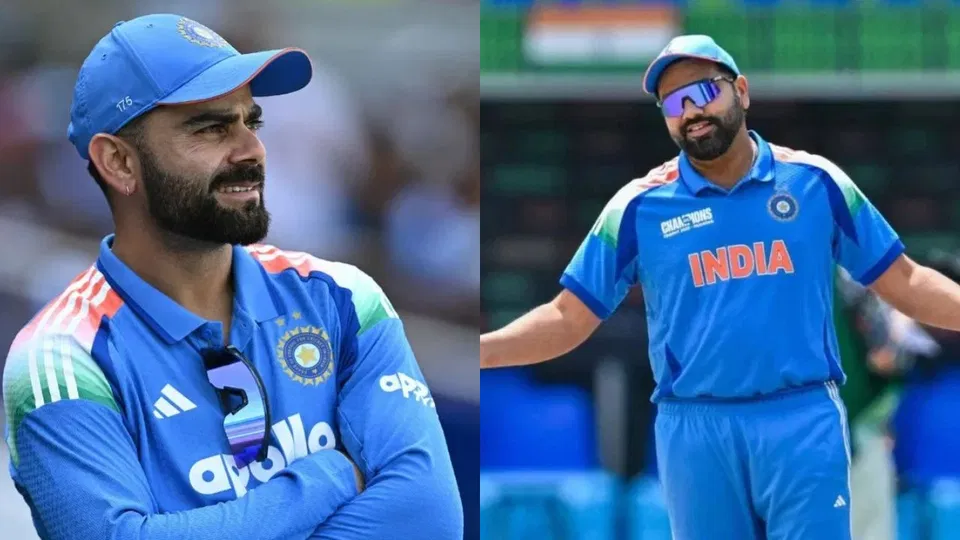
At a time when most other batters have had to compromise in one area or another, Rahul has continued to push the boundaries at the peak of his powers. Take his knock against South Africa in Raipur, for instance. After centuries from Virat Kohli and Ruturaj Gaikwad, both lost their wickets in quick succession, with KL Rahul coming to bat in the 36th over.
In that game, India lacked batting depth, with Washington Sundar and Ravindra Jadeja at No.6 and 7, respectively. Rahul took the onus, playing a 66-run knock at a strike rate of 153.49, while the lower-middle order struggled. His knock helped India reach 358/5, despite South Africa’s pacers staging a mini comeback after the carnage.
That also explains how much better Rahul has been than his counterparts across conditions. In the matches he’s played since the one-ball rule, all other batters have collectively struck at 124.20 and taken around 6.96 deliveries for every boundary from the 35th over onwards. They have played around 34.49% dot balls.
Rahul's Ability vs pace
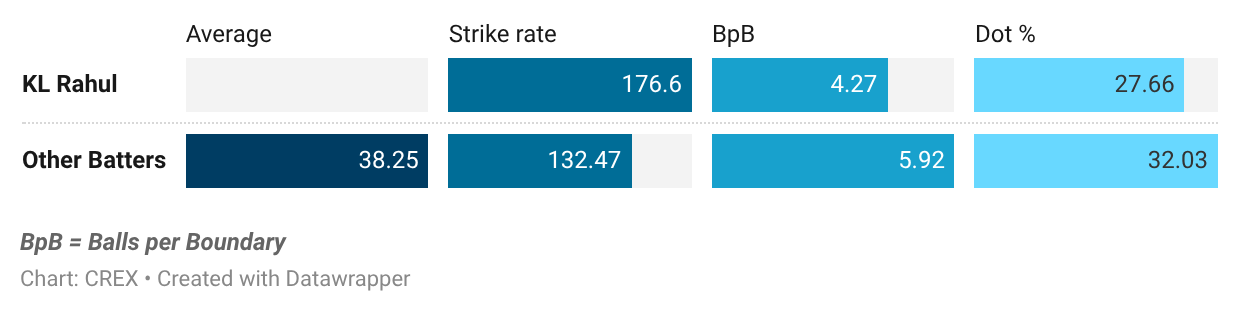 KL Rahul vs other batters in the same match since one-ball rule
KL Rahul has been even more dominant against pace. He strikes at a whopping 155.81, with a balls-per-boundary ratio of 5.06. Both figures are the second-best, behind Harry Brook, among batters from the top 10 ODI teams who have faced at least 100 balls of pace in this period.
However, Rahul's average of 134 is in a league of its own. Brook is a distant second at 50.25, which is impressive in itself but nowhere near Rahul's mark. He isn't just scoring quickly; he's doing so consistently throughout the innings.
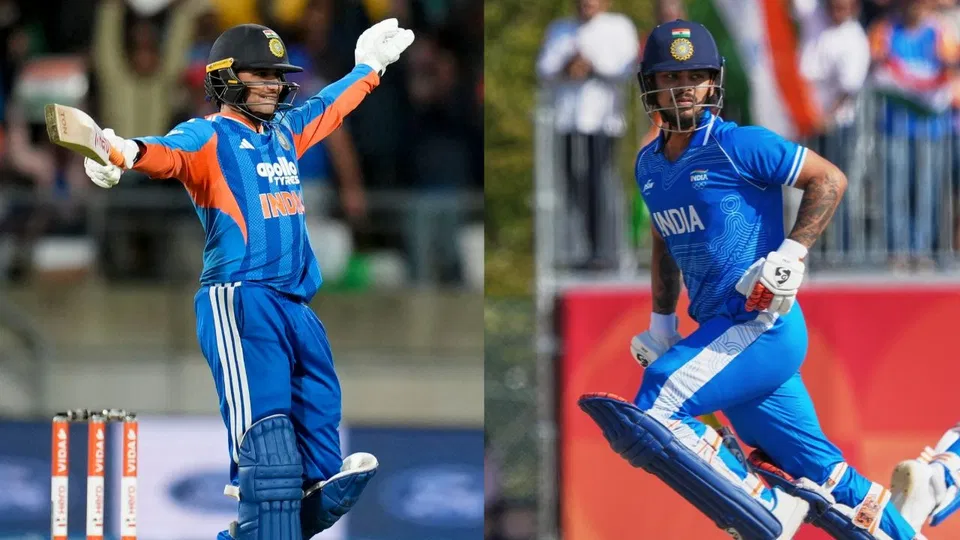
His extensive off-side range has been a major reason behind his sublime run against fast bowlers.
Usually, batters rely on powering deliveries through the on-side to maximise their natural bat swing at the back end of the innings. But Rahul has the drives and punches to work with, making him hard to restrict.
That’s also why wider lines don’t work as significantly against him in the slog overs. New Zealand found it first-hand earlier this year.
On a relatively slow Rajkot pitch, India lost three quick wickets and were reduced to 118/4 in the 23rd over. They lost their top four, and batters struggled to get used to the pitch’s slow pace in the first innings. Ravindra Jadeja, for instance, took 44 balls for his 27, while Nitish Kumar Reddy scored a run-a-ball 20 before losing his wicket.

KL Rahul, however, not only held his end tightly but also provided the momentum after a massive slowdown by other batters in the middle overs. He single-handedly took India to 284/7 with an unbeaten 112 at a strike rate of 121.74. This knock also highlighted a key aspect of his batting: the ability to power off-pace deliveries despite the old ball.
Rahul has a stable base and can generate immense power, even if his sublime strokeplay doesn’t give that impression. He’s among India’s best bets on slower balls on a gripping pitch and solves so many middle-order issues. If any doubts remained about his ability against pace on abrasive pitches in slow conditions, this innings removed them altogether.
Power on fuller lengths
Unsurprisingly, pacers have collectively started bowling a lot fuller to extract maximum movement in the air with the old ball. Since the one-ball rule, fast bowlers have bowled 25.91% fuller lengths, from full-toss to full lengths, in the final 16 overs. Between 2024 and the rule change, they bowled just 15.35% such deliveries.
As a result, batters have slowed down a bit on fuller lengths at the back end of the innings. Their strike rate has come down from 133.68 to 125.94. But KL Rahul hasn’t shown any aftereffects of the same.
He has struck at 176.60 and found a boundary every 4.27 deliveries without getting out on such lengths from the 35th over onwards. All other batters in the same game have struck at 132.47 and hit a boundary every 5.92 deliveries. So, batting hasn’t exactly been as easy as Rahul has made it look.
West Indies tried to stop him with pace-on fuller deliveries in Mullanpur, with the likes of Keemo Paul, Jayden Seales, and Alzarri Joseph trying to nail yorkers in the slog overs. Rahul kept converting them into half-volleys, while others ended up being full tosses. They were dispatched with ultimate ease.
Even when West Indies occasionally nailed their yorkers, Rahul somehow drilled them through the boundary with his power game. Like in the final over, when Keemo Paul attempted a wide yorker, he just threw his hands and found a boundary at third man. Earlier in the over, he had whacked a couple of maximums when Keemo missed his yorkers.
KL Rahul has put all doubts about his ability against the old ball to rest with his exceptional skills. In a way, it hardly comes as a surprise given the quality he possesses. But it will be a massive relief for India, who already have several other issues to sort out in the lower middle order ahead of World Cup 2027.
.jpg)