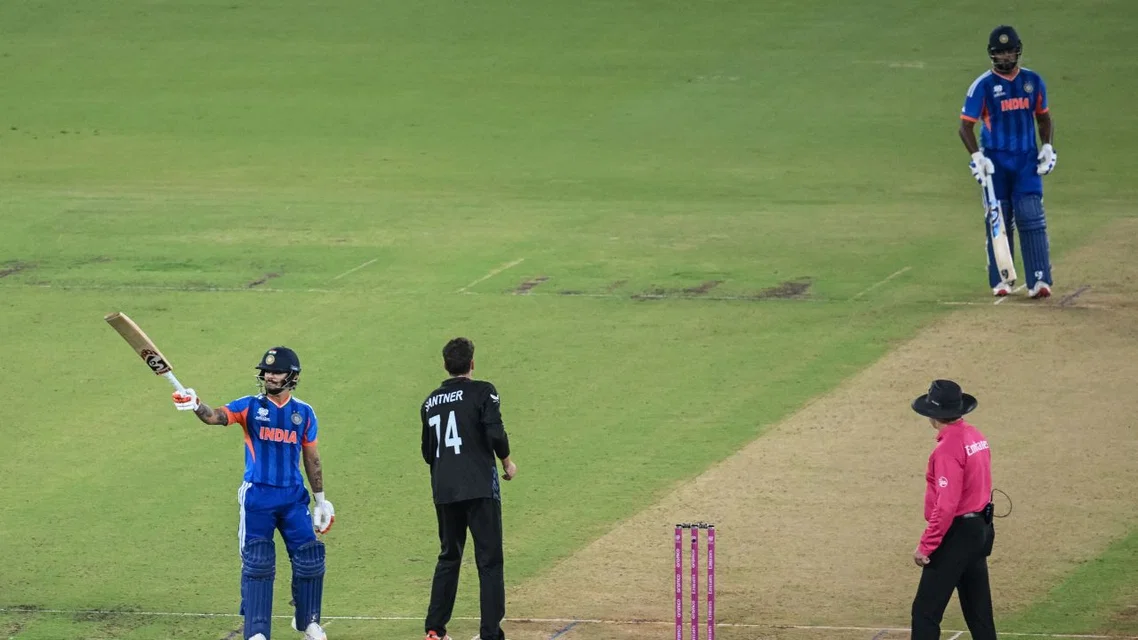
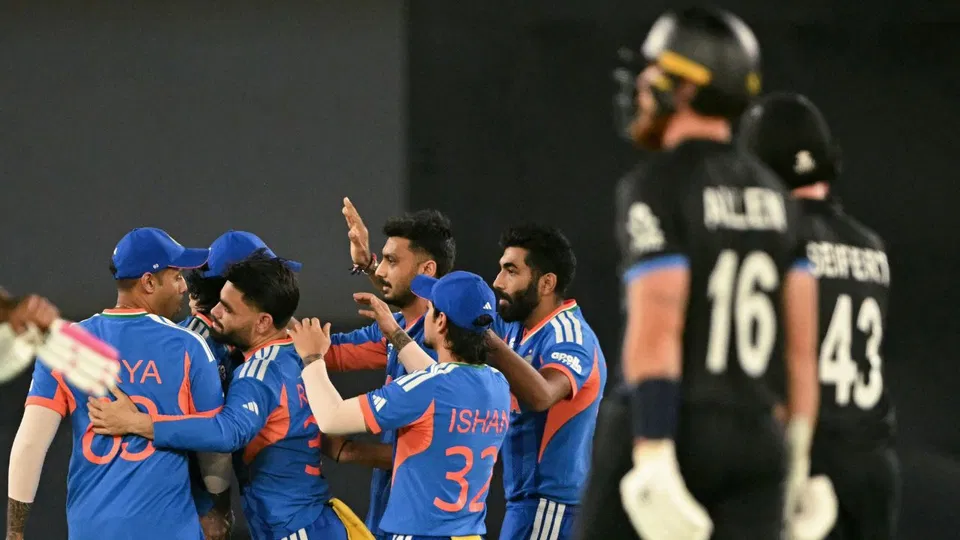
 India vs New Zealand in T20Is. Image Credits: AFP
India have played on such flat pitches recently that they were bound to struggle on tracks offering even the slightest assistance to bowlers. It started in Ireland and persisted in England right after the T20 World Cup 2026. India were outplayed across both tours, with their batters repeatedly struggling to adapt to surfaces that demanded a different approach.
The issue is not a lack of skill. India’s batters are among the most skilled T20 players the game has ever seen. But playing on flat pitches conditions their muscle memory to play through the line, leaving them less prepared to deal with movement, grip or extra bounce.
Ireland, for instance, troubled India on the slow pitches in Belfast, forcing their batters to target longer square boundaries on a gripping surface. England, meanwhile, used sheer pace and extra bounce to unsettle them, exposing their struggles to deal with movement off the surface. Even Japan gave India a run for their money in a one-off T20I in Sano.

Much of this can be traced back to the conditions India encountered in the preceding months. They deliberately played on flat pitches during the Super 8 and knockout stages of the 2026 T20 World Cup to maximise their batting strength. The IPL followed, producing the highest run rate ever recorded in a season, at 9.88.
As a result, India's batters were not adequately prepared for conditions that deviated from the norm. Even when pitches offered little assistance to bowlers, their issues resurfaced.
New Zealand set to bring fresh challenges for India
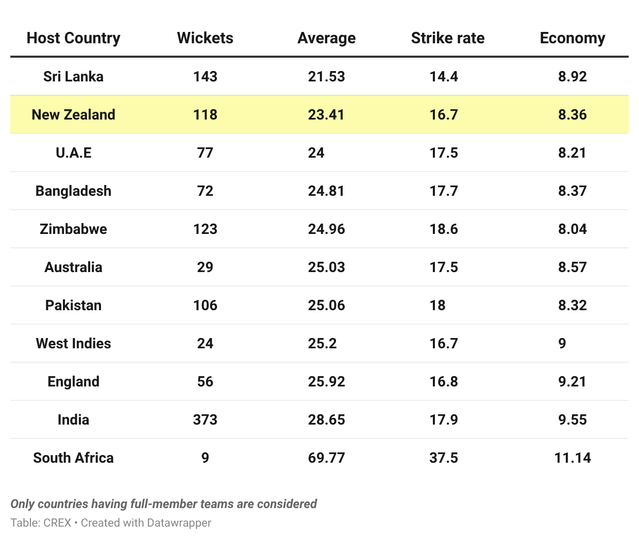 Pacers in each country in T20Is since October 2025
India will face a couple of fresh challenges when they take on New Zealand in the upcoming home series. For starters, the conditions will be vastly different from what they are accustomed to in India and across the subcontinent. Then there is New Zealand’s pace attack, packed with bowlers who know exactly how to exploit their backyard conditions.
With early spring still setting in, the pitches are likely to offer plenty of pace and early movement, more so under lights.
Since the start of New Zealand’s previous home season last year, the country has recorded the second-lowest average for pacers (23.41) among all countries with more than two T20Is. Fast bowlers have conceded just 8.36 runs per over and taken a wicket every 16.7 balls during this period.
Length deliveries have been particularly effective in these conditions, accounting for 58.47% of all wickets taken by pacers at an average of 21.48 and an economy rate of 7.60. Matt Henry, Kyle Jamieson and Jacob Duffy have relentlessly exploited this length at home, having grown up bowling on such surfaces.
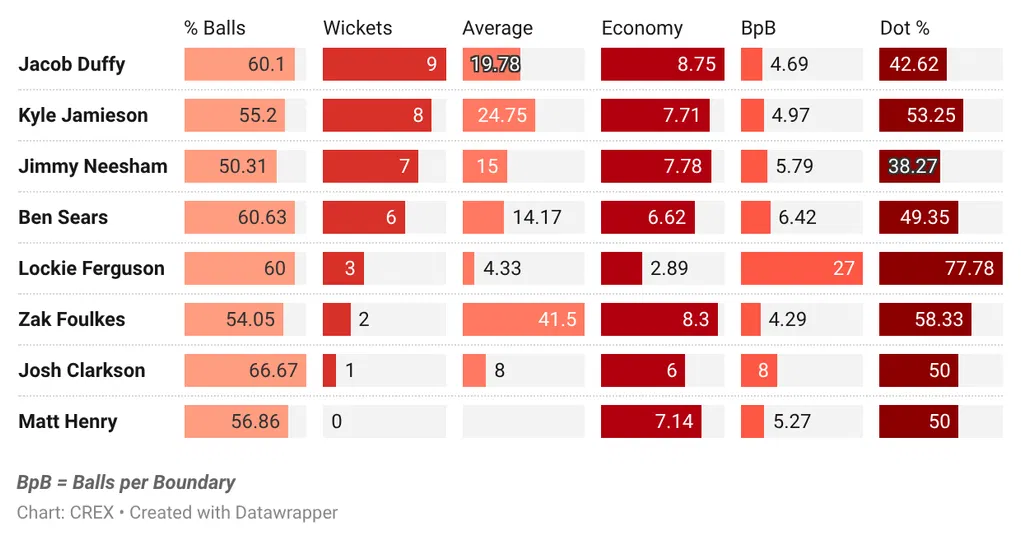 New Zealand seamers on length balls at home since last summer
Since the start of the previous domestic season, Duffy has bowled 60.10% of his length deliveries at home. Henry and Jamieson have followed a similar approach, pitching 56.86% and 55.20% of their deliveries in the same area, respectively.
All three know how to make the most of any movement in the air or off the surface, particularly in the early overs.

Fresh pitches could also offer steep bounce, bringing hit-the-deck seamers into the equation. New Zealand have Lockie Ferguson and Adam Milne to provide that extra threat, making it harder for Indian batters to settle in and play on their own terms.
Between the conditions and the quality of the opposition's pace attack, India could find themselves with far less room to manoeuvre than they have enjoyed recently.
India are coming off playing on flat pitches
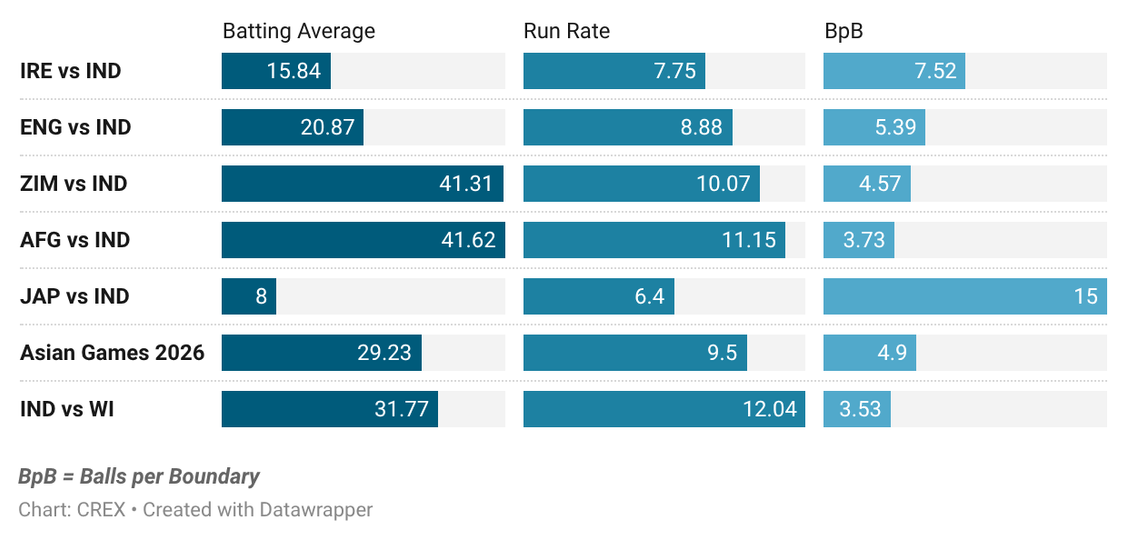 India's batting record by each series post T20 World Cup 2026
After three overseas tours to Ireland, England and Zimbabwe, India returned home to face Afghanistan. While Afghanistan were technically the hosts, India obviously enjoyed home conditions in New Delhi. On out-and-out flat pitches, they scored at 11.15 runs per over, hitting a boundary every 3.73 deliveries.
The India-West Indies series that followed was even more explosive, with a run rate of 11.68, the third-highest ever in a T20I series. India alone scored at 12.03 runs per over across more than four innings.
On such batting-friendly surfaces, playing through the line came naturally, and neither opposition had enough firepower in their pace attacks to pose a consistent threat.
The Asian Games 2026 offered a brief departure from these conditions, with pitches that were not quite as flat as those in India. However, India played only two matches in the tournament and faced relatively weak bowling attacks.
They were also the only side to field a full-strength team, leaving them with little exposure to the kind of quality bowling they could encounter against stronger opposition.
Consequently, scoring runs remained relatively straightforward, even when the conditions were less conducive to batting. India made the most of the inexperienced attacks they faced, although some of their vulnerabilities did come to the fore.
Shortly before the Asian Games, they had nearly lost a one-off T20I against 41st-ranked Japan in conditions that made batting particularly difficult.
The pattern is clear. India have either played on flat pitches recently or faced opposition that couldn’t fully exploit more challenging conditions. Adapting to a completely different environment in New Zealand will require considerably greater application, especially with so little time to adjust.
The short turnaround after the West Indies series, coupled with the jet lag from travelling such a long distance, could make the transition even more demanding.

India have barely had a break from cricket or travel. The West Indies series began just three days after the Asian Games 2026, and the New Zealand series is set to start only five days after the West Indies rubber ended.
India have a point to prove
After winning the 2026 T20 World Cup, India were blanked by Ireland and England in their next two overseas assignments, raising questions about their ability to succeed away from home. Those concerns were not entirely unfounded. Even in Zimbabwe, players like Blessing Muzarabani troubled their batters.
Much has changed since those tours, though, with several players working on the shortcomings exposed by those defeats. Abhishek Sharma, for instance, has added a more controlled pull shot by rolling his wrists to address the problems he faced against Muzarabani. Shreyas Iyer, meanwhile, has worked on his grip and realigned his backlift to generate more power in his shots.
India have also tweaked their personnel to achieve a better balance. Naman Dhir has come in as a better spin-bowling all-rounder, while Nitish Kumar Reddy offers a more reliable pace-bowling option. Meanwhile, Washington Sundar and Shivam Dube have gradually moved out of the preferred combination as India look to build desired depth without compromising their bowling resources.
New Zealand, however, will pose a formidable challenge, particularly with a near full-strength squad available for the first three T20Is.
India's biggest test will be finding a way to counter the hosts' pace attack, especially with the new ball. Their famed batting line-up will be put under considerable pressure, with most batters having limited experience in these conditions.
India must implement the learnings from those defeats and show greater tactical awareness this time. In terms of individual skill and team combination, they appear to have addressed several of their earlier concerns. Yet, for all the progress they have made, the world champions still have a point to prove away from home.