


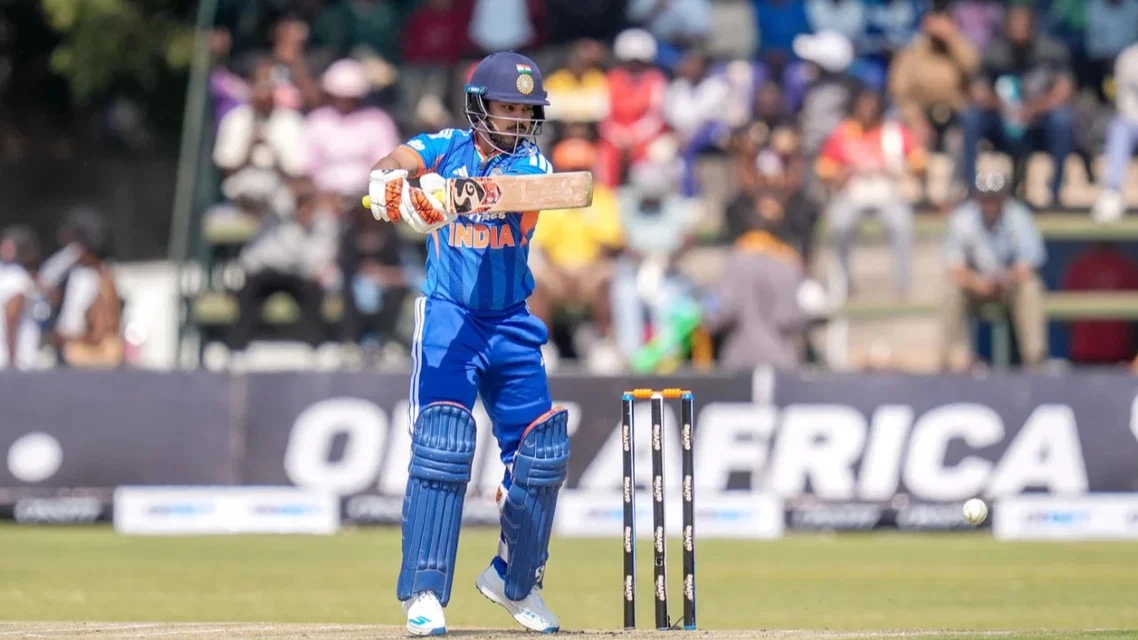
 Ishan Kishan has shown some issues outside Asia. Image Credits: BCCI
Ishan Kishan has been among the most improved batters across formats this year. After scoring tons of domestic runs, he returned to India’s white-ball formats and has continued his tremendous form. No other batter has as many runs as Kishan in T20Is this year.
Yet some of his common issues have persisted, even if he has found ways around them at times. Kishan has still not shown consistency, earlier in England and now in New Zealand.
Ishan Kishan’s overseas issues addressed
Since returning to the Indian setup earlier this year, Ishan Kishan has scored 878 runs at an average of 41.80 and a strike rate of 186.41 in 24 T20I innings in Asia. He has hit five fifties and a century. In between, he’s also played multiple match-winning knocks.
Outside Asia, however, Kishan’s average and strike rate fall to 23.41 and 135.09, respectively. He has just two fifties. Remove his numbers against Zimbabwe, where the pitches suited his strength, and his numbers deteriorate further.
His issues began on the Ireland tour, where he could assemble just 13 runs across two innings at a venue with spongy bounce and bigger square boundaries. An underwhelming England tour followed, where Kishan hit a half-century in Southampton but pacers troubled him consistently.

In Zimbabwe, the southpaw found form again, but the bowling attack he faced wasn’t tailor-made to trouble him deeply. The pitches also slowed down as the game progressed. Now, his issues have carried over to New Zealand, where he has a solitary run in two matches.
In subcontinent conditions, Ishan Kishan has proven his mettle on the trickiest of decks and at the biggest of stages. Take his one-man effort against Pakistan on a sluggish Colombo pitch or against Sri Lanka in Nisshin; he has stepped up in the most precarious situations. Finding ways on slow and low pitches has never been his problem, especially after his improved off-side range.
But whenever the pitch has had significant bounce, Kishan can show his limitations against pace. He was among the many Indian batters troubled by the zip and pace England pacers had in their own backyard.
What hasn’t worked for Kishan outside the subcontinent?
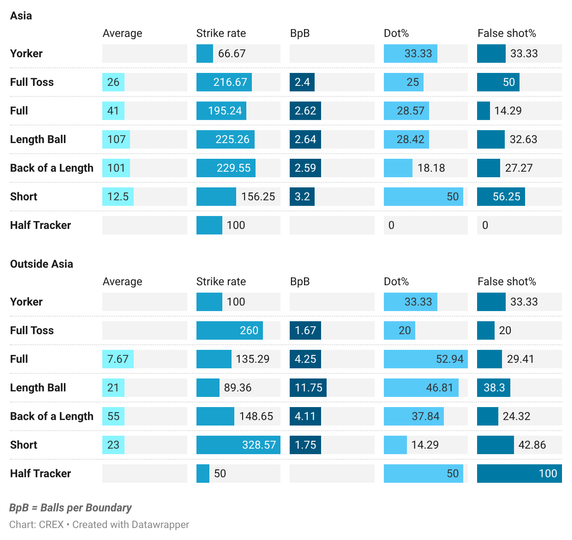 Ishan Kishan vs pace in T20Is in 2026
Ishan Kishan has never really been a great player of bounce, and while he has worked on certain aspects, this issue has remained. At home and on other subcontinent pitches, the bounce usually remains consistent or low. His hands help him manoeuvre the field and access square boundaries.
However, on high-bounce surfaces, Kishan has failed to ride the extra bounce from fuller lengths. Most of his overseas issues have come on full and good-length deliveries.
This year, he has averaged just 7.67 and struck at 135.29 on full lengths against pace outside Asia. He plays around 29.41% false shots. On the same lengths, his average and strike rate stand at 41 and 195.24, respectively, in Asia. He plays just 14.29% false shots.
Similarly, Kishan’s average and strike rate have been 21 and 89.36, respectively, on length deliveries outside Asia. He plays 38.30% false shots.

He has elite hand-eye coordination and, at times, commits a bit too early on the front foot. Moreover, he plays with an elevated backlift to maximise his downswing for horizontal-bat shots. But when he’s denied width by keeping lines into his body, Kishan rushes to bring his backlift down from an awkward, compressed angle.
On stump or down-leg lines, Ishan Kishan averages a mere 14.80 and strikes at 134.55 against pace outside Asia. He loses his wicket every 11 deliveries and plays around 29.09% false shots.
Take his dismissal against Jacob Duffy in Auckland, for instance. The pacer bowled into his body, and the ball just bounced a bit from good length. Kishan looked to work on the leg side, but could only toe-end it back to the bowler.
Similarly, Matthew Hollard just got a hint of movement and deliberately bowled fuller-length into Kishan’s body in Belfast. He went for the shot too early and could only play a thick edge to the wicketkeeper.
His inability to transfer his weight back often leaves him rushed, as he always wants to extend his arms with hard hands. Josh Tongue didn’t really bowl all too short; it was an in-between length that climbed sharply after pitching. Kishan could only get a top edge, as the ball came before he could complete the bat swing.
Pull shots are no longer an issue for Kishan, and his improved off-side range comes from his high grip. So short balls don’t trouble him much, particularly when he gets even slight width. But a lengthier downswing is a trade-off, which puts him in trouble on pitches with extra bounce, such as in Bristol and Auckland.
Kishan needs to keep evolving as a batter
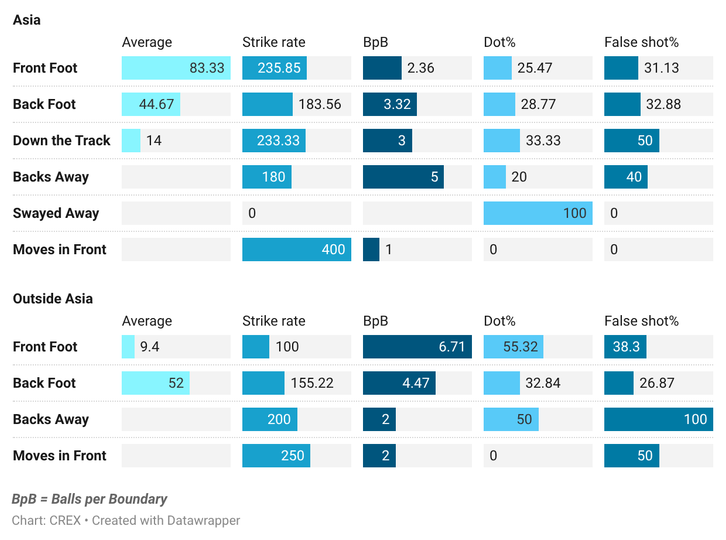 Ishan Kishan vs pace in T20Is in 2026
With the current setup, Ishan Kishan will always face occasional issues on pitches with high, steep bounce. He’s still among the better batters and will work on most pitches. He’s a luxury player who can bat anywhere and take the gloves in white-ball cricket.
However, India would want him to work on a few issues with bounce and straighter lines at times. Kishan could shorten his bat path and remain flexible whenever the surface offers more bounce. He can also avoid locking his front foot to give himself a chance to rock back on high pace.
From the front foot, Kishan averages 9.40 and strikes at 100 outside Asia against pace this year. Teams have been smart enough to bring him on front foot from fuller lengths to exploit his vulnerability. The extra bounce from those lengths cramps him severely.


There’s still time in the next T20 World Cup in Australia, but India will want to build around the current set of batters, including Ishan Kishan. There will be more bounce than what he encountered in England or New Zealand. Fuller lengths will climb sharply and won’t give him enough time to adjust to high pace.
There are always some issues or another for every batter. Ishan Kishan is no exception. As an Asian batter who has grown playing on low-bounce subcontinent pitches, the southpaw is bound to struggle with bounce.
But he’s shown his tendency to improve on his shortcomings in the last couple of years. Some adjustments and smart judgement will unlock more layers of Kishan’s batting in overseas conditions too.
.jpg)
.jpg?type=mq "Australia vs Afghanistan Live Streaming")