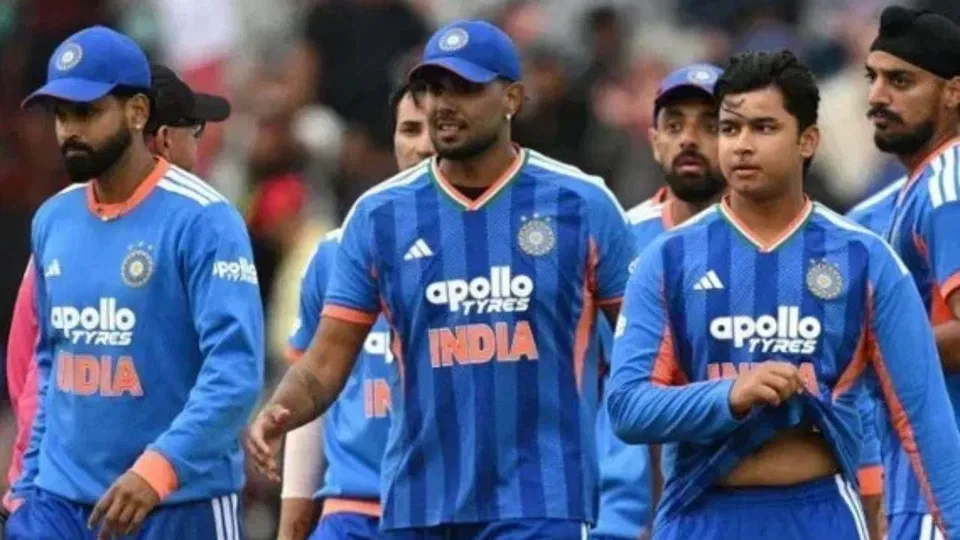
India have more than enough LHBs in their playing XI. Image Credits: AFPIndia finally ran out of patience in the second T20I against England and dropped Sanju Samson to accommodate Vaibhav Sooryavanshi at the top. There was obvious external pressure, and Samson didn’t help his cause with the scores 1, 0, & 5 on the UK tour.That Ishan Kishan keeps the wickets takes that extra value Samson has to offer. So, Sooryavanshi opened the innings with Abhishek Sharma in Manchester and became the youngest debutant for India.How India’s batting setup becomes one-dimensionalWith Vaibhav Sooryavanshi opening, India’s batting unit has become one-dimensional, with as many as six LHBs in the top seven. They have Abhishek and Vaibhav at the top, followed by Ishan Kishan at No.3 and Shivam Dube at No.5.Then, there’s Tilak Varma at No.6 and Axar Patel at No.7. Only Shreyas Iyer, who bats at No.4, is an RHB in this lineup.Also Read: Vaibhav Sooryavanshi Breaks Silence For 1st Time After Abysmal India DebutUnder this management, India have usually played more LHBs, but they still found ways to get a few RHBs in every order. They had Samson in the top order, Suryakumar Yadav in the middle, and Hardik Pandya in the lower order at the T20 World Cup 2026.India had three RHBs at T20 World Cup 2026 final, but only one in 2nd T20I vs EnglandThat maintained the variety and allowed them to make the unit flexible. But since Samson is dropped and Hardik has been unavailable, India suddenly seem to have run out of options.Why India need to have more variety in the batting orderHaving so many southpaws makes India highly vulnerable, even if their batters play spin well. This makes planning against them easy, with bowlers able to bowl without altering their lines altogether.Take the 2nd T20I, for instance. Both Jofra Archer and Josh Tongue were able to bowl with an away angle to the two openers in swinging conditions.Even when Ishan Kishan came, the English pacers kept the line on the off-stump and hardly had to change anything. Another issue is that Tilak Varma has spin issues, so India need to be cautious with his usage, which makes the batting unit more restrictive.England Cricket @englandcricket A 15-year-old debuts 😮 Utter brilliance from Bethell 🙌 Three Lions claim victory 🦁 Full 2nd IT20 highlights 👇 Jul 5, 2026, 11:30 AM Shivam Dube has done well and can be promoted, but that means Axar Patel’s batting value diminishes. A notable issue also arose against spin, something that troubled India even at the T20 World Cup 2026.Will Jacks bowled three economical overs at 7.33 with Vaibhav’s wicket, and Liam Dawson also delivered reasonably well. Overall, the finger spinners went for 8.16 runs per over and took two big scalps.That will always remain an issue with such an LHB-dominant lineup, no matter what. Even on better batting decks at home, India struggled to put spinners away at times.How should India order their batting lineup?Firstly, India need to break an all-LHB top three, no matter how. Even if they want to open with Abhishek and Vaibhav, Sanju Samson or Shreyas Iyer needs to take the No.3 slot.Samson doesn’t fit in the lineup if he doesn’t open, so India’s captain should be at No.3, followed by Ishan Kishan. Kishan might feel out of position, but still, they need a decent spin batter around Shivam Dube and Tilak Varma.At No.5, Hardik Pandya should bat in the full-strength side. Currently, they have Suryansh Shedge, who can be promoted to whack pace or restricted for death overs based on the situation.Once Hardik returns, one of Tilak or Dube will need to go out to accommodate an RHB with a superior range against spin. Apart from Tilak’s poor technique against spin, Dube can also be restricted by negative lines into his legs to control his bat swing.They have Axar Patel, a better spin bowler than these two, and he can be promoted if needed. The choice between Tilak and Dube should be based on the opponent.If the opponent has more spinners, Dube should play, and vice versa. The management tried Samson in the middle last year to make room for Shubman Gill, but the move didn’t work.Sanju Samson by batting positionFor this series against England, they can look to push Samson at No.3 and Iyer at No.5 as an experiment, especially in Hardik’s absence. It would mean Iyer bats out of position, but Samson gets to prove his credentials since he has again been treated unfairly.Eventually, a couple of players will need to sit out of a full-strength XI once Hardik Pandya returns. But for now, India need to get more RHBs in the batting unit to avoid the same issues they faced in the past.Also Read: What Went Wrong For Ravi Bishnoi In IND Vs ENG 2nd T20I? Former PBKS Coach Explains





.jpg?type=mq "Watch - Nat Sciver-Brunt's Special Entry With Her Son In Women's T20 World Cup Final")