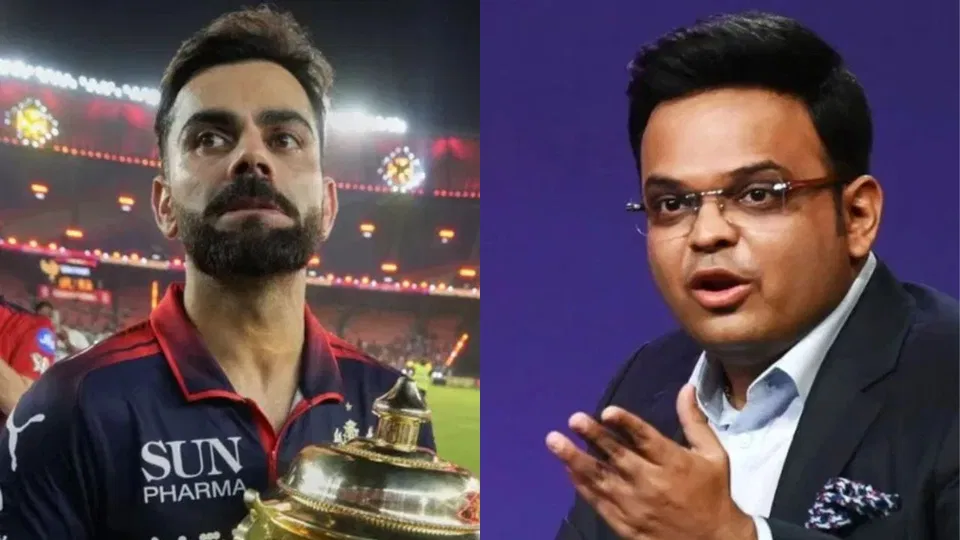
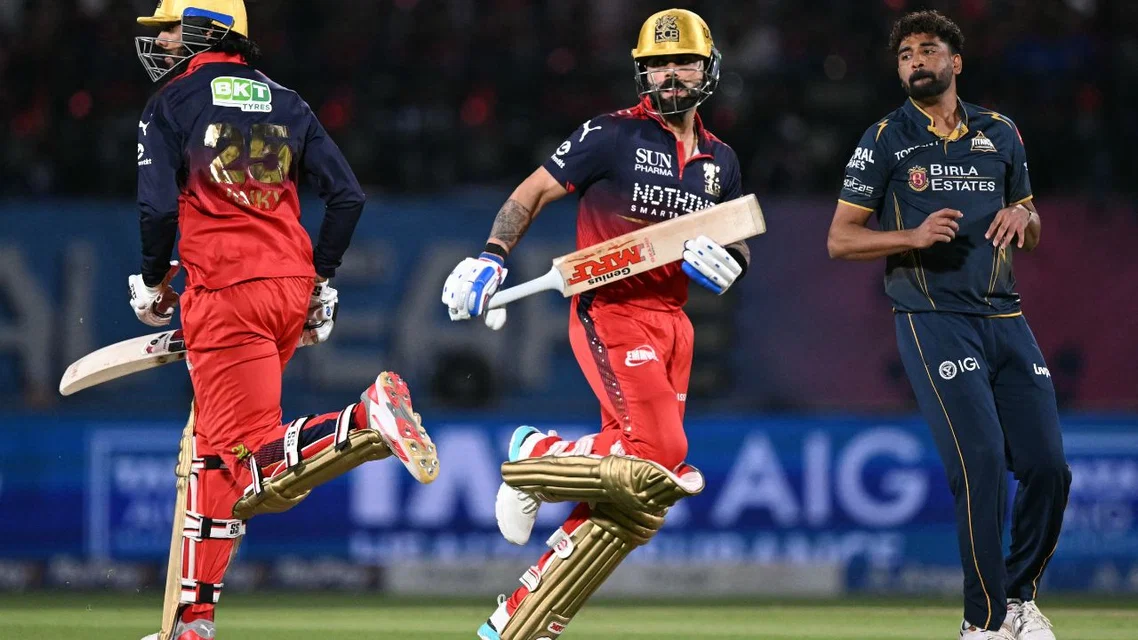
 Virat Kohli Venkatesh Iyer Opening for RCB vs GT. Image Credits: AFP
If there was one team capable of defending 156 in the IPL 2026 final against RCB last night, it was Gujarat Titans (GT). Before the IPL 2026 final, GT had the joint-most wickets (33) while boasting the second-best average (26.73) and economy rate (9.19) in the power play this season.
In Ahmedabad, these numbers were even better: 19 scalps, 17.79 average, & 8.05 economy across seven innings.
So RCB, chasing a rather modest total of 156 on a two-paced deck, couldn’t afford a false start and give the opponent an opening. They had to neutralise the new-ball attack, and so they did. Venkatesh Iyer and Virat Kohli came with an attacking intent and ensured RCB were off to a rapid start without early jitters.
How RCB openers nullified GT pacers’ new-ball threat
RCB have been prolific in using the depth of the crease or coming down the track to take on pacers and disrupting their lengths with the new ball this season.
Before the final, they stood second on the list, playing around 14.60% of power play deliveries on these feet, and found ample success with their methods.
In the summit clash, RCB doubled down on their settled strategy and played 30.55% of deliveries by advancing down the track, backing away, or going deep in the crease.
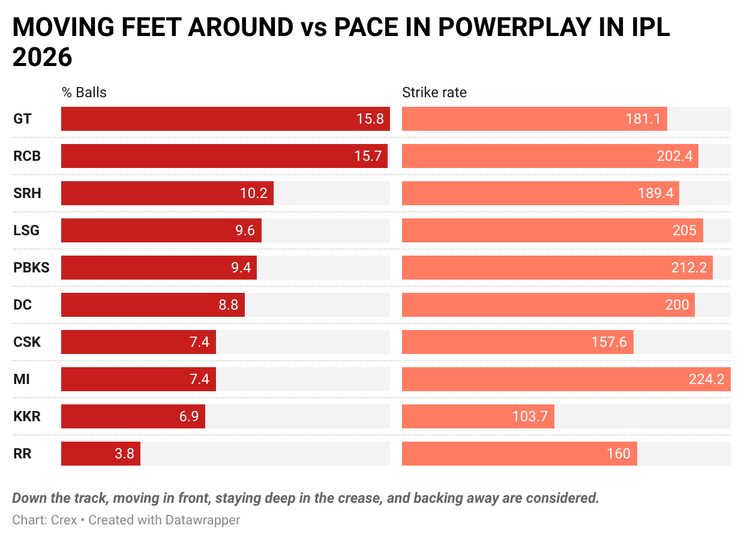 Team wise distribution of batters' feet movement in IPL 2026 power play
Venkatesh Iyer led the charge with 37.5% such feet movement, which fetched him around 12 runs at a strike rate of 200. That’s been his technique all these years; he tries to be as aggressive without getting stable in the crease. With new-ball movement on offer, Iyer manages to survive most of the time and extract most from his limited technique.
Meanwhile, Virat Kohli also played 33.33% deliveries either by going back or charging at the bowler last night. He doesn’t need to overdo it like Iyer, since his pace game is far superior. With his stable base, Virat was still aggressive enough to use his strong wrists to put pacers away whenever they hit good lengths.
Virat Kohli himself described the change in approach after the final
“Yeah, I mean, simple chat to Venky in the change room. And I just told him one thing: we need to kill the game in the power play. And he said, ‘Yeah, let’s go’. So it was total clarity. There was no doubt at any stage when both of us were going," Kohli claimed on the aggressive route in the power play.
"We just wanted to strike. We just wanted to take the bowlers on because we knew in a big game, if you lose a couple of wickets, things can get tricky. So never let the run rate go up to seven and a half, eight,” the chase master further added.
Kagiso Rabada lost his plot after early assault
RCB needed to be proactive to unsettle Kagiso Rabada, who was among the best power play operators of IPL 2026. Rabada’s biggest strength was hitting the good and back of length areas, with 43.25% deliveries between 6-8 meter lengths and 35.71% deliveries between 8-10 meter lengths before the final.
From these two areas combined, he fetched 14 of his 19 power play scalps at 18.57 runs apiece and conceded only 7.83 runs per over.
RCB's assault in the final rendered even the safest lengths ineffective, as good-length deliveries disappeared at 20 runs per over, while back-of-a-length balls went at 18.
Kagiso Rabada was also forced away from his immaculate lengths, with fuller lengths (4-6 meters) rising from 12.30% to 33.33% and shorter lengths (10+ meters) increasing from 5.55% to 33.33% in the summit clash.
He ended up conceding 44 runs inside three power play overs, with Devdutt Padikkal's dismissal being his only success.
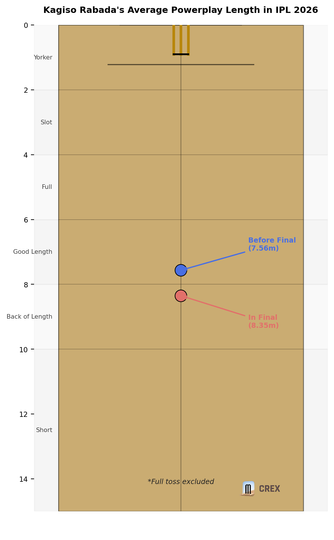 Kagiso Rabada's Pitch Map in IPL 2026
By the time field restrictions were lifted, RCB had raced away to 70/2, already covering 44.87% of the target.
Gujarat Titans briefly threatened a comeback when Rashid Khan struck twice in the ninth over, but they could never apply pressure due to a controlled required rate. Although the chase lasted 18 overs, the final was effectively won in the first six.
Also Read: RCB Players Whose Release Could Prove To Be Biggest Blunder Before IPL 2027