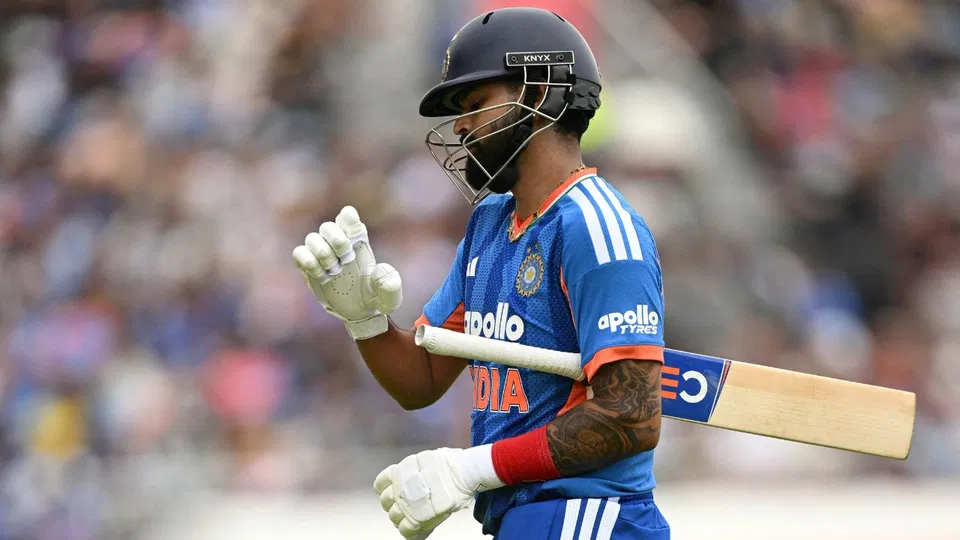
India's top order has faced issues with short balls. Image Credits: AFPEngland gave Jofra Archer an extended spell, using him for three consecutive overs in Nottingham last night, and rightly so. Archer and Josh Tongue might have been wayward at times, but they have a knack for picking wickets.Their natural attributes are high enough that they can afford to bowl a few loose deliveries, for it also fetches them wickets. That’s precisely what happened against India last night.How England pacers employed short balls against Indian openersJofra Archer actually started with a very full delivery, aiming to extract some early swing, as Arshdeep Singh found in the first innings. However, he soon shifted to bowling good and short lengths once Abhishek Sharma made his intentions clear on the first ball itself.This was a repeat from the 2nd T20I, where Archer also started with a fullish length before shortening it for subsequent balls. It’s just that Nottingham’s deck was not as quick early on.The next three deliveries to Abhishek were back of a length, with Archer extracting notable movement to beat him. The lines were immaculate in the body, which meant Abhishek, who often tries to move to the leg side to access the off-side region, was cramped for room every time.England Cricket @englandcricket Super Salty 🏏 Jofra & Tongue on 🔥 A strong victory at Trent Bridge 👏 Full match highlights here 👇 Jul 8, 2026, 11:30 AM When Vaibhav Sooryavanshi finally arrived at the crease on the fifth ball, England immediately put a third man in place. This third man was a protection, since Vaibhav pounces on any width and has a rapid bat speed to take the ball over the boundary.Similar to the previous game, Archer again started with a pacy short delivery, and the southpaw was late in his shot. The next one depicted why the third man was placed: a back-of-a-length ball with some room on offer, and Vaibhav threw his arms at it, and it flew just over that fielder.Also Read: The Technical Flaws Behind Sanju Samson’s Zimbabwe OmissionThat’s how confident Vaibhav is in his abilities; he knows no boundaries are too big if he gets to extend his arms. This was not a bad delivery; it’s just that Archer gave only some room in a bid to angle the ball away, which was enough for the batter.Josh Tongue’s false start and course correctionJosh Tongue is more wayward of the two, and his false start showed why. Even though Archer gave him a pattern on where to bowl, Tongue, for some reason, attempted a yorker first up, which ended up being a full toss.Abhishek was not going to miss it; he opened his bat face and guided over backward point for a maximum. Then, on the third delivery, the English pacer made a big mistake by attempting a fuller length against Vaibhav and was dispatched for a six again.Two maximums in three balls, both on fullish lengths. After these two boundaries, Tongue finally corrected his lengths, and what started was a nightmare for India.On the fifth delivery, Tongue bowled a short ball away from the body and deliberately forced Abhishek to hit towards the deep backward point fielder. The extra bounce meant the ball ended up going squarer, even though he wanted to play over covers.Then came the biggest wicket of Sooryavanshi in the next over, when Archer bowled a well-directed bouncer into his body. It was quick, and with Archer’s pace, even Vaibhav was late in his shot and ended up gloving it straight to the wicketkeeper.Indian batters in the top three were undone by short ballsEngland had tried the same even in the last game in Manchester, where Vaibhav looked uncomfortable against short lengths at times. A similar plan fetched them a massive wicket this time, as the young sensation couldn't extend his arms enough on this occasion.The short balls had worked again, but this was not it. They still had to get Ishan Kishan, and did so with another non-fuller length with a high pace.Despite going for six the ball before, Tongue backed himself with another short one, angled away, and Kishan, still hunting the pull, could only skew it flat to deep square leg. Three balls, three wickets for the short ball.How short balls have stifled the Indian teamAll in all, India’s top three faced 57.14% of deliveries shorter than 8 meters, on which they scored at a strike rate of 166.66 and lost three wickets in Nottingham. This has become a pattern with the Indian team, for England have consistently targeted their top order with bouncers.For instance, Archer has attempted around 56.66% of deliveries shorter than 8 meters, while Tongue’s tally stands at 41.66%. Saqib Mahmood, who featured in the opening T20I, bowled around 81.81% short deliveries during the field restrictions.An all-LHB top three is anyway a recipe for disaster, and their issues with short balls have made them more vulnerable. Unlike IPL, where surfaces allowed them to get away with loose shots, they will be tested more in the international arena while playing square of the wicket.It’s not that they need to change their approach altogether, but they definitely need better shot selection. Opponents, such as England, which have high-end pacers, will always trouble them on non-flat surfaces.India's middle-order batters, such as Shreyas Iyer and Shivam Dube, remain susceptible to short-pitched bowling despite recent improvements. If the top order also develops a recurring weakness against the short ball, opponents will have a clear blueprint to exploit throughout the batting order.Also Read: Vaibhav Sooryavanshi To Be Benched? India's Predicted Playing XI For 4th T20I Vs England 2026