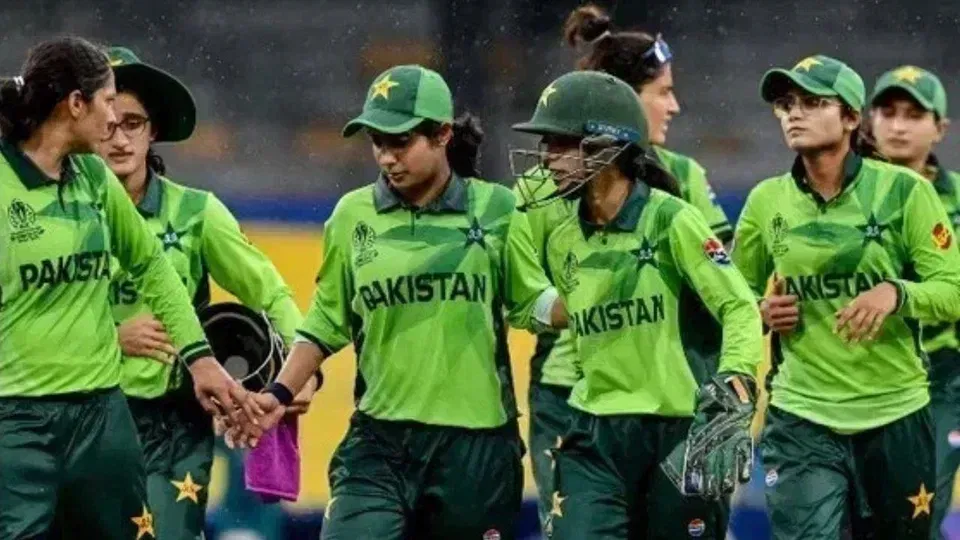
Pakistan Men's and Women's teams have a number of similarities. Image Credits: AFPPakistan's men’s and women’s teams are stuck in a rut in white-ball formats at the moment. Their patterns have been common: occasional flashes of brilliance, but no consistency.It was visible during the Men’s T20 World Cup 2026, and the story has continued in the Women’s T20 World Cup 2026. There are several commonalities.Inadequate batting approachOne common issue across both teams has been a lack of intent from most batters. That’s visible in their strike rates in white-ball cricket.Pakistan's women’s team has a strike rate of just 110.28, below the other top five teams, and takes around 6.96 balls for every boundary in T20Is since 2024. In the same period, the men’s side has scored at just 131.16, the fourth-worst among 10 T20I teams, and has a balls-per-boundary ratio of 5.96.Their biggest issue has come outside the field restrictions in the middle overs, where the lack of enough power-hitters has come to the fore. Between overs 7 and 16, Pakistan Women have the second-worst strike rate (101.24) among the top 10 teams and play around 44.05% dot balls.Also Read: Fatima Sana vs Aliya Riaz? Reported Rift Adds To Pakistan’s T20 World Cup StrugglesAt the same time, Pakistan Men also have the fourth-worst strike rate (126.96) and play around 34.44% dot balls. That high dot% indicates how sluggish they have been when other teams have become more dynamic with their approach.That has also been the case in ODIs. Both teams languish in the mid-table, with the men’s team being worse than the women’s team in the middle overs.Sluggish intent against spinPakistan’s poor numbers in the middle overs are directly connected with their inability to whack spin. Both men’s and women’s sides have been unable to maintain the scoring rate against slow bowlers.Since 2024, Pakistan Women have been one of the two teams to strike below 100 against spin in T20Is. They have a strike rate of 95.94 and an average of 14.50, the worst among the top 10 sides.Since last year, the team has made decent individual progress, with their strike rate rising to 103.74, but it’s still the lowest among all. That again reflects that the Pakistan Women’s team have not progressed enough against spin.In ODIs, they again remain low, with a meagre average of 26.73 and a strike rate of 72.64. They play so many dot balls and eventually get out.Pakistan men's and women's teams have been poor vs spinMeanwhile, the story remains the same with the men’s side. Since 2024, Pakistan Men have a strike rate of 125.36, the fourth-lowest among the top 10 teams, and take as many as 7.10 balls for every boundary.In ODIs, their strike rate (79.52) has been the third-worst, and they play 52.74% dot balls. The innings construction skills and cutting down dot balls are clearly missing, which eventually leads to a lower run rate.Overdependency on few playersThis has been more common in women’s cricket, but the trend has also begun in the men’s side. In T20Is, Pakistan Women are heavily dependent on a couple of players in the batting department - Muneeba Ali and Fatima Sana.The two have collectively scored 34% of batters’ runs alone since 2024. Meanwhile, others have not been as consistent at times.Most of them have low strike rates and averages, with occasional decent knocks to show. Sana has been the standout performer, contributing heavily across the board.Even in bowling, Pakistan Women have mostly relied on Sadia Iqbal, Fatima Sana, and Nashra Sandhu. The three have snared 60% of the total wickets for the team.A comparison with a few other top sides explains it. For instance, India Women’s top three wicket-takers have shared only 45.36% wickets among them, while Australia Women stand at 49.49%.Star Sports @StarSportsIndia A statement win! 💪 Bangladesh hold their nerve and seize a crucial win over Pakistan. #T20WorldCup #BANvPAK Jun 20, 2026, 10:37 PM In men’s cricket, the problem has been more about striking quickly, with only a few players doing consistently. Sahibzada Farhan and, to an extent, Fakhar Zaman have only been able to blend consistency with intent in the shortest format.Someone like Babar Azam or Mohammad Rizwan has scored runs at times, but without maintaining the scoring rate. Meanwhile, Saim Ayub and Mohammad Haris have been quick but have not contributed consistently enough.The story has been, more or less, the same in ODIs. Salman Ali Agha has an average of 43.16 and a strike rate of 94.64, while other consistent batters like Babar Azam and Mohammad Rizwan have again failed to match the tempo, with the latter also dropped for the same reason.Inability to compete with big teamsAnother common trend has been how both Pakistan’s men’s and women’s sides couldn’t compete with big teams. That is again due to the reasons mentioned above; their game is simply outdated.Star Sports @StarSportsIndia BIGGEST WIN FOR INDIA OVER PAKISTAN IN T20Is (61 runs)! 🤯 With that, they make it 8-1 in #INDvPAK in the ICC Men's T20 World Cup and qualify for the Super 8! 👏 Watch them next in ICC Men's #T20WorldCup | #INDvNED | WED, 18 FEB, 6 PM! Feb 15, 2026, 10:36 PM In T20Is, Pakistan Women have won only two of 16 games against the top five ranked sides, with a win-loss ratio of 0.142, since 2024. Meanwhile, they have won just two of 14 ODI matches against these teams.The men’s side has won just nine of 35 games against top-five teams, with a win-loss ratio of a mere 0.375, in T20Is. Pakistan Men have done relatively better in ODIs, with 10 wins in 20 games at a win-loss ratio of 1.Pakistan men's and women's team haven't won enough games against big nationsHowever, they have not won against New Zealand and India in this period. Their wins have mostly come against depleted Australia and South Africa sides.Overall, multiple trends are common in Pakistan’s men’s and women’s teams in white-ball cricket. They need a better domestic structure and a player pool to match the standards, because other top teams have moved way ahead.Also Read: “Yashasvi Jaiswal Suffered Because Of Virat Kohli”- AB de Villiers’ Shocking Take








.jpg?type=mq "Indian Players Who Have Donned Jersey No 3 Before Vaibhav Sooryavanshi")