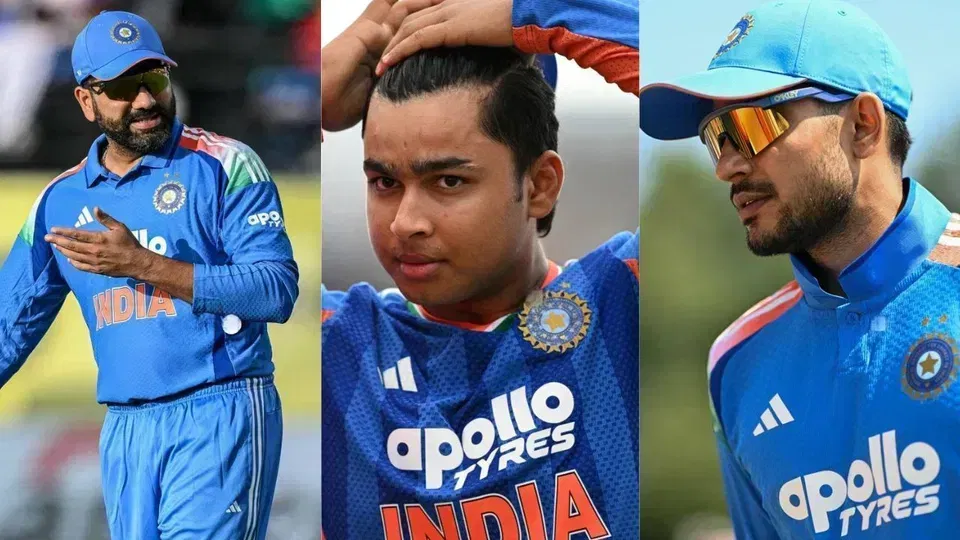





 India have been sloppy in the field lately. Image Credits: Getty
How many dropped catches are too many dropped catches? For India, the threshold seems to be rising with every match. They are among the worst catching sides at the moment, with the problem looking particularly acute in the shortest format.
Dropping catches is largely part and parcel of the game, and realistically, not every missed chance has a significant bearing on the outcome of a match.
But chances are being spilled too often now, and the mistakes are starting to feel less like isolated lapses and more like a pattern. And unfortunately, it has become contagious across their entire fielding unit.
India’s catching problems
India’s catching standards have been below par for a while now, but the problem seems to have worsened since the 2026 T20 World Cup. Since then, India have dropped 32 catches across 19 T20Is, the most among full-member teams.
They have dropped at least one catch in 12 different matches during this period. The Men in Blue were also the worst catching side at the T20 World Cup, spilling as many as 14 chances. Sri Lanka (11) and Ireland (10) were the next worst.
India missed one chance against the USA in Mumbai, but that was only the beginning. They went on to put down four chances each against Pakistan in Colombo and the Netherlands in Ahmedabad.
Also Read: Will Morne Morkel Also Leave India After Ryan ten Doeschate And T Dilip?
Later, they let three more chances slip against the West Indies in Kolkata before dropping two more against New Zealand in the summit clash.
A few of them did prove costly, even if India didn’t end up losing the match. For instance, Milind Kumar was fortunate to get away after Mohammed Siraj failed to hold on to a chance at third man in the fifth over. Milind added another 31 runs to his tally before eventually being dismissed in the 12th over.
Shaheen Afridi, meanwhile, made India pay 20 runs for three reprieves in the space of 17 balls in Colombo. Hardik Pandya couldn’t contain his frustration after two consecutive drops off his own bowling, venting at Ishan Kishan and Kuldeep Yadav in equal measure.
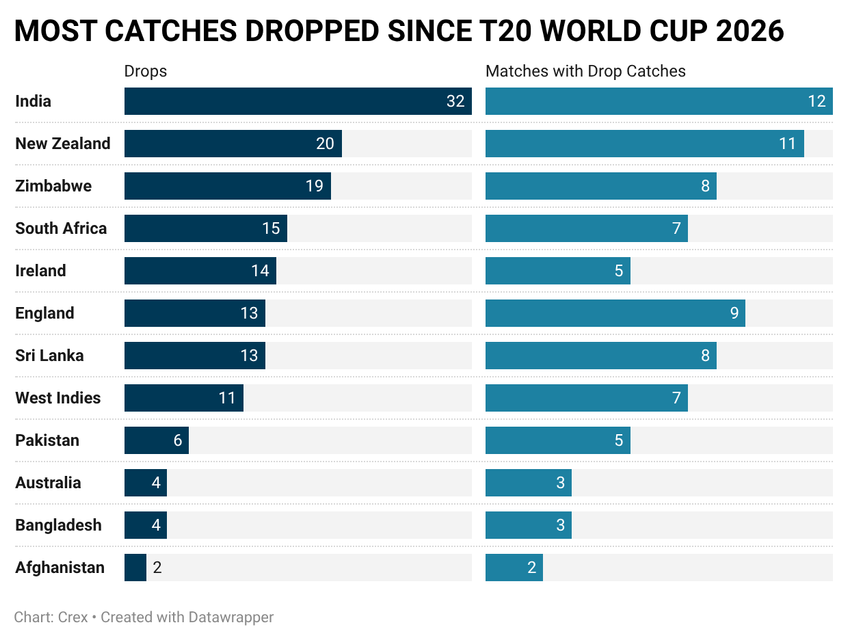 India have dropped the most catches since T20 World Cup 2026
The standards haven’t improved one bit since. From the start of the UK tour, India have again been sloppy in the field, with dropped catches and missed run-outs becoming a constant issue.
India dropped three catches each in two T20Is in Ireland before putting down five more in England. The catching woes peaked in Zimbabwe, where as many as seven chances went down, five of them in the final T20I alone.
The biggest culprits
Tilak Varma and Abhishek Sharma have been the two biggest culprits. Since the T20 World Cup, no other fielder from the full-member nations has put down as many catches as Tilak, who has six to his name. Abhishek Sharma is next with five.
Both also dropped once each off their own bowling. Zimbabwe’s Milton Shumba and England’s Phil Salt are joint-third, with four dropped chances each. Shumba, for the record, put down all four in a single game during the second T20I against Bangladesh in Bulawayo.
Shivam Dube and Ishan Kishan come next, with three dropped catches each. Kishan has put down all three despite having his gloves on, while also being involved in a comical missed run-out along the way. Dube, meanwhile, has never been the most reliable fielder, with India often looking to keep him out of the hot spots.
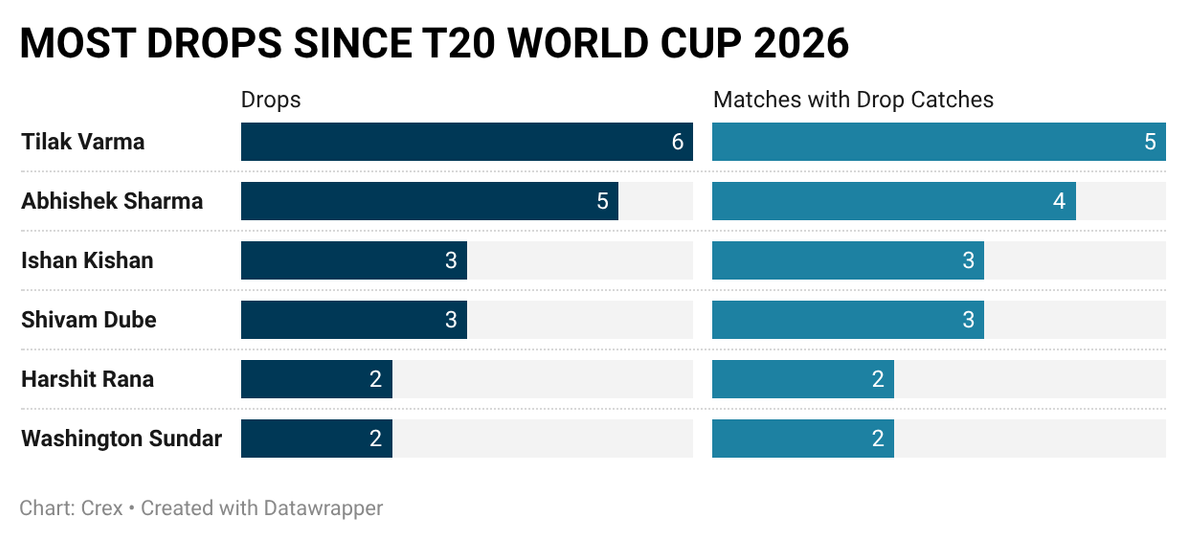 Tilak Varma and Abhishek Sharma have been the worst catchers
Ashok Sharma even started celebrating by thanking the heavens, assuming he had earned his maiden international wicket in the third T20I. Only for Ishan Kishan to put down a straightforward chance without even having to move, both gloves already in position.
Similarly, Yash Thakur was denied his first wicket in India colours on just his second delivery the previous day after Tilak Varma failed to hold on to a rather simple chance at cover.
The bowlers paying the price
Almost every bowler has been on the receiving end of India’s sloppy fielding in recent times. With the problem persisting for so long, bowlers have repeatedly had to wait for their rewards in an unforgiving format.
Axar Patel and Arshdeep Singh have suffered the most from India’s fielding lapses. Six catches have gone down off each of their bowling since the T20 World Cup, and not a single one was dropped by the bowler himself.
Also Read: Why T Dilip's Stint With Team India Has Ended Suddenly?
Suryansh Shedge could have prevented some of the carnage had he pounced on a rare chance offered by Jos Buttler after he completed his century in Southampton.
Buttler went on to add another 30 runs off just 13 deliveries, providing a final flourish that propelled England to a massive 257/3. With a new batter at the crease, India could have had a better chance of stemming the onslaught in slog overs.
Prince Yadav and Yash Thakur have had four chances go begging off their bowling. Shivam Dube follows with three, all of which came in a single game against the Netherlands at the T20 World Cup. Two fortunately came in the final over, when the result was already beyond doubt.

Prince Yadav and Yash Thakur haven’t even played as many games, yet four chances have gone down off each of their bowling. Harry Brook made India pay the most for their sloppy fielding, after Dube misjudged one while running back off Prince’s bowling in Southampton.
Brook was on just three at the time, but went on to belt 95 runs off 51 deliveries, with eight maximums, and remained unbeaten. His reprieve, along with Buttler’s drop in the same game, proved crucial as India failed to win a single T20I against England in four attempts.
What’s behind India’s catching woes?
It’s hard to pinpoint a particular reason behind India’s poor fielding standards. There could be several factors at play, but one possibility is the relentless schedule and the fatigue that comes with it. Players have had little time to rest between tournaments, which can inevitably affect concentration and sharpness in the field.
Indian players have been playing almost non-stop since the start of the year, with the 2026 T20 World Cup, IPL and now three consecutive away series leaving them with barely any respite. It’s difficult to quantify how much that has contributed to the lapses, but fatigue could certainly be one piece of the puzzle.
There have also been plenty of injuries since international cricket resumed after IPL 2026, with several players breaking down after just a handful of matches.
That could influence how aggressively they throw themselves around on the field, particularly when trying to avoid picking up another injury in an already demanding schedule.
Rapidly shifting between vastly different atmospheric conditions could also affect a fielding side’s visual tracking and spatial awareness.
During India’s recent tours, players have had to transition from the damp, overcast conditions of England to the high-altitude environment of an open ground in Harare, with little time to adapt between the two.
Such drastic changes can make high catches harder to judge, as they introduce greater unpredictability. Shivam Dube struggled to hold on to a chance in Southampton as the ball continued to wobble until the last moment, while Mayank Yadav was forced to extend his arms at the last second in Harare after misjudging how quickly the ball would drop.
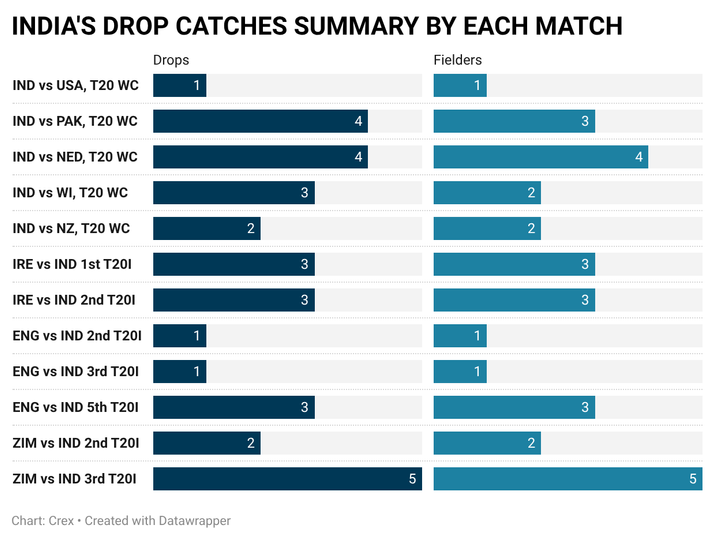 India have dropped 32 catches since T20 World Cup 2026
The conditions in India can present their own challenges. Most matches are played under lights, where tracking the white ball against the night sky can be tricky.
On high catches in particular, the ball can seemingly disappear for a split second against the backdrop. As many as 68 catches were dropped across the T20 World Cup 2026 matches played in India, while 179 went down during IPL 2026.
Ambati Rayudu made an interesting point on Cricinfo about how high catches are practised in training. Coaches often use a padded bat to hit balls high into the air, which generates a relatively clean and stable spin. A wooden bat, however, can produce far more violent spin, causing the ball to wobble or drift unpredictably as it descends.
That can make it considerably harder for fielders to judge the angle and trajectory of a high catch in a match. The way catches are simulated in training may not always replicate the unpredictability of a ball struck off a wooden bat, and that difference could be playing a role in some of the lapses.
Then there is the sheer power with which batters are striking the ball these days. Stronger bats allow them to generate greater speed and distance, leaving fielders with less time to react. Tilak Varma found that out the hard way when he misjudged a chance at cover, only for the ball to beat his hands and crash into his ribs before he could close them.
Several misjudgments on the ropes in Ireland and England could be attributed to a similar problem. In Belfast, Arshdeep Singh had only a few yards to cover to his right, yet the ball still burst through his hands because Harry Tector generated extraordinary power with his bottom hand.
It may ultimately be a combination of all these factors. A little fatigue here, an unfamiliar condition there, and any of them can make a catch that much harder. Whatever the reason may be, India’s catching standards have reached a point where they can no longer be dismissed as mere lapses.
Also Read: Ryan ten Doeschate Steps Down As India's Assistant Coach, Set To Join IPL Team
.jpg?type=mq "India' Strongest XI For Sri Lanka Test!")