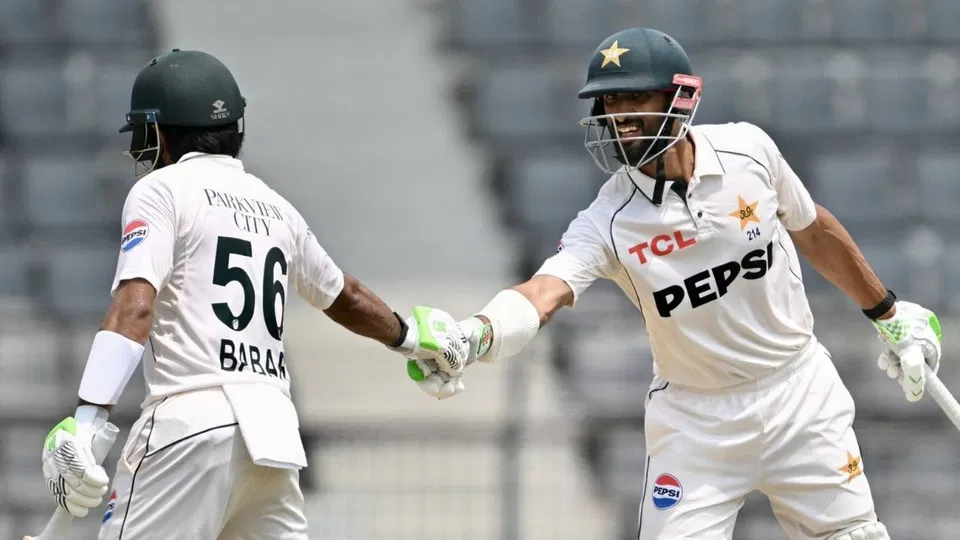





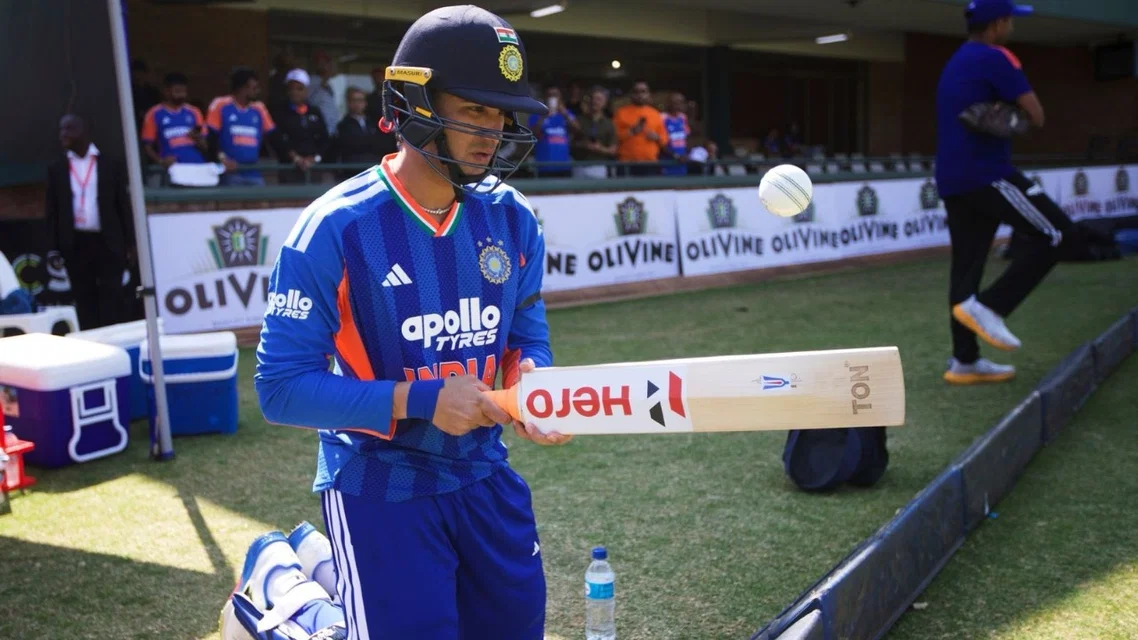
 Abhishek Sharma was not at his best in Zimbabwe. Image Credits: AP
Is Abhishek Sharma’s batting form a concern? Maybe or maybe not. But either way, he hasn’t been as explosively consistent as he was in his initial couple of international years.
His mean reversion came at a time when Vaibhav Sooryavanshi finally realised the importance of adapting to different gears and playing according to the surface. The Zimbabwe series was more about Vaibhav’s maturity and evolution against a fairly strong bowling attack. On the other hand, Abhishek’s troubles on back-of-a-length deliveries became more pronounced.
Abhishek Sharma’s below-par performances
Abhishek Sharma has been below par right from the UK tour, which began with a two-match rubber against Ireland. Since then, he has 191 runs at a meagre average of 19.10 and a strike rate of 166.08 in 10 innings, comprising a solitary fifty.
The worst of his performances, however, came against Zimbabwe, where the southpaw could collectively score 11 runs across three outings. He faced just 20 deliveries and hit only two boundaries, both against spin, throughout the series.
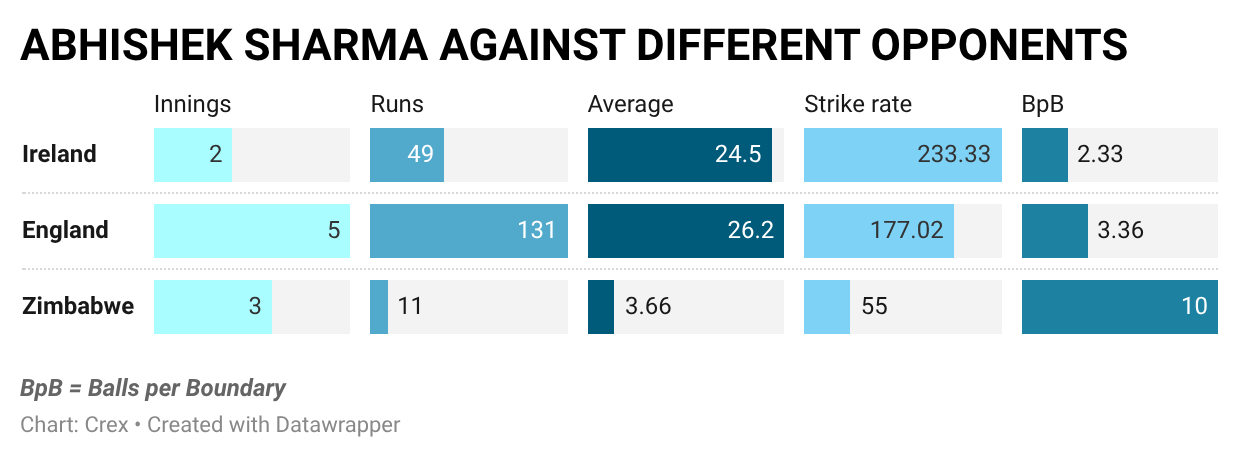 Abhishek Sharma wasn't at his best away from home
On all three occasions, Blessing Muzarabani dismissed him with his shorter lengths and extra bounce. Against him, Abhishek faced 14 deliveries, but could score only two runs and lost his wicket thrice.
At times, he found some ways to score here and there against Ireland and England despite struggling most of the time. In Zimbabwe, though, he found himself in a rut he could not escape at any stage.
Abhishek’s numbers would have been even worse had he not hit those couple of fours against Sikandar Raza in the second T20I. Fortunately for him, he chipped in occasionally with the ball to still find solace on an otherwise disappointing tour.
Issues with back-of-a-length and outside off-stump deliveries
Abhishek Sharma has been consistently troubled by good and back-of-a-length deliveries since the start of the UK tour., as has been the case with most batters from India. All but one of his nine dismissals against pace have come on deliveries pitched between 6 and 10 metres.
Muzarabani exploited the same weakness in Harare, pitching all 14 of his deliveries to Abhishek within this range. Two of the three dismissal balls were slightly fuller, while the other was more towards the back of a length.
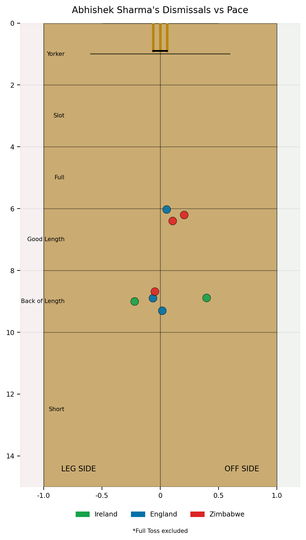 Abhishek Sharma found himself in trouble against good and back-of-a-length deliveries
More telling, though, were the lines of those wicket-taking deliveries. Muzarabani consistently bowled a touch wider of off stump and got Abhishek all three times from that channel.
Rather than attacking his body, he trusted the untrusted bounce and the line outside off stump to create the problem. Abhishek’s trademark powerplay shot, where he makes room and slashes over cover, did not come off throughout the series.
Instead, he kept edging those shots either through to the wicketkeeper or towards the third-man region. A major technical issue that came to the fore was his inability to keep his shots down or adjust their placement according to the bounce of the pitch.
At times, the Harare pitches demanded that he play slightly straighter with a more vertical bat, but Abhishek continued to attack square of the wicket. His dismissal in the final T20I was a good example.
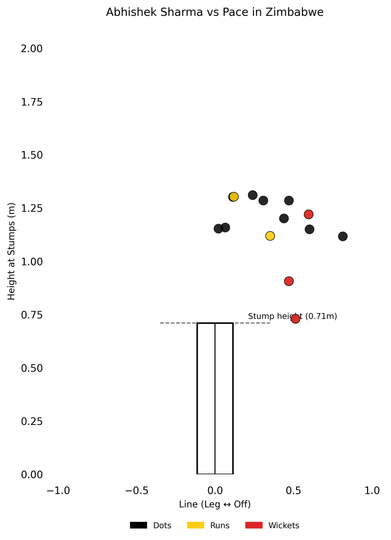 Abhishek Sharma failed to counter Blessing Muzarabani
It was the fullest delivery Muzarabani bowled to Abhishek in the series, with the slower pitch making it difficult to hit through the line. Abhishek again backed away and tried to smash the ball over cover, but the lack of pace meant he could only get an outside edge and lost his wicket.
Similarly, on another occasion, he went too hard at a slightly straighter delivery and ended up offering a simple catch to the third-man fielder. There, the extra bounce undid him.
The square boundaries in Harare are also significantly longer than those on offer at many Indian grounds. As a result, Abhishek could not get away with those mistimed slashes in the first two T20Is on pitches that were not completely flat.
Vaibhav Sooryavanshi showed the way
Vaibhav Sooryavanshi was the best batter from either side in the series. And that’s not because he scored the most runs. It was because of his ability to adapt when the surfaces demanded adjustments and composure.
It started right from the first T20I. The best example, however, came in the final game, which was played on a used pitch. Vaibhav was vigilant enough to control his pull shot against deliveries outside off stump and took his time before unleashing.
When Muzarabani tried to force him into a pull with a rising short delivery in the second over, Vaibhav Sooryavanshi didn’t fall for the bait. Instead, he dabbed the ball to the left of third man along the ground. Similarly, when a delivery bounced slightly more than anticipated in the fourth over, he was smart enough to bring his bat swing inwards despite being set up to cut.
Abhishek Sharma, on the other hand, played hard slashes at a similar line multiple times and struggled to control the bounce. There was an element of impatience in each of his dismissals.

India went through a lean patch between overs 8 and 11, with no boundaries as the spinners tightened their grip on a sluggish surface. Vaibhav still waited for his opportunity before eventually finding the fence.
A 31-ball fifty was slow by Vaibhav’s standards, but that was what the situation demanded. Abhishek could take a leaf out of his book.
His failures in Zimbabwe by no means suggest that he struggles whenever the decks are not batting-friendly. He has found ways to win games for India on such surfaces away from home previously.
But the series did illustrate that Abhishek Sharma needs to work more on controlling his aerial shots and getting closer to the line of the ball when playing through the line becomes difficult. Given how much he has up skilled his game over the last couple of years, he should be able to find a way around this latest roadblock too.
Also Read: VVS Laxman Reminds Shreyas Iyer Of 2 Consecutive Series Losses In Front Of Teammates
.jpg?type=mq "How Much Money Did Vaibhav Sooryavanshi Earn?")