


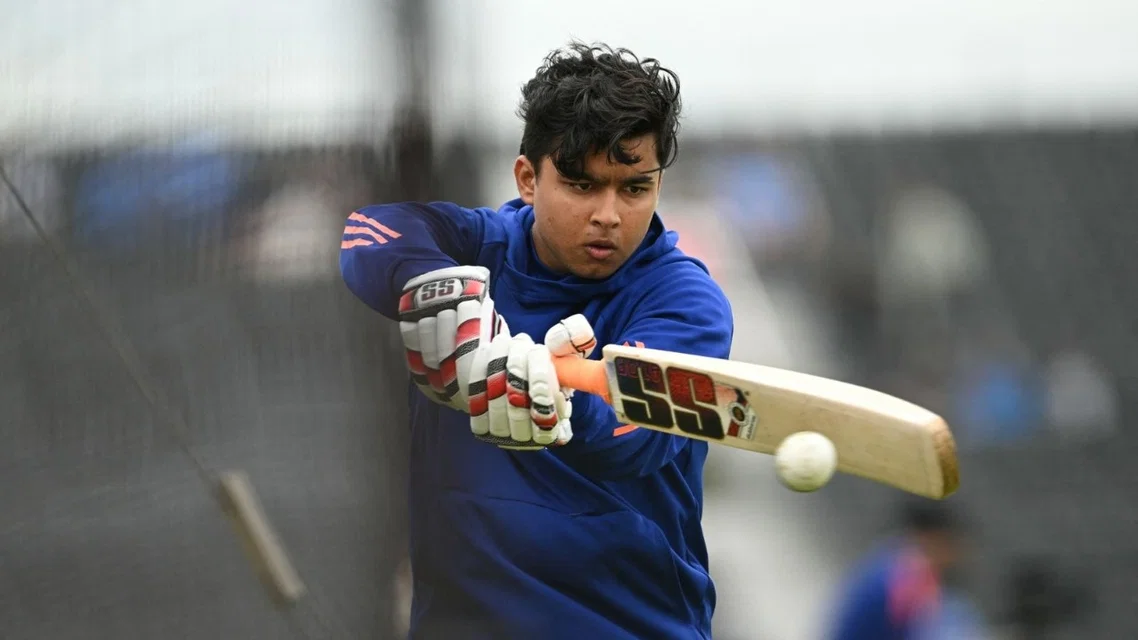
 Vaibhav Sooryavanshi hit his maiden international half-century against Zimbabwe. Image Credits: AFP
“There have been several ups and downs in the last four months.” These were Vaibhav Sooryavanshi’s words before the start of the Zimbabwe series. He had just got his first taste of international cricket, and with it, his first real experience of failure.
It wasn't that there were too many setbacks. But at that level, and with those expectations, even a few can feel overwhelming. After all, Vaibhav had replaced someone like Sanju Samson, who himself earned a spot after years on the sidelines.
Vaibhav Sooryavanshi overcame his struggles in Zimbabwe
Zimbabwe’s lanky pacers Blessing Muzarabani and Richard Ngarava picked up from where England left off. The short balls.
On the first ball, Vaibhav looked to ramp over third man but missed it altogether. The first delivery of the second over posed another challenge, as a back-of-a-length ball straightened after pitching and squared him up.
Also Read: List Of All Records Broken By Vaibhav Sooryavanshi In India vs Zimbabwe 1st T20I 2026
Then came a loose delivery that gave him an opening to what would eventually be his maiden international half-century. Ngarava banged one in short again, but ended up bowling a tad too straight into the body, allowing Vaibhav Sooryavanshi to unleash his trademark pull shot.
He swivelled it over the deep backward square leg for a 99-metre six. Predictably, the pacer responded by pitching fuller on the following delivery. Vaibhav adjusted beautifully, holding his shape before threading a late drive past extra cover.
The shot of the day followed immediately. Ngarava attempted another short delivery outside the off-stump line, only for the left-hander to create some room and hammer it over long-off with a straight, vertical bat.
It was a stroke that combined exquisite timing with immense power, executed in one of the toughest areas of the ground to clear. By this time, he’d found his rhythm.
Brad Evans erred by pitching the ball up. Vaibhav promptly cleared his front leg and muscled it straight back over the bowler's head. A leg-side delivery followed, and he whipped it over fine leg for another maximum.
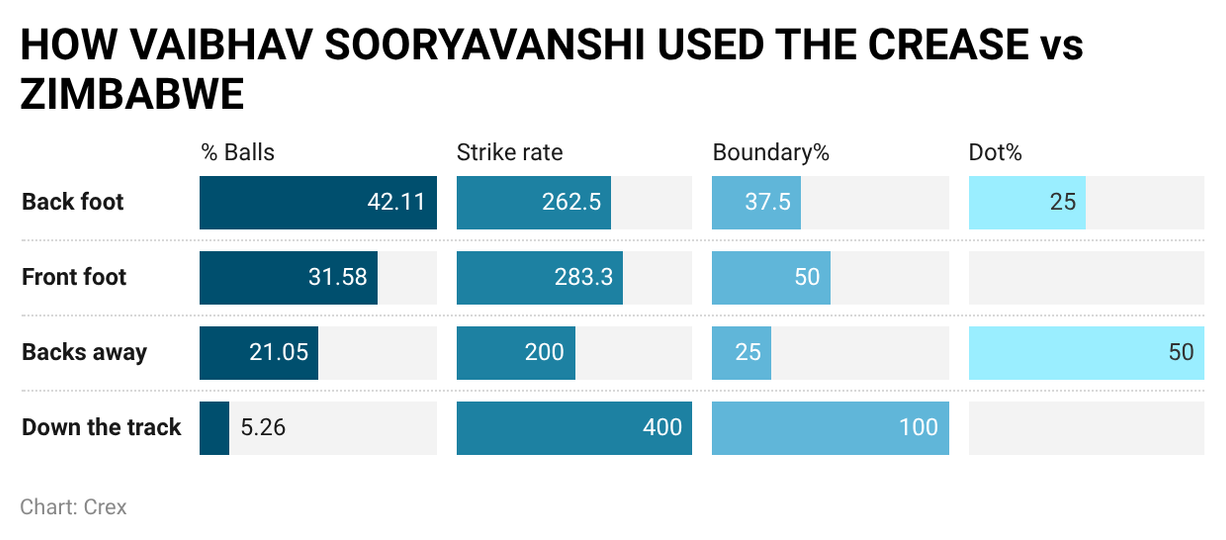 Vaibhav Sooryavanshi showed good usage of his crease
Next up was Zimbabwe’s best pacer Blessing Muzarabani, who had conceded just three runs and dismissed Abhishek Sharma in his first two overs. Vaibhav welcomed him by making room and lofting an aerial drive over sweeper cover for four.
Muzarabani then rolled his fingers over a fuller delivery, but Vaibhav waited on it, delayed his bat swing, and hammered it straight down the ground for a towering six. Anticipating the short ball next, he advanced down the pitch and cut it over deep point for another boundary.
To bring up his maiden international fifty, Vaibhav flat-batted a back-of-a-length delivery over the bowler's head before jogging through for a couple. It had taken him just 18 balls to reach a landmark that could well be the first of many.
The technical adjustments
For starters, Vaibhav Sooryavanshi had some idea of the conditions in Harare, the spot where he cracked a scintillating century in the U19 World Cup final six months ago. Still, the bowling quality was higher, on a surface that, as Sikandar Raza described at the toss, was not a typical Harare pitch.
So, Vaibhav had to become a problem solver once again. Rewind to the fourth ball of the second over.
Instead of instinctively looking to hook a back-of-a-length delivery outside off, he stayed leg-side of the ball and played through the line with a straight bat down the ground. Earlier, he would have tried to manufacture that same delivery towards the leg side or slightly squarer.

Against Jofra Archer in Bristol, he had swivelled into a pull against a similar delivery and only just managed to clear deep midwicket. Even against Josh Tongue in Manchester, he failed to connect with a hook shot at a ball just outside the off-stump line.
However, while facing Blessing Muzarabani, he resisted the temptation to hoick across the line on wider lines. Instead, he targeted the packed off side, giving himself a far greater margin for error even if he mistimed the stroke. That is exactly what happened, but because the ball travelled towards the off side, it landed safely.
Earlier, deliveries angling across him had often produced top edges because he tried to hit against the angle. This time, he rode the angle instead of fighting it. The emphasis was clearly on playing the line of the ball rather than premeditating the shot, with far more strokes driven straight or through the off side, even against slightly shorter lengths.
The drive off Ngarava and the straight six off Muzarabani encapsulated Vaibhav's biggest adjustment. Instead of forcing the shots, he allowed the ball to come to him and played it late.
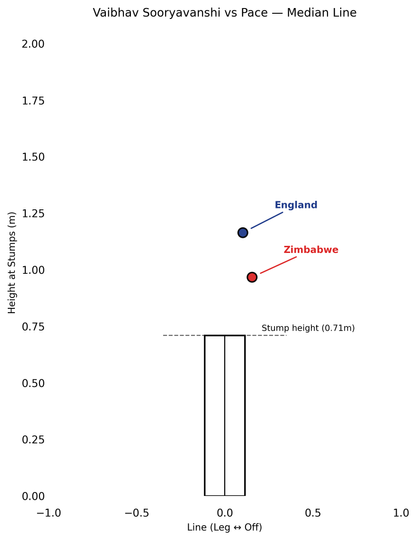 Zimbabwe bowled a bit wider to Vaibhav Sooryavanshi
Backing away and charging down the track became another recurring feature of Vaibhav's innings, forcing the Zimbabwe seamers into reactive bowling rather than allowing them to dictate terms.
From Richard Ngarava to Brad Evans, they repeatedly shifted the ball away from his body, inadvertently giving him the room to survive a few mistimed strokes. Their inability to stick to a disciplined line, along with the comparatively lower bounce than in England, ultimately worked in his favour.
Vaibhav’s quick learning ability comes to the fore
Vaibhav Sooryavanshi has always been a quick learner, with an uncanny ability to tweak his methods whenever a new challenge emerges. Throughout his short career, his growth curve has been remarkably steep.
When he first burst onto the IPL scene, fuller lengths exposed the double downswing in his bat path and the late wrist whip. Within months, though, he had lowered his backlift, kept the bat closer to his body, and largely addressed that weakness.
A similar pattern emerged in IPL 2026. Gujarat Titans arrived in Qualifier 2 with specific plans, forcing Vaibhav to bide his time before counterattacking.
Against Zimbabwe, the challenge was different again. This time, it was the back-of-a-length ball angling across him on surfaces far less forgiving than those in the IPL, and he found a way to respond.
It would have been harsh to judge him too quickly for his struggles in England. The transition from IPL pitches to English surfaces is never straightforward, with the extra bounce often proving the biggest adjustment for young batters.
Nor was Vaibhav alone in finding those conditions difficult. The scrutiny around his dismissals merely reflected the weight of expectation that already follows him.
The opening T20I in Zimbabwe was less about the half-century and more about the adjustments that shaped it. It was evidence that he had identified the problem and was already working towards a solution, even if the quality of opposition and execution differed from England.
For a batter with barely any First Class experience, Vaibhav's capacity to adapt continues to stand out. His maiden international fifty may not end up being his most memorable innings, but it could well be remembered as one of his most reassuring.
Also Read: Vaibhav Sooryavanshi Himself Reveals Reason Behind Unique Celebration
.jpg?type=mq "Akash Deep and Mukesh Kumar appointed as DSPs")