.jpg?type=hq) Fifa World Cup and Jay Shah - (Source: AFP)
Fifa World Cup and Jay Shah - (Source: AFP)
June is no less than a festival for sports lovers as India is playing against Afghanistan, and the FIFA World Cup is also underway in USA, Canada, and Mexico. It will be fair to say that fans are more inclined to football these days to witness the mega sporting event, coming once every four years.
So far, 12 matches have been played, and in every World Cup edition, FIFA introduces a new concept. This time around, too, the Gianni Infantino-led organisation introduced new developments. Interestingly, FIFA has taken inspiration from Cricket and introduced the Snickometer in the World Cup.
FIFA Introduces Cricket-Like Snickometer For World Cup 2026
On Monday, Sweden and Tunisia kickstarted their FIFA World Cup 2026 campaign, where the first glimpse of Snickometer was seen. Notably, the technology, inspired by cricket, the Snickometer, was used to see whether Sweden forward Alexander Isak touched the ball.
For the unversed, Mattias Svanberg came on the pitch in the 84th minute and scored a goal after 16 seconds, becoming the 2nd fastest goal by a substitute in World Cup history. However, the celebrations had to wait because the referee was not convinced.
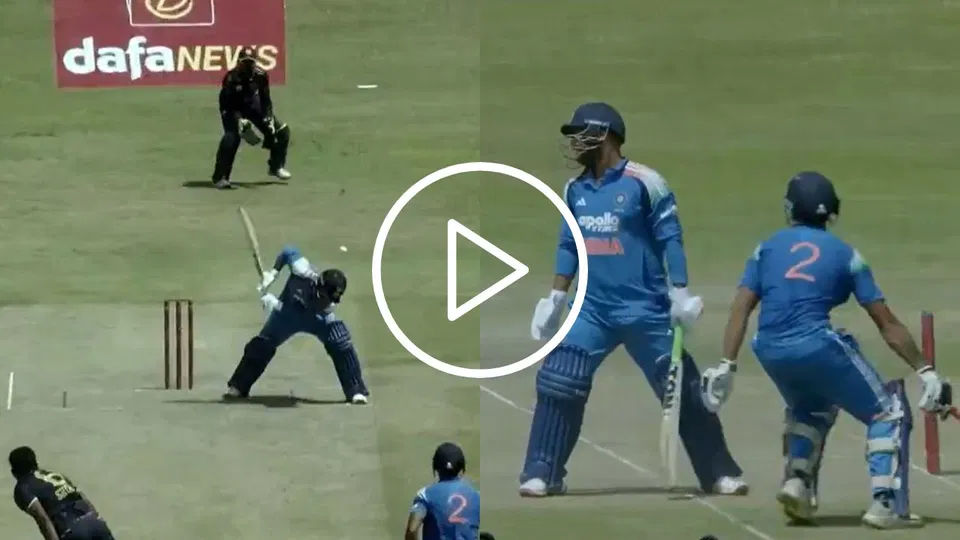
Also Read: Revealed: Why Sri Lanka Started Run Chase With 10/0 vs India A Without A Ball Bowled?
The official ruled out the goal, citing that Isak was in an offside position. It was then that the officials opted to see the snickometer, which showed that there was no touch, and the goal stood.
What Is a Snickometer Introduced by FIFA?
The snickometer (often called 'Snicko') in football refers to a graph generated for Video Assistant Referee (VAR) reviews to detect the exact moment a ball is touched. Adapted from cricket, it is first introduced during 2026 Fifa World Cup. Notably, if there is any deflection, the graph shows a spike just like cricket.
How It Works
The Motion Sensor: The official match balls contain a highly sensitive motion-sensing microchip suspended in their centre.
Data Tracking: This sensor tracks every single touch and impact on the ball 500 times a second.
The Visual Graphic: When a touch or deflection needs to be verified, the system generates a waveform graph. A flat line represents no contact, while a visible spike on the graph indicates the precise frame the ball was touched.
How is FIFA’s Snickometer different from Cricket’s Snickometer?
Cricket snickometer: Aimed at detecting faint edges when the bat touches the ball, helping umpires decide close catches or edges. It relies on audio signals from microphones near the bat-ball contact zone. The technique has a long history in cricket officiating and broadcasts.
The real time snickometer, known as Ultra-edge was introduced in 2013 when England and Australia locked horns in the Ashes.
FIFA football Snickometer-style usage: Adapted for football to resolve ambiguous build-up touches or off-ball interactions during VAR reviews.
In 2026, FIFA reportedly employed a cricket-like Snicko approach to assess whether a contact occurred in the chaotic moments around a goal, using audio-visual waveform evidence derived from the ball and event timestamps.
Also Read: India A Channel Pakistan-Type Running Disaster vs Sri Lanka

.jpg?type=mq "Why Sri Lanka will Start innings With 10/0")