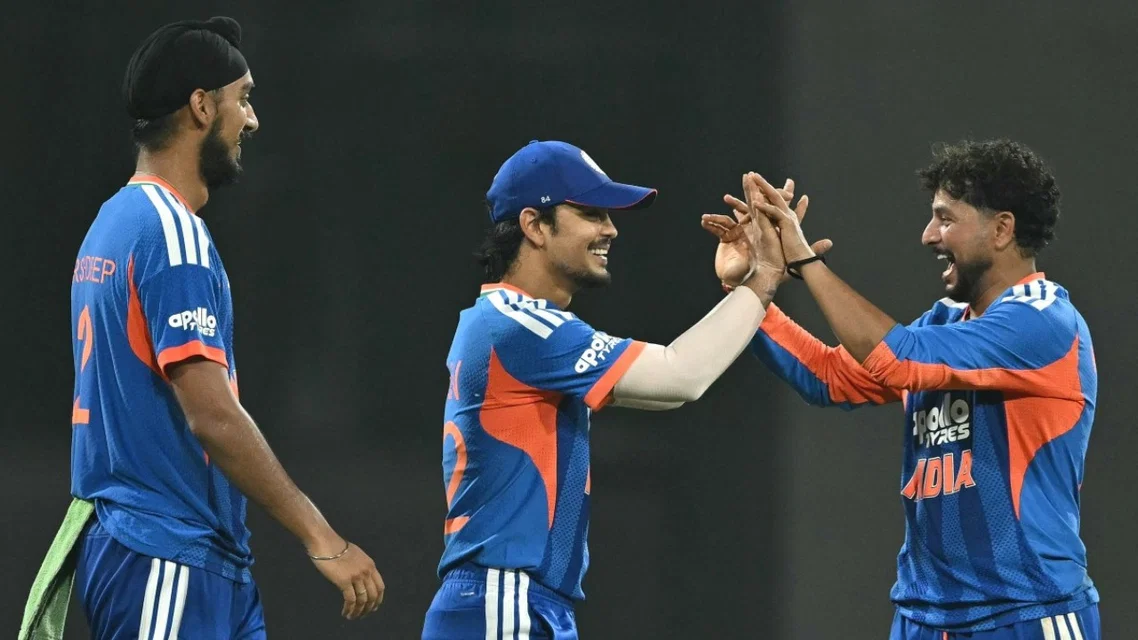
 Kuldeep Yadav should return to the XI in the final T20I. Image Credits: AFP
More than anyone, Kuldeep Yadav would want India to win. Because every time they lose, his place in the side comes under threat, regardless of his match returns or recent form with the ball.
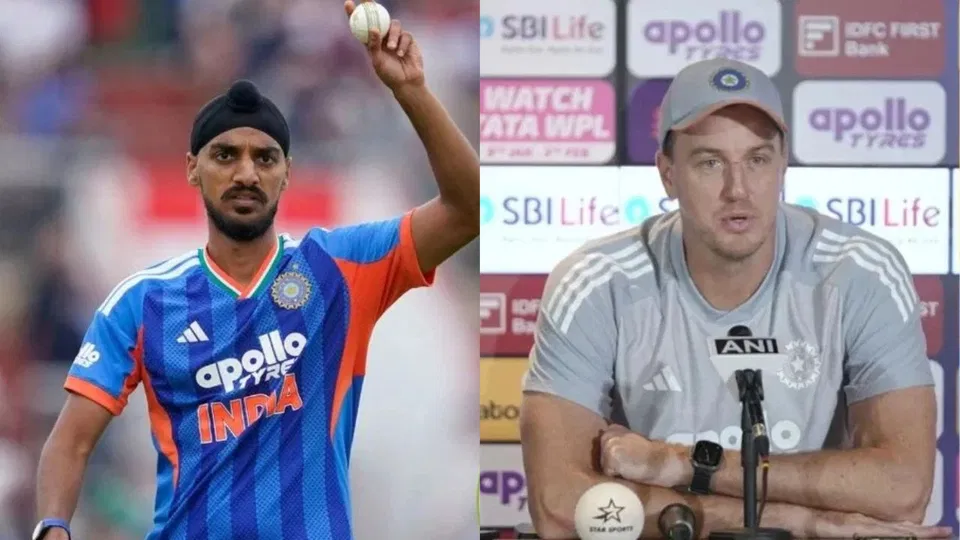
In Ranchi, every Indian bowler conceded more than 11 runs per over. All but Kuldeep went for 13 or more, with Mayank Yadav the only bowler to take wickets. Axar Patel recorded his highest economy rate in a multi-over T20I spell, while Arshdeep Singh was also taken to the cleaners.
Kuldeep, meanwhile, conceded 13.20 runs per over and dismissed a dangerous Sherfane Rutherford, who looked set to score a century. He had also created a chance off the previous delivery, but Mayank couldn't grab it. In a match that produced the second-highest aggregate in T20I history, Kuldeep could hardly be blamed.
If anything, he fared better than his figures suggest, displaying his bowling smarts at times. The dew made the ball hard to grip late in the night, but the spinner did his best and created a couple of chances. He also picked up two wickets and played a pivotal role in restricting West Indies to 171 in the first T20I in Lucknow.
Yet India dropped Kuldeep for the Indore T20I to accommodate an extra pacer, Prince Yadav. It was almost inevitable, given the pattern that has come to define the current management’s approach.
Should India have tried Kuldeep Yadav more in the West Indies T20Is?
 West Indies vs spin in 2026
India’s combinations have not been a major issue. In fact, they are finally playing the right players for the kind of combination they have relentlessly pursued. Naman Dhir is a clear upgrade over Washington Sundar, while Nitish Kumar Reddy offers more value with the ball than Shivam Dube.
Yet, amidst all this, Kuldeep Yadav has been sidelined again, presumably because he can’t bat or hit big shots. Kuldeep has his issues as a bowler and is currently far from his best in white-ball cricket. His lines have been off at times, and he hasn’t been imparting enough revs either. But there was still ample reason to persist with him.

For starters, India are without their biggest wicket-taking threat in the spin department, Varun Chakaravarthy. Ravi Bishnoi hasn’t featured in the series either, and he remains far from convincing as a specialist option. That leaves India without a wrist-spinner capable of posing a consistent wicket-taking threat in the middle overs, particularly on the flat pitches seen throughout the series.
Axar Patel has tried his best, but the pitches have hardly offered him much assistance. Naman Dhir, too, has struggled to stem the flow of runs consistently, despite producing some excellent defensive spells. India have simply not been able to take enough wickets through spin in the middle overs.
That is where Kuldeep could have offered a wicket-taking option, particularly when batters looked to attack him. In Indore, for instance, the dew never settled in, allowing Indian bowlers to grip the ball better and defend the total. Kuldeep could have enjoyed better bowling conditions than he did in the previous two games.
Similarly, the freshly laid Hyderabad pitch offered some grip in the fourth T20I. India bowled first with a relatively dry ball, and Dhir had to be taken out of the attack after conceding 19 runs in the eighth over. Had Kuldeep played, India could have rotated their fast bowlers more effectively instead of being forced to rely on extended spells from them after Dhir came under attack.
West Indies’ issues against wrist spin
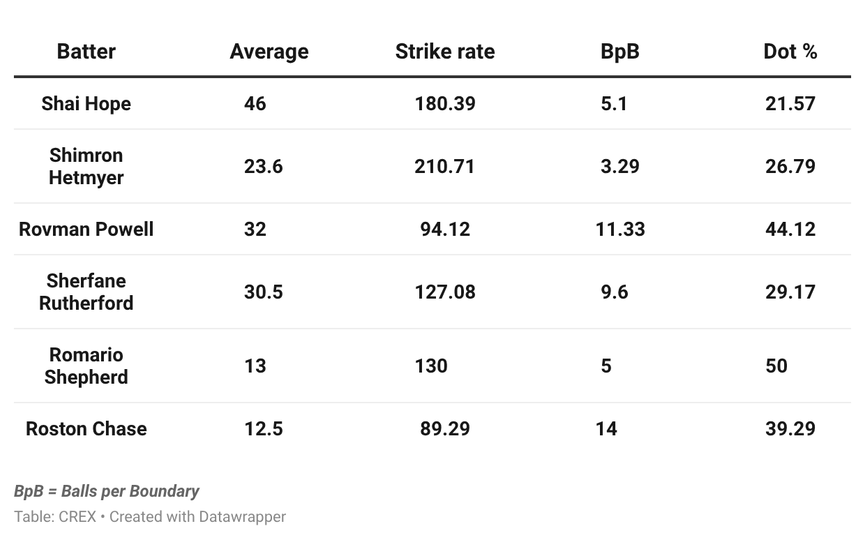 Key West Indies batters vs spin in T20Is in 2026
At the moment, West Indies have several quality players of spin throughout their batting order. Yet, they have struggled against wrist spin at times.
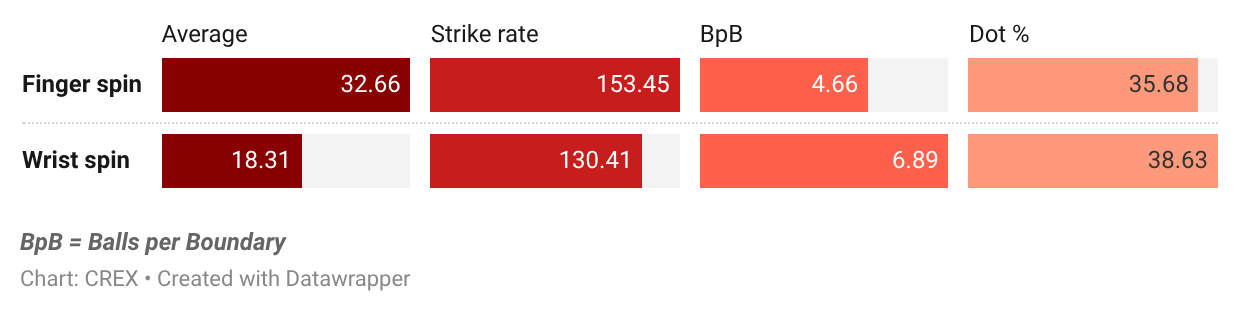
This year, they have averaged just 18.31 and struck at 130.41 against wrist spin. They have lost a wicket every 14.03 deliveries and found a boundary every 6.88 balls.
Shimron Hetmyer has struck at 210.71 but has been dismissed five times in 56 balls. Rovman Powell, meanwhile, has managed a strike rate of just 94.12 while playing 44.12% dot balls. Kuldeep himself has dismissed Powell twice in 34 deliveries.
Sherfane Rutherford has also struggled, striking at 127.08 and taking 9.60 deliveries per boundary. Roston Chase and Romario Shepherd have been underwhelming against wrist spin as well.
Kuldeep Yadav has historically enjoyed success against West Indies, often exposing their technical vulnerabilities to wrist spin. He was also the best bowler from either side in the ODI series, picking up wickets at regular intervals while remaining economical in one of the highest-scoring series in history. The West Indies batters have struggled to pick him on several occasions.
In this T20I series, West Indies have scored freely in the middle overs, particularly in the last three games. They have averaged 49.50 at a strike rate of 183.33 in this phase, hitting a boundary every 4.15 deliveries. Kuldeep has missed two of those games.
He is far from perfect, and bringing him back will not solve all of India’s problems. But with other options yet to make a convincing case in his absence, Kuldeep deserves another opportunity. He certainly did not do enough wrong in his previous outings to warrant being dropped.
In Bengaluru, India’s biggest challenge will again be to contain the West Indies batting unit if they want to win the series. Kuldeep's inclusion could provide the wicket-taking threat they have lacked in the middle overs while easing the workload and pressure on Naman Dhir. If India want to retain their batting depth, one of the pacers may have to make way.