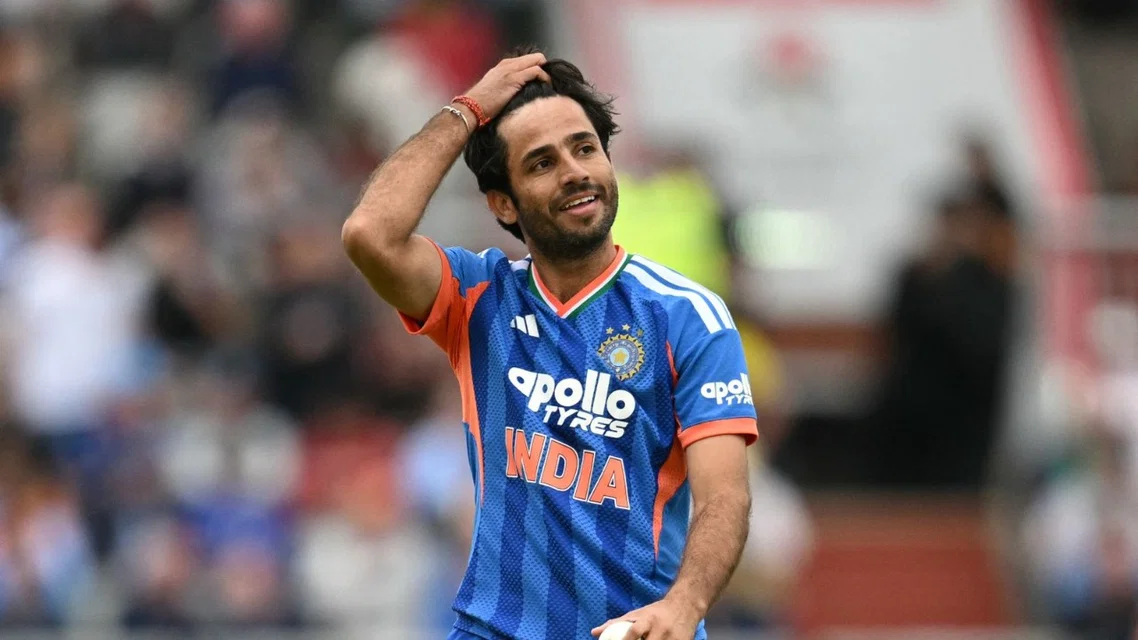
 India can't rely on Ravi Bishnoi in T20Is. Image Credits: AFP
You know India’s spin options are thin when Ravi Bishnoi continues to be picked in T20Is. The options are even scarcer in the wrist-spin department.
With Kuldeep Yadav not being at his best and other options not experienced enough, India have again chosen Bishnoi for the Afghanistan series. He is by no means a bad spinner, but there’s still plenty of work to do before he can establish himself as a truly India-worthy option.
Ravi Bishnoi’s inconsistent performances
 Ravi Bishnoi's T20 performances since IPL 2026
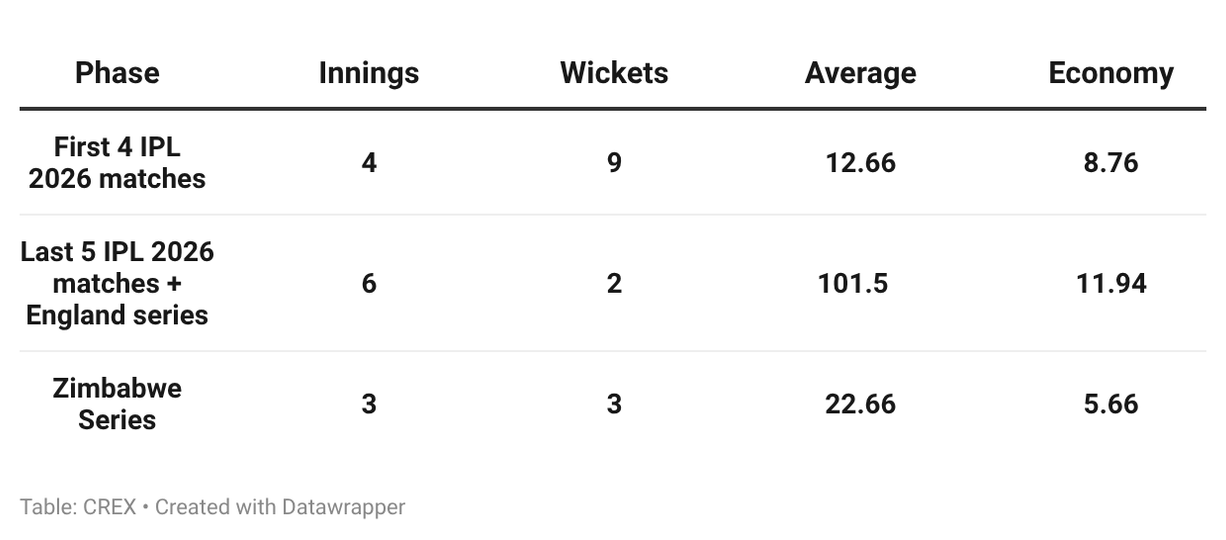
After underwhelming returns with Lucknow Super Giants (LSG), Ravi Bishnoi was picked by Rajasthan Royals ahead of IPL 2026. He started the tournament brightly, picking up nine wickets at an average of 12.66 and an economy rate of 8.76 in four innings.
However, his form fell away rather quickly. In the remaining five matches he played that season, Bishnoi managed just two wickets at an average of 71.50, while his economy rate climbed to 11.
Consequently, he was dropped midway through the season to make way for Yash Raj Punja. In his first IPL season with limited experience on Indian pitches, Punja performed reasonably well, claiming nine wickets at an average of 31 and an economy rate of 9.30 across eight innings.
Despite that, Bishnoi was surprisingly included in the T20I squad for the England tour, with Kuldeep Yadav rested. His selection was indicative of how limited India’s options are in the wrist-spin department. With no ready-made alternatives knocking on the door, they had to turn to a player who had fallen out of the scheme but offered experience at the international level.
Also Read: Undeserving Players Picked In India's T20I Squad Vs Afghanistan
That experience ultimately worked in Bishnoi’s favour, earning him an unexpected opportunity to reinforce his place in the side. Unfortunately, he made little of the chance, registering his career-worst T20I figures in Manchester before being dropped for the remainder of the series.

After an underwhelming UK tour, where his limitations came to the fore, Bishnoi was initially left out of the Zimbabwe series. However, an untimely injury to Varun Chakaravarthy opened the door for his return.
Bishnoi did reasonably well, but his performances need to be viewed in context. Zimbabwe had an inferior batting unit that has traditionally struggled against spin, while the conditions were also conducive to slow bowling. Against a much stronger England side and in the IPL, Bishnoi has shown flashes of effectiveness, but has also been easily hittable.
What went wrong for Bishnoi?
 Ravi Bishnoi lost his control over lengths after initial success
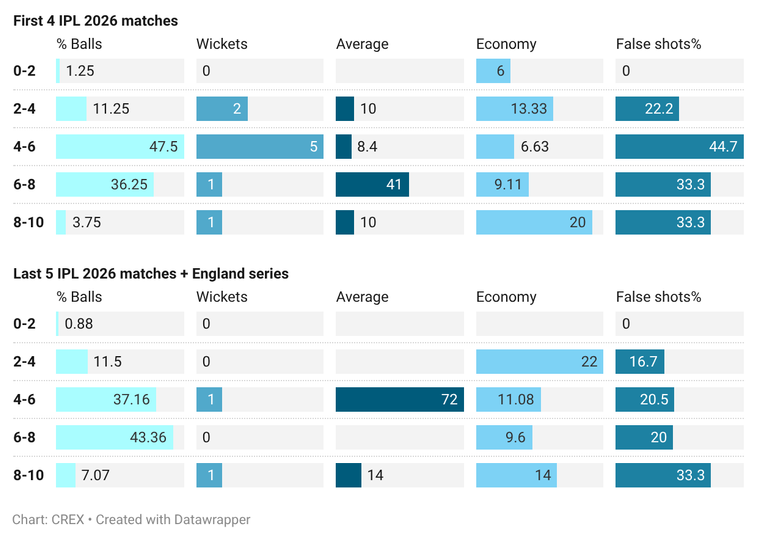
When Ravi Bishnoi started IPL 2026 on a high, he hit good lengths between 4 and 6 metres more often and found considerable success. In his first four matches, around 47.50% of his deliveries landed in this zone, yielding five wickets at 8.40 runs apiece. He also conceded only 6.63 runs per over.
He still erred on the shorter side at times, with 36.25% of his deliveries landing in that zone during this period. Those balls went for 9.11 runs per over and fetched him only one wicket. At times, though, the conditions in Guwahati worked in his favour. The black-soil surface offered lower bounce and occasional grip, allowing Bishnoi to get away with some of his errors in length.
However, as he bowled more, his lengths gradually started getting shorter. From his fifth IPL match onwards through the England tour, his good-length deliveries dropped to 37.20%. Meanwhile, 43.36% of his balls landed in the 6-8 metre zone, with another 7.07% going even fuller into the 8-10 metre range.

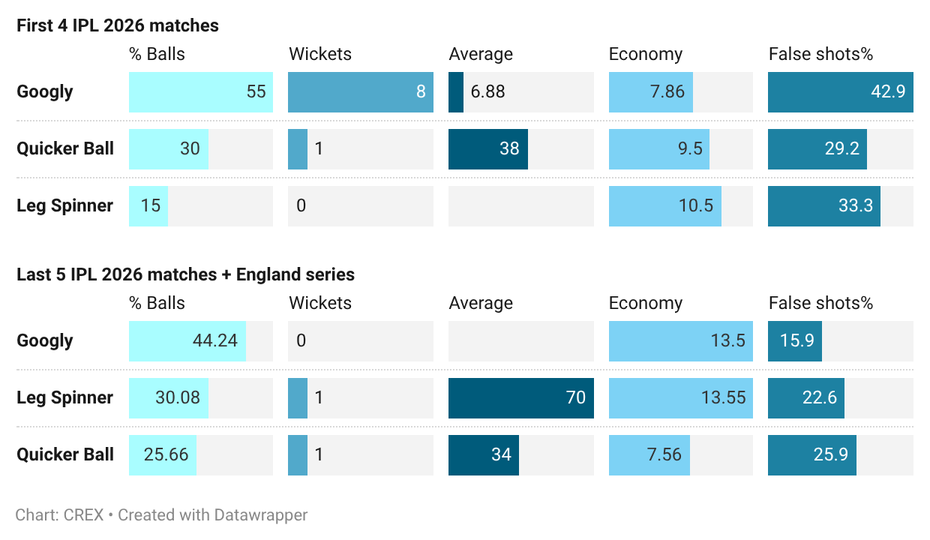
Another part of the problem was predictability. After his initial success, Bishnoi became easier to read, particularly with his variations. His googly, which had brought him considerable success early in the IPL, was eventually countered by batters. In his first four matches, he bowled around 55% googlies, picking up eight wickets at an average of 6.88 and an economy rate of 7.86.
From his fifth IPL match through the England tour, however, his googlies went for 13.50 runs per over without yielding a single wicket. Their usage consequently fell to 44.24%, while the proportion of leg-breaks increased from 15% to 30.08%. For a bowler who relies so heavily on the googly as a wicket-taking weapon, its ineffectiveness significantly reduces his threat.
Bishnoi found some rhythm again against Zimbabwe, landing 50.66% of his deliveries between 4 and 6 metres. But Zimbabwe’s batters were not adept enough to consistently force him away from his preferred lengths in Harare. His googlies, too, proved difficult to counter, largely because the batting unit struggled to deal with his variations.
Why India need to have more options beyond Ravi Bishnoi
 Ravi Bishnoi hasn't got enough success with googlies
At this stage, India have plenty of time to prepare for the 2028 T20 World Cup in Australia. But they need to develop and trial more spin options beyond Ravi Bishnoi.
Bishnoi’s career has followed a fairly predictable trajectory. After a period of poor form, he finds some rhythm, strings together a few impressive performances and looks to be back at his best. But the purple patch tends to fade rather quickly.
That has happened again in 2026. He enjoyed some success early in the IPL before going through a lean period and producing poor outings on the England tour. Yet India have continued to back him, largely because of the lack of alternatives. Kuldeep Yadav has been left out for now, while the other available spinners have retained their places.
The bigger concern with Bishnoi is his lack of control over his lengths, something that could hurt him badly in Australia. He often errs on the shorter side, and those deliveries could sit nicely for batters on Australian pitches. He is unlikely to get the same amount of grip either.
Much of Bishnoi’s success has come on surfaces offering lower bounce, where he can extract some grip and skid the ball through. He does not naturally generate a great deal of bounce, and that pattern is evident in his IPL career as well.
When the pitches in Lucknow were low and offered substantial grip, Bishnoi was one of LSG’s biggest weapons and picked up wickets consistently. But as the surfaces became flatter from 2024 onwards, his effectiveness declined. A similar pattern emerged in Jaipur, where the pitches offered truer bounce rather than the low, skiddy conditions that suit him.
There is also a limitation in how much he turns his leg-breaks. Bishnoi has increasingly relied on pace and a flatter trajectory to beat batters, with his high release speed creating an unusual angle.
But once batters become accustomed to that pace and trajectory, his threat diminishes. His googly then becomes easier to target, while the lack of turn on his leg-break means he has little else with which to control the flow of runs.
He has also been put under pressure relatively easily through early aggression in his spells. Once batters attack him and find a few boundaries, he often appears to run out of options. That is concerning for someone who is supposed to be a lead spinner, especially when he is not even a consistent presence in the IPL.
India’s wicket-taking options are limited as it is, particularly with Varun Chakaravarthy losing some of his mystery factor and Kuldeep Yadav struggling for consistency in recent times. That makes it even more important to build a stronger pool of spinners before the next major tournament.
Bishnoi can still be part of that process, but with two years to go before the T20 World Cup in Australia, India need to find alternatives. Bishnoi alone cannot be trusted to solve their spin problem, particularly in conditions that may expose his limitations.
Also Read: Full List Of Changes In India Squad for Afghanistan T20Is Compared To Zimbabwe Tour