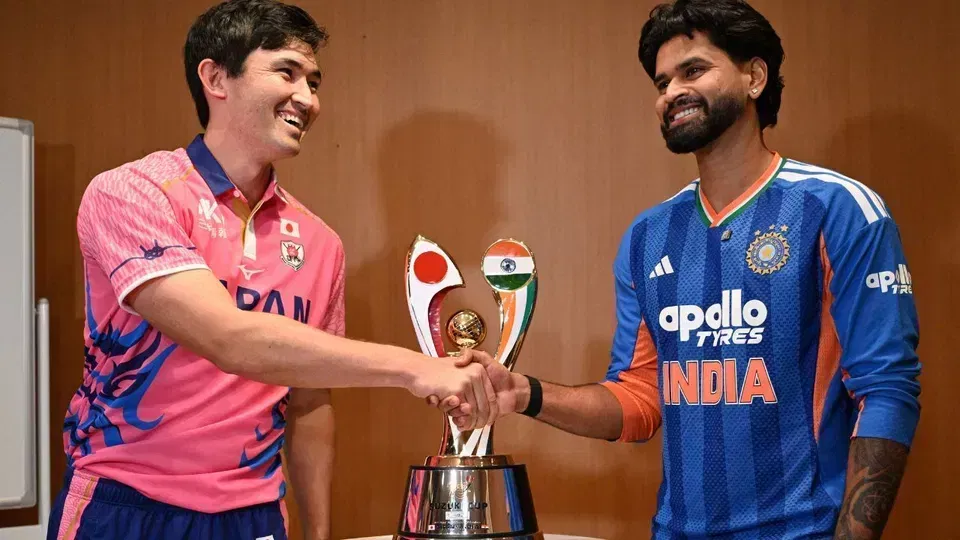
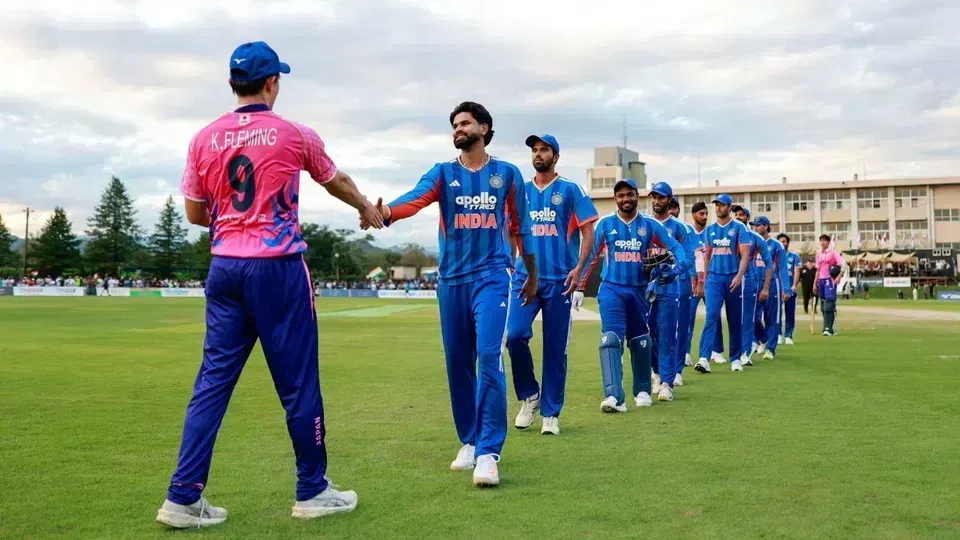
India struggled to get going against Japan. Image Credits: BCCIJapan gave India a scare on a lottery of a pitch, making for a surprisingly even contest in treacherous conditions. One way for an inferior side to stay competitive against a stronger opponent is to prepare bowling-friendly pitches and make batting as difficult as possible. Against India, that approach can be even more effective, given how accustomed they are to playing on out-and-out flat decks at home.It is why they can find themselves in trouble whenever the conditions become even slightly tricky for their hard hitters. Their series defeats in Ireland and England were cases in point. Japan, the 41st-ranked T20I side, exposed the same vulnerability, pushing India far closer to the edge than they would have expected.How Japan suffocated India with precise planningWhile the pitch was obviously not up to the mark in Sano, Japan certainly left no stone unturned in their preparations. More importantly, they executed their plans almost immediately.With Sanju Samson taking strike first up, Japan brought on left-arm spinner Charlie Hara-Hinze, who naturally takes the ball away from right-handers. He got plenty of drift and grip off the surface and, as it turned out, dismissed Abhishek Sharma with the first ball he bowled.When Ishan Kishan came on strike in the third over, Japan opted not to give Charlie his second over and instead turned to off-spinner Benjamin Ito-Davis. The idea was the same: take the ball away from the batters and force them to play either against the turn or towards the fielders.Charlie eventually returned for the final over, by which point Tilak Varma and Shreyas Iyer were at the crease. Against Iyer, he was the obvious choice to take the ball away, while Tilak, despite being a left-hander, has shown vulnerabilities against spin of all kinds. Charlie was therefore the safer option than the off-spinner, Benjamin, who had already done his job by dismissing Kishan earlier in the innings.Also Read: Axar Patel, Shreyas Iyer Get Wide Overturned vs Japan! What Do ICC Rules Say?Japan were equally sharp with their field placements. When Samson faced Ibrahim Takahashi in the second over, they stationed a deep midwicket and long-on as the bowler turned the ball into him. The setup paid off on consecutive deliveries: first, the long-on fielder prevented a boundary down the ground with a magnificent effort, before Samson could only get a thick edge on the next ball that flew straight to the fielder at deep midwicket.They employed a similar setup in the final over, with a deep extra cover and deep point in place as Charlie turned the ball away from Iyer. Iyer was looking to play late and use the turn, but after surviving an earlier scare, he eventually picked out the fielder at deep extra cover.Perhaps the biggest indicator of Japan's preparation, though, was how rarely they left anything to chance. Whenever the ball went high, there was almost always a fielder underneath it. That speaks a lot about their planning.The stock balls on wider linesLines bowled by Japan against India in SanoJapan used only spin against India, but more importantly, their spinners consistently bowled wider of the stumps. They rarely went into the batters’ arc on a tacky pitch where clean strokeplay was difficult, and when they did bowl wider, they hardly ever rushed the batters with quicker deliveries.Instead, they flighted the ball to extract as much turn as possible, while the wider lines made it even harder to generate enough power to find the boundary. As many as 81.25% of their deliveries were either outside off stump or even wider, and those balls accounted for three wickets and 62.50% of false shots.When they did flatten their trajectory, however, Japan’s spinners changed their lines and attacked the batters’ legs. Abhishek Sharma’s dismissal was a perfect example. As soon as he came to the crease, Charlie Hara-Hinze went over the wicket and fired one into his legs.Abhishek Sharma still went for the sweep, staying slightly low to play the shot, but could only top-edge it. The ball flew towards short fine leg, where the fielder had to run back and complete a fine catch.Watch the video below:FanCode @FanCode Yeh kya hogaya?! 🤯 Stream Japan v India T20I LIVE on FanCode 📲 #JPNvIND Sep 22, 2026, 1:31 PM Benjamin Ito-Davis used a similar approach in the third over, bowling a couple of flatter arm balls that created LBW opportunities in the space of five balls. The one to Kishan looked particularly close, but Japan had no reviews to challenge the decision.For the most part, then, Japan’s spinners stuck to their stock deliveries: flighted balls bowled wide of the stumps, designed to turn sharply and induce mistimed shots. Whenever they flattened the trajectory, they went the other way, cramping the batters for room and using the angle to bring LBW into play. India tried a variety of options, but very little worked in conditions that clearly left their batters uncomfortable.India’s inability on non-flat surfaces came to the fore againIndia might have made a jailbreak against Japan, but their repeated struggles on pitches that offer something more than the flat surfaces they are accustomed to at home will be a source of frustration. And this is hardly a recent development.When India began their T20 World Cup 2026 campaign against the USA at the Wankhede Stadium, they were reduced to 77/6 on a surface that offered some grip to the spinners. It took a Suryakumar Yadav special to pull them out of trouble.There were even reports that India were unhappy with the pitch and had complained to the officials. Later, Netherlands’ Aryan Dutt also unsettled their batters with tight lines before Shivam Dube once again came to their rescue.Things reached a new low when Ireland clean-swept India in Belfast in their first assignment after their T20 World Cup 2026 triumph. The pitches offered movement for the pacers and spongy bounce, conditions that proved difficult for Indian batters coming straight from the flat surfaces of IPL 2026.Also Read: Who Was India’s Captain In 1st, 50th, 100th, 150th, And 200th T20I Wins?The lack of pace off the pitch made it difficult for them to control their downswing or play late against the spongy bounce. Ireland were also smart enough to force them to play square of the wicket, towards the longer boundaries.The pitches and dimensions were a world away from what India typically encounter at home, and their horizontal-bat shots became increasingly difficult to execute. With little pace coming off the surface, the batters were forced to generate most of it themselves.England presented another challenge. Against a superior pace attack, India encountered surfaces with more pace and movement upfront, along with extra bounce. Jofra Archer and Josh Tongue repeatedly hit the deck hard and used shorter lengths to unsettle the batters.India averaged just 17 and lost 14 wickets at 11 balls apiece on lengths shorter than eight metres against pacers in that series. They also played around 38.96% dot balls on those lengths. Most of their batters struggled to ride the bounce and were repeatedly exposed by the combination of high pace and steep bounce.Star Sports @StarSportsIndia IT WENT DOWN TO THE FINAL BALL! 🤯 #TeamIndia hold their nerve to seal a thrilling 2-run win over Japan! 💪 #JPNvIND #SuzukiCup Sep 22, 2026, 2:24 PM Now Japan have pushed them into another uncomfortable situation, albeit in a five-over game that left little time to adapt. But that cannot completely excuse India. As world champions, they are expected to find ways to adjust to different conditions, especially against a team like Japan, who were playing their first game against a Full Member nation.The pattern is becoming increasingly difficult to ignore. Teams can make India vulnerable by taking them away from the flat surfaces where their batters can play through the line with confidence.When the pitch takes pace away, offers movement or produces awkward bounce, India have repeatedly struggled to find a reliable scoring method. That is an issue they can no longer afford to overlook.Also Read: Who Is Charlie Hinze, Japan’s 17-Year-Old Sensation Who Got Abhishek Sharma, Shreyas Iyer Out?