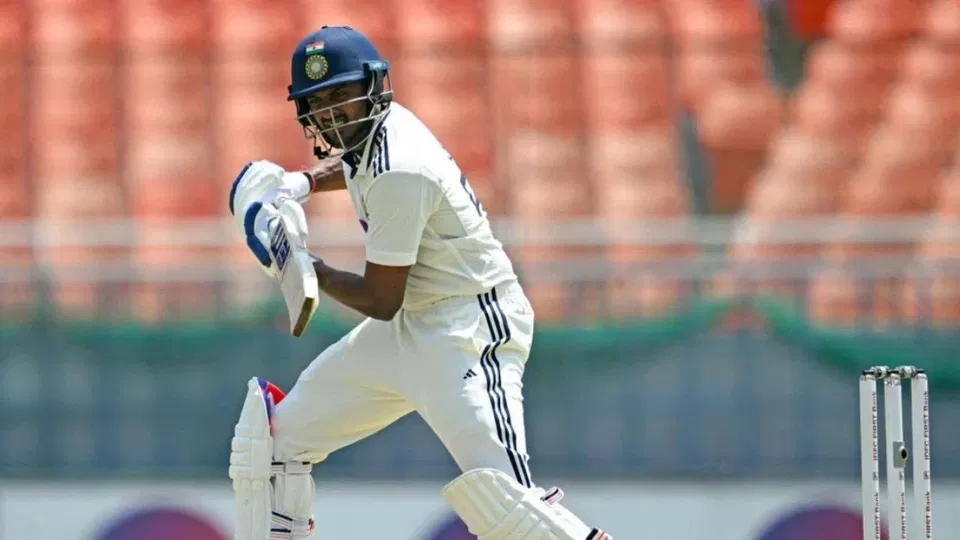
Ravindra Jadeja was below par with the ball in Sri Lanka. Image Credits: AFPRavindra Jadeja is an interesting case in Tests. At this stage, he’s more of a batting all-rounder, with runs all over the world. As a bowler, however, his returns have been limited for a while now.After Ravichandran Ashwin’s retirement, Jadeja was supposed to carry the bowling burden in a team in transition. Washington Sundar is still learning bowling tricks to sustain in longer spells, while Kuldeep Yadav has not been trusted enough in this format. Manav Suthar has made a bright start, but he’s still only three Tests old, and Saransh Jain has just made his Test debut and has his issues.Ravindra Jadeja ends with a below-par Sri Lanka tourRavindra Jadeja started the Sri Lanka tour on a bright note, producing a tempting spell in the first innings in Galle. He tested both edges, attacked the stumps and varied his position on the crease to keep the batters guessing. Three wickets followed, and he appeared set for a fruitful series.However, his impact diminished as the series progressed. Jadeja continued to do a fine job of containing the scoring, finishing with the second-best economy rate (2.60), but the wickets did not come as consistently. Despite bowling the second-most overs in the series, he managed only eight wickets at 33.38 apiece across four innings.Sony Sports Network @SonySportsNetwk Jadeja finds the edge, Jurel snaps up a sharp one.👌 Sri Lanka are now 8 down! Watch #SLvIND, 2nd Test, LIVE NOW on Sony Sports Network TV channels & Sony LIV. #SonySportsNetwork #SonyLIV #BeautifulGameOfTestCricket Aug 27, 2026, 2:35 PM Even Prabath Jayasuriya, who was nowhere close to his best, finished with more wickets at a better average than Jadeja. The Indian left-armer was given plenty of opportunity, bowling deep into the innings and often against the lower-order batters; around 44.39% of his deliveries were to No.7 or below. Yet even then, he struggled to make consistent inroads, going through spells without creating enough threat.Also Read: The Precision Behind Sonal Dinusha’s MethodsOn pitches where the spinners did not get enough grip, Jadeja’s limitations with the ball became even more apparent. His conventional methods were less effective, and as the series wore on, the batters grew increasingly comfortable playing him out. India definitely needed more wickets from their premier spinner, particularly once Manav Suthar’s threat was blunted through deliberate attacking, and Saransh Jain looked listless late in the second Test.The inability to hit consistent lengthsFoot split of LHBs vs Ravindra Jadeja in SL vs IND seriesRavindra Jadeja has always been a bowler of supreme accuracy, with his ability to hit immaculate lengths being one of his biggest strengths. In Sri Lanka, however, he found it harder to hit his spots consistently. On pitches that required him to shift from the traditional 4-6 metre range to a slightly fuller 3-5 metre length, Jadeja struggled to make that adjustment regularly.Overall, he landed just 58.94% of his deliveries between 3 and 5 metres, the lowest among all spinners with at least 100 balls on either side. Yet this was also the length that brought him most of his success. Seven of his eight wickets came in this range, at 19.71 runs apiece, while he generated false shots on 25.14% of deliveries.Jadeja, though, erred on the shorter side more often, with 37.04% of his deliveries landing between 5 and 7 metres. That length brought him just one wicket, at an average of 112, while costing him three runs per over. False shots also dropped to 18.25%.Median Line of each spinner vs RHBs in SL vs IND Test seriesLeft-hand batters, in particular, were able to neutralise his threat with relative ease. Jadeja took only three wickets against them at an average of 53, while generating false shots on just 19.52% of deliveries. He was also considerably more expensive against LHBs, conceding at 3.31 an over compared to just 1.98 against RHBs.Jadeja was fractionally shorter against the southpaws, but in many ways, he was forced into bowling that way. Whenever he hit a good length, left-hand batters were willing to use their feet, doing so on 19.73% of deliveries to turn good-length balls into half-volleys. That naturally encouraged Jadeja to shorten his length to avoid being hit down the ground, but in doing so, he gave batters greater access to their back-foot scoring options.At one stage in Galle, Sonal Dinusha came down the track to a good-length delivery and whipped it over midwicket for a boundary before sweeping a fuller ball for a couple. Jadeja was subsequently forced to shorten his length, allowing Dinusha to comfortably rock back and work the ball towards the on-side with his strong wrists.The sequence was repeated several times. Not every instance resulted in a boundary, but aggressive use of feet forced Jadeja to keep changing his lengths and searching for alternative ways to create a threat.He was also a tad too straight against the left-handers, frequently drifting down during the series. One possible reason for those lines could be an attempt to curb the sweep, a shot that is difficult to execute when the ball is closer to the stumps.Median Line of each spinner vs LHBs in SL vs IND Test seriesHowever, Jadeja sometimes overdid it, to the point where his natural angle actually made sweeping easier. That, too, may have been a consequence of how heavily the Sri Lankan left-handers relied on the shot.The tour was always going to be challenging for Jadeja, given that he does not have the ideal pace variations to exploit Sri Lankan conditions. But his struggles extended beyond speed.He failed to consistently find the right lengths despite bowling considerably more and for longer spells than most of his fellow spinners. On pitches offering slow turn and limited grip, his stock deliveries lost much of their effectiveness, exposing how heavily his threat depends on his ability to hit the right areas ball after ball.Recent trends and the need for better bowling returns from JadejaGood-length balls in each series in Asia since 2023It is difficult to say whether this points to a genuine pattern, but Ravindra Jadeja has not been among the most accurate spinners for some time now. Against the West Indies last year, he landed 66.27% of his deliveries in the traditional 4-6 metre range, behind Khary Pierre (72.57%) and Washington Sundar (67.39%).The trend continued in the South Africa series, where Jadeja again ranked behind three spinners, with 69.67% of his deliveries landing in this zone. Axar Patel (78.33%) and Washington Sundar (75.77%) were more consistent from India, while South Africa’s Keshav Maharaj (70.25%) also edged ahead of him.And now, against Sri Lanka, the numbers dipped even further. With the ideal length shifting to 3-5 metres, Jadeja landed just 58.94% of his deliveries in that zone, the lowest among all spinners from either side, as mentioned earlier.Jadeja is still doing a reasonably good job with the ball, but his recent returns have fallen short of the standards he has set for himself. Batters have increasingly found ways to put him under pressure and take him out of the game. When West Indies followed on in Delhi last year, Jadeja bowled 33 overs for just one wicket, which came only after John Campbell had raced to a terrific century. Even against South Africa, Simon Harmer outbowled him on rank turners in Kolkata and Guwahati.Sony Sports Network @SonySportsNetwk Ravindra Jadeja gets one to turn sharply as #TeamIndia hunt for wickets. 😮💨 Watch #SLvIND, 2nd Test, LIVE NOW on Sony Sports Network TV channels & Sony LIV. #SonySportsNetwork #SonyLIV #BeautifulGameOfTestCricket Aug 27, 2026, 10:45 AM Manav Suthar has begun his Test career on a bright note and could eventually develop into the kind of attacking option Ravichandran Ashwin provided India for several years. But despite his talent and superior variations, he still has plenty to learn. His inability to create enough chances with a softer ball became apparent in the Sri Lanka series and ultimately played a part in India being unable to force a result in Colombo.That makes Jadeja’s role even more important. He needs to step up more consistently with the ball, not merely by controlling the scoring but by creating breakthroughs. He is now the senior bowler in this spin setup, and India cannot afford him to act as a secondary threat.The challenge will become even greater with the Border-Gavaskar Trophy at home next year. Jadeja will need to find his lengths more consistently and make regular inroads against Australia’s stronger batting unit. In favourable home conditions, his batting will remain a major asset, but it may not be enough on its own to compensate if his bowling continues to fall below his lofty standards.Also Read: Suryakumar Yadav Reveals Why He Lost His Cool With Kuldeep Yadav