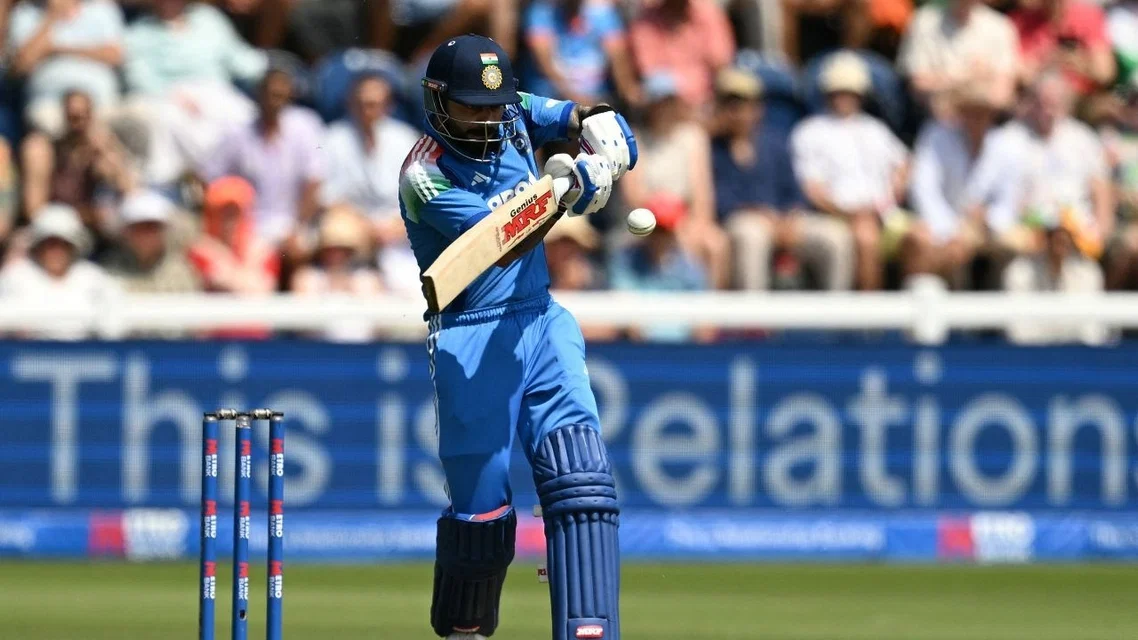
 Virat Kohli has shown a new dimension to his ODI game. Image Credits: AFP
It’s not hard to understand why Virat Kohli has been so successful in ODIs all these years. Few, if any, have paced an innings better than him.
At this stage of his career, his game is so refined that muscle memory seems enough to help him score more consistently than most batters in the format. Yet, Kohli has found another way to evolve, unveiling a different version of himself in recent times.
Virat Kohli’s renewed early intent
Since the ODI series against South Africa last year, Virat Kohli has shown a clear shift in intent at the start of his innings. Rather than easing himself in, he has looked to seize the initiative immediately, putting bowlers under pressure from the outset.
The numbers reflect that change. Across eight innings since the South Africa series, Kohli has struck at 93.69 in the first 15 balls of his innings while requiring only 6.93 deliveries for every boundary. His dot-ball percentage has also dropped to just 54.95%.
Between 2024 and the ODI rubber against South Africa, Kohli managed a strike rate of just 67.31 in the first 15 balls of his innings. He found boundaries much less frequently and spent far more deliveries without scoring.
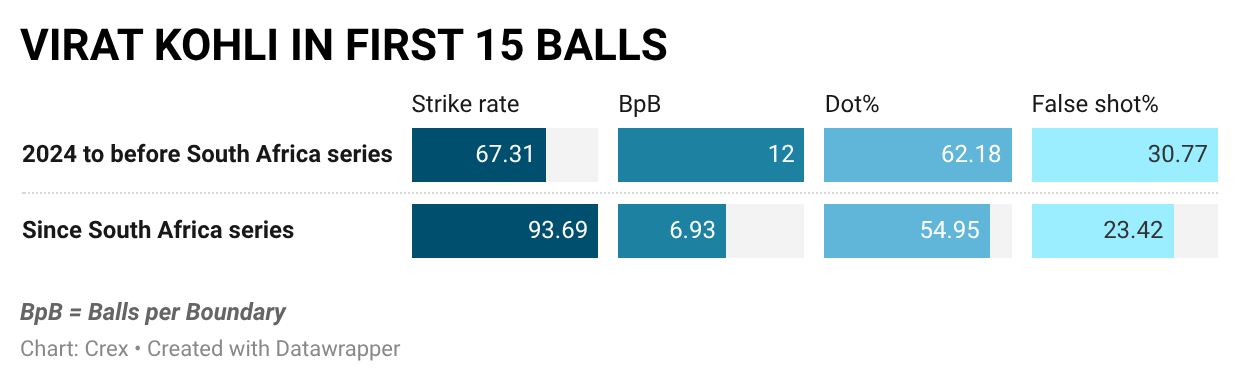 Virat Kohli starts a lot quicker in ODIs now
The improvement stems from a noticeable change in approach. Kohli has increased his share of attacking shots in the first 15 balls of his innings from 37.82% to 51.35% across the two periods.
More importantly, those attacking shots have become increasingly effective. Kohli now scores at a strike rate of 138.60 and hits a boundary every 4.07 deliveries when playing attacking shots, compared to a strike rate of 120.34 and a boundary every 5.36 deliveries previously.
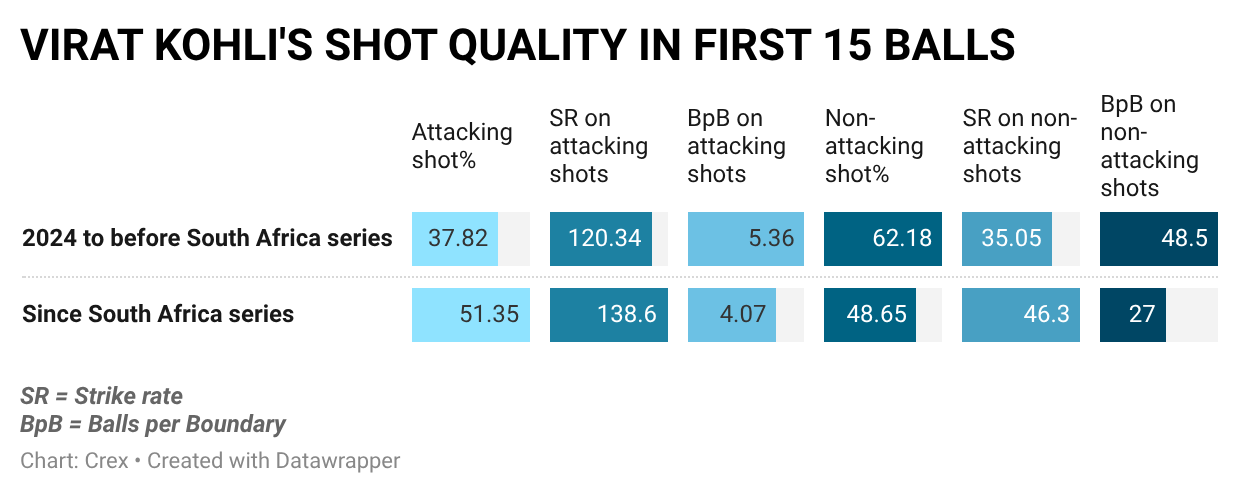 Virat Kohli now plays more attacking shots early in the innings
The most recent game in Cardiff perfectly illustrated that shift. On a two-paced surface, Gus Atkinson had already given England an early breakthrough before Kohli walked in the eighth over.
Rather than settling in, he immediately took on the fast bowler, striking him for two boundaries and finishing with three in his first 15 deliveries. On a surface where caution would have been understandable, Kohli once again demonstrated that his fresh default approach is to seize the initiative rather than ease himself into the innings.
Perhaps the most impressive aspect of Kohli's transformation is that the added aggression has not come at the expense of control. Despite taking considerably more risks early in his innings, his false shots have fallen from 30.77% to just 23.42%. He is not only attacking more often but also doing so with greater precision.
The bigger gains against pace
While Virat Kohli has shown a clear shift in intent early in the innings, the change is even more pronounced against pace. His willingness to take on pace from the outset has become a defining feature of this transformation.
Also Read: Virat Kohli Predicted To Follow Rohit Sharma In ODI Retirement
Against pace in the first 15 balls, Kohli's strike rate has jumped from 68 to 110.39. His balls-per-boundary ratio has improved from 10 to 4.81, while his dot balls have dropped from 68% to 59.74%.
Good-length deliveries, often a pacer's go-to length early in an innings, have been treated far more aggressively. Kohli's strike rate on these lengths in the first 15 balls has risen from 54.55 to 89.47, while his balls-per-boundary ratio has improved from 15.40 to 5.70.
The share of attacking shots has also risen from 28.57% to 43.86%, while false shots have fallen from 29.87% to 19.30%. Meanwhile, Kohli has also improved his strike rate against back-of-a-length deliveries from 80 to 107.69.
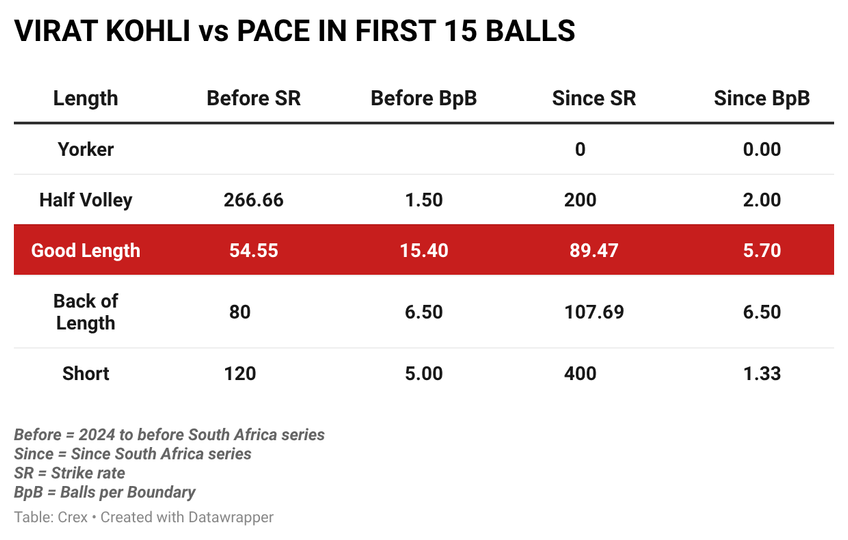 Virat Kohli has found a new way to tackle good-length deliveries vs pace
Take the Vadodara ODI against New Zealand earlier this year, for instance. When Virat Kohli walked in at 39/1 in the ninth over, Shubman Gill was yet to find his rhythm, managing just 10 runs off 23 deliveries.
Kohli immediately put his foot on the accelerator, striking two boundaries off Zakary Foulkes in the final over of the powerplay before adding two more against Kristian Clarke in the 12th. The burst of intent eased the pressure on Gill, who went on to score a vital 56 as the pair added 118 runs for the second wicket.
Even against spin, Kohli has consistently looked to attack more deliveries, with his share of attacking shots rising from 44.64% to 64.71%. The returns have not been as dramatic as against the pace, but the change in mindset is equally clear.
What prompted Virat Kohli's change in approach
There could be multiple reasons why Virat Kohli has altered his tried-and-tested method at this stage of his career. One of them could be how his early struggles came to the fore in challenging conditions in Sri Lanka and Australia.
He consistently registered low scores in both series and looked vulnerable early in his innings. While spin exposed him in Sri Lanka, pace created problems in Australia.
Taking them on gives Kohli a better chance to disrupt the bowlers' rhythm and force them out of their comfort zone on tricky decks. On a surface like Cardiff, where caution could easily have resulted in another low score, that proactive approach helped Kohli score 65 runs at a strike rate of 98.48.

For a World Cup in South Africa, this method could become more rewarding because bowlers are likely to find help at various stages. From pace-friendly surfaces in Johannesburg to slower ones in Paarl and several venues across Namibia and Zimbabwe, the challenges will vary significantly from game to game.
Secondly, Rohit Sharma has moved back towards his traditional approach of absorbing pressure early before accelerating later, but the transition has not always been smooth. For much of his recent ODI career, he was the aggressor at the top, maximising the powerplay and allowing the batters around him to settle into longer innings.
Someone still needs to play that aggressor role, and Kohli has often found himself in that position after early wickets have left India needing a shift in momentum. That has required him to take on a more proactive role early in the innings, something his exceptional control and range of shots allow him to do without compromising his consistency.

He has still hit three fifties and as many centuries in eight outings. The difference is that he has done so at a much quicker pace, with his strike rate rising to 109.67.
At this stage of his career, Virat Kohli also has the luxury of playing a more aggressive role because India possess several high-quality ODI batters around him. Shubman Gill has established himself as one of the format's most consistent performers, while Shreyas Iyer and KL Rahul have also been reliable middle-order contributors.
Either way, Virat Kohli has unveiled a new dimension to his ODI game just when we thought we had seen it all. And perhaps that is the perfect reflection of his greatness in this format.
Also Read: India's Record At Lord's Ahead Of IND Vs ENG 3rd ODI, 2026

.jpg?type=mq "Players Who Might Retire before 2027 ODI World Cup")