







 Image Credits: AFP
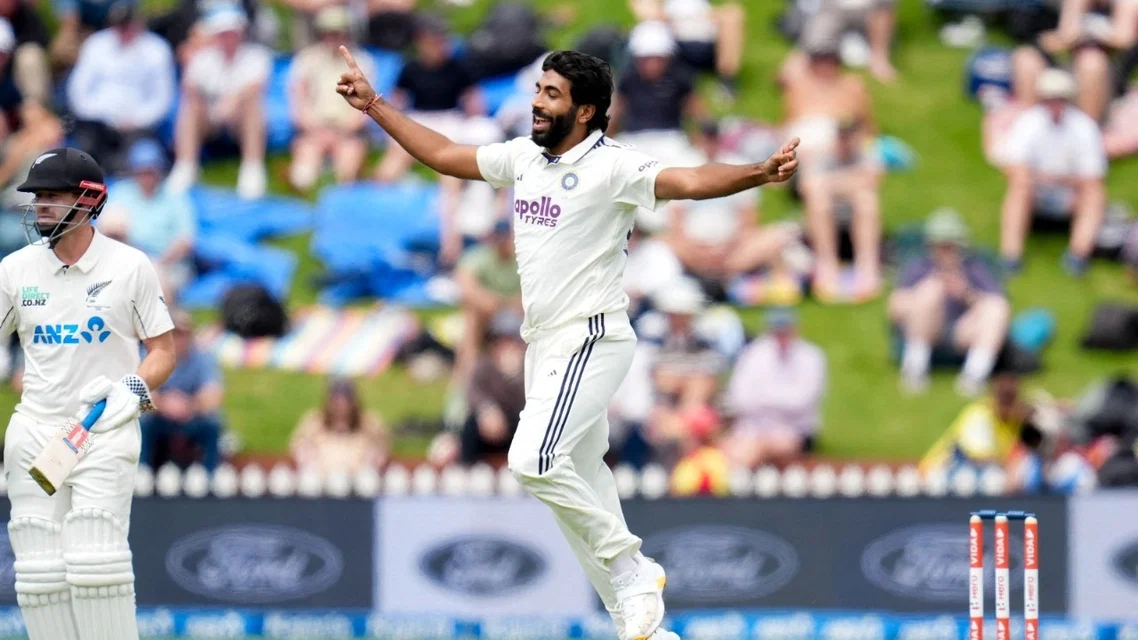
Jasprit Bumrah was playing a Test after nearly a year. He was still expected to perform at his peak, and he delivered. In one sense, the first day unfolded almost as anticipated after India won the toss.
Mohammed Siraj’s exclusion was also expected after Shubman Gill’s press conference. So were its after-effects. India got off to a perfect start, but that was down to a fair bit of luck and a certain Jasprit Bumrah.
India’s expected problems and Jasprit Bumrah’s heavy lifting
India’s pace attack was always going to rely more heavily on Jasprit Bumrah after they omitted Mohammed Siraj. Bumrah started with a magnificent delivery, and Tom Latham decided to shoulder arms, only to see his stumps rattled. The other Indian seamers, however, consistently erred on their lengths, bowling a fraction short.
With some bounce and early moisture, the 5-7 metre length is typically a good length on these pitches, where new-ball wickets are imperative. While Bumrah landed 70% of his deliveries in this good-length area, Kamboj (56.76%) and Akash (38.89%) consistently missed their marks in the first 15 overs. Even Prasidh Krishna was short while also being a tad erratic with his lines.
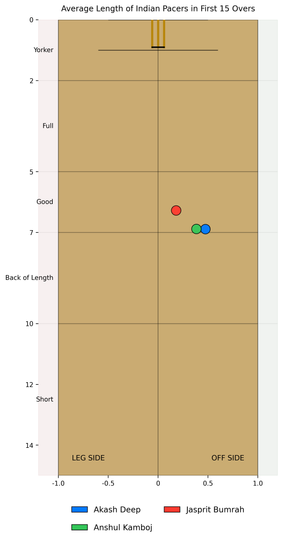 Akash Deep and Anshul Kamboj bowled shorter lengths with the new ball
The bigger issue, however, was the attributes and natural lengths. Anshul Kamboj and Akash Deep aren't express quick, so batters have enough time to work them out whenever they bowl even slightly shorter.
Their margin for error is significantly lower than Bumrah's, whose natural pace and zip help him make shorter lengths effective.
Some of this was expected, particularly with Akash Deep, whose natural lengths are traditionally better suited to subcontinental pitches.
He thrives on low-bounce surfaces, keeping his lines straight, and his deliveries skid on from hard lengths. On higher-bounce pitches, his lack of pace also means his fuller deliveries can become a tad too floaty without enough zip.
In the eighth over, Henry Nicholls initially played a slightly shorter delivery from Anshul Kamboj off the front foot before immediately shifting to the back foot as Kamboj continued to bowl short. He hit a boundary off the fourth delivery.
When Akash Deep came into the attack from the same end two overs later, he started with a floaty fuller delivery that Nicholls drove easily. A predictable shorter delivery was then nudged off the back foot.
Apart from Bumrah, no other pacer consistently threatened the stumps, which was important given the seam movement wasn't particularly pronounced.
As a result, New Zealand's batters weren't forced to play at every delivery. While they left just 16.66% of deliveries against Bumrah, they were able to leave 46.66% of deliveries from the other pacers with the new ball.
Poor shots allowed India to take the advantage despite improper lengths
At one stage, India looked to have squandered the advantage of winning the toss, despite taking two early wickets. However, a couple of poor shots from New Zealand's batters gave them an opening just before Lunch. Rachin Ravindra, in particular, showed a Jaiswal-esque flaw with his cut shot.
On a back-of-a-length delivery that was also slightly wide, Rachin had every reason to go for the cut. But he failed to get close to the line of the ball and instead threw his hands at it, failing to get it off the middle of the bat. Moreover, the early moisture had dried out, making the pitch a tad quicker and bouncier than when he had first walked in.

Daryl Mitchell, meanwhile, looked to move forward almost immediately, even though there was little to no lateral movement to counter.
India had a forward short leg in place, and Bumrah deliberately angled the ball into the batter and shortened his lengths since the movement was nearly gone. Mitchell played with hard hands and gave Yashasvi Jaiswal a catch at short leg.
Both wickets came pretty much against the run of play. India's bowling attack had started to look shallow, with seam movement almost diminishing.
Their bowlers, barring Bumrah, of course, created hardly any substantial chances after their initial success, but New Zealand's batters handed them two crucial breakthroughs.
Mohammed Siraj’s absence came to haunt India
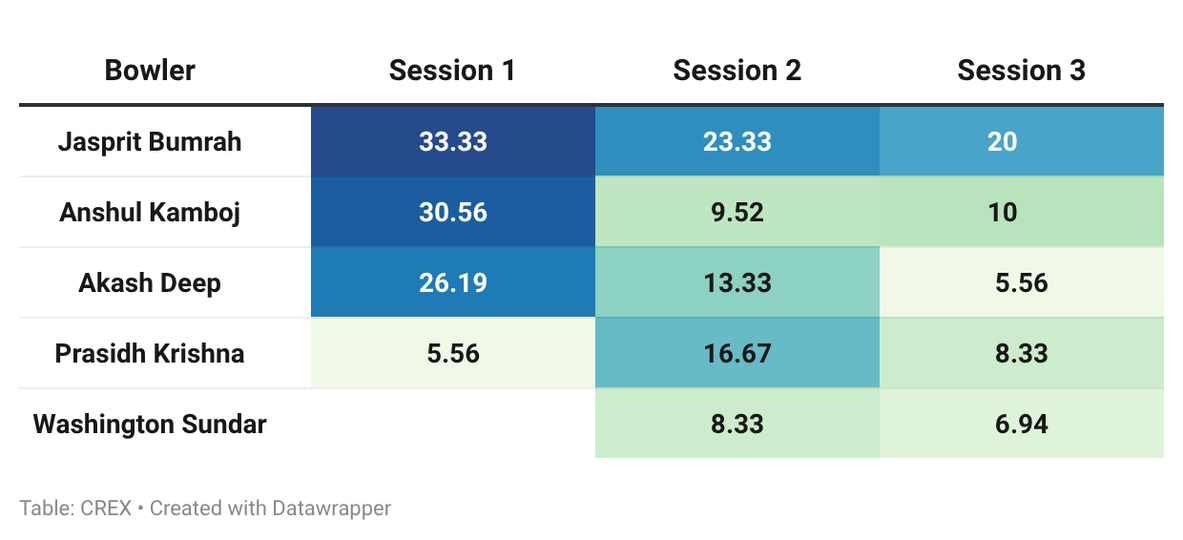 False shot% induced by each bowler in each session
While Tom Blundell got out early in the second session, India's shallow and one-dimensional bowling attack did come back to haunt them. For instance, they had a four-man pace attack, yet Bumrah bowled more than a third of the overs in the first session and the early part of the second.
After Lunch, he bowled an extended five-over spell at full throttle. But that meant he couldn't return for another short burst just before the Tea break, even as the runs continued to flow.
That, in turn, allowed New Zealand batters Henry Nicholls and Glenn Phillips to form a substantial partnership without facing any real threat.
In the second session, they scored at 3.07 runs per over and played just 14.10% false shots. More importantly, the workload also disrupted the roles of India's other pacers.
Prasidh Krishna, for instance, had to bowl against the wind in the second session, which doesn't suit his attacking nature and reduces his potency. He has recently worked on bowling fuller lengths with more zip, but bowling against the wind takes away that advantage. His shorter lengths, meanwhile, also lose pace and don't arrive with the same threat.
He's also coming off an injury and naturally looks short on pace and zip. Asking him to bowl into the wind was always going to make his task harder and lead to wayward bowling.

This is precisely the kind of workload that Mohammed Siraj is better equipped to handle. He thrives on bowling more and more overs and could have been better suited to operate in the crosswind. More than anything else, he would have hit the good-length area more consistently.
Bowling into the breeze also requires slightly fuller lengths to compensate for the loss of pace and carry. Siraj's natural pace is higher than that of Akash and Anshul, making him a greater threat now that the pitch has flattened out completely.
But with Bumrah effectively left to shoulder the attack alone, he had to keep returning for aggressive spells. The effects were visible at the start of the third session itself.
By the time he completed his fourth over, the ace pacer looked out of gas. He bowled a couple of no-balls in an attempt to make something happen, while his lines were also a tad erratic on either side of the stumps. Both were highly uncharacteristic of Bumrah.
With the other pacers continuing to operate with shorter lengths, India still struggled to contain the runs over an extended period.
Bumrah eventually returned for a solitary over with the second new ball, having been away from the attack for 23 overs. But having expended so much energy earlier in the day, he was again visibly down on pace and rhythm.
Ideally, India should have been able to bring him back a couple of overs earlier to help him find some rhythm before the second new ball.
But that wasn't possible, and they ended up going wicketless for most of the second session and the entirety of the third. It's all rather messy for India, but hardly surprising, really.