





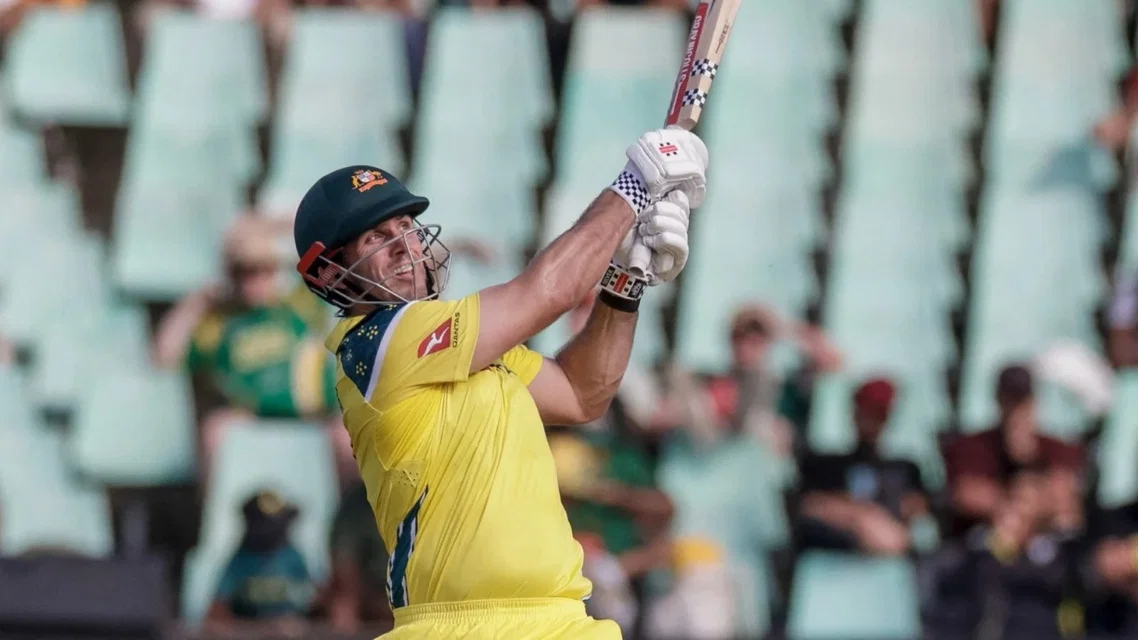
 Image Credits: AFP
Jason Gillespie initially nicknamed Mitchell Marsh ‘Bison’ because of his unusually large head. Little did he know that the moniker would eventually become an apt reflection of Marsh’s imposing physique and, more importantly, his destructive batting. Few batters are as intimidating against pace bowling as Marsh.
In a way, his proficiency against pace should come as little surprise, given that he grew up in Perth, home to the WACA, one of the quickest and bounciest pitches in the world. Yet, Marsh continues to impress, now complementing his brute power with greater consistency. He is currently among the finest white-ball batters in world cricket.
How Mitchell Marsh has become an all-round ODI opener
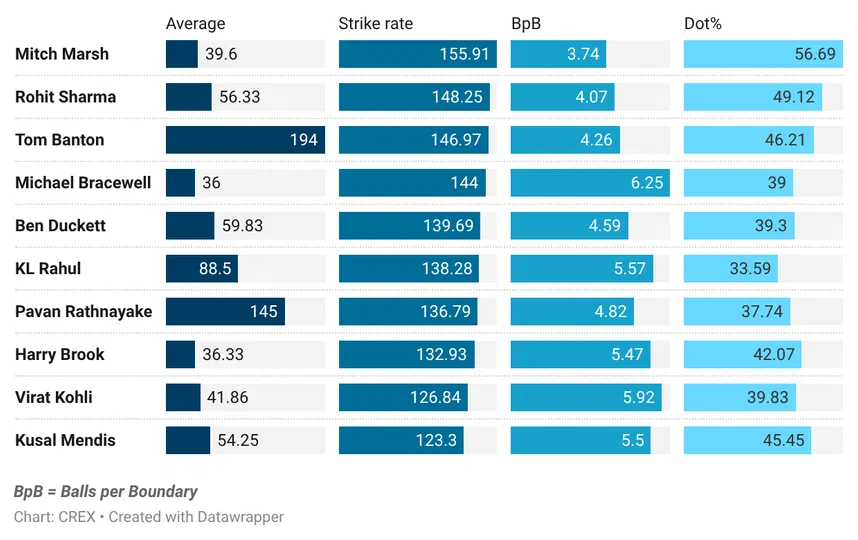 Best players of back-of-a-length and short deliveries since 2025 (minimum 100 balls)
Despite his massive potential from the start, Mitchell Marsh wasn’t always a consistent batter across formats. There were always flashes of brilliance, enough for Australia to back him more than most other players, but consistency has only come recently. It first emerged in T20 cricket and has gradually carried over into his ODI game as well.
Since 2025, Marsh has 653 runs at an average of 50.23 and a strike rate of 105.15 across 14 ODI innings. He has six fifties and a century in this period. As Travis Head has been hot and cold, he’s done heavy lifting for Australia in the powerplay, scoring quickly without sacrificing consistency.
Among all batters with at least 200 balls in the first 10 overs, Head has the best strike rate (119.88), followed closely by Mitchell Marsh’s 115.90. However, Marsh averages a whopping 61.43, compared to Head’s 33.17.
Most recently, Travis Head fell for a golden duck against England in Perth. However, Marsh refused to let the English quicks build further pressure, counterattacking with a 29-ball half-century inside the powerplay. He departed soon after, but by then, the Australian captain had already put his side on course for a comfortable run chase.

It was hardly the easiest pitch to bat on, and no other batter from either side managed to cross 30. Marsh produced a similarly valiant effort in Cairns last year, when South African spinners wove a web on a spin-friendly surface. Opening the innings, he scored 88, while the other Australian batters managed just 99 runs collectively.
His effort wasn’t enough to take Australia over the line, but more than enough to underline how reliable he’s become. At a time when Australia have been navigating a transition, with several players retired or sidelined by injuries, Marsh has found a way to make an impact almost every time he walks out to bat. And he’s done so across different pitches, conditions, and opponents, while also leading the side amid Pat Cummins’ continued absence from ODIs.
Mitchell Marsh, the pace-hitter, is peaking at the right time
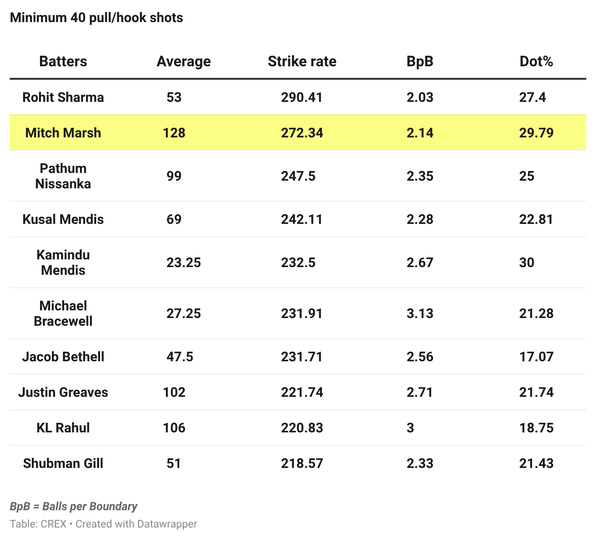 Best players of pull and hook shots vs pace since 2025 (minimum 40 balls)
Unsurprisingly, much of Marsh’s success stems from his exceptional ability to dominate pace bowling. He combines his long reach with immense power and a remarkably stable base to take on fast bowlers. He’s a Bison for a reason.
Since 2025, Mitchell Marsh has averaged 65.29 and struck at 114.82 against pacers in ODIs. Among all the batters with at least 350 deliveries, his strike rate is the third-best, while his average ranks fourth. He’s done so while opening the innings, where he needs to counter the new-ball threat before whacking hard lengths in the middle overs.
In Durban a few months ago, Mitchell Marsh faced Marco Jansen, Gerald Coetzee, and Corbin Bosch on a tricky surface against South Africa. Travis Head and Cooper Connolly had got starts but struggled to score quickly, while Josh Inglis fell cheaply. Marsh, however, was brutal against the Proteas quicks, racing to 60 at a strike rate of 166.66, including as many as six maximums.
Australia eventually bundled on 221, and if Marsh hadn’t played that counterattacking knock, things could have been considerably worse. He can take conditions out of the equation with his magnificent strokeplay and power. Even on relatively slow surfaces, Marsh can force the pace for the same reason.
Much of that comes from his ability to dominate shorter lengths, which he can hit comfortably even off the front foot. Since 2025, Marsh has recorded the best strike rate (155.91) and balls-per-boundary ratio (3.74) against pace on back-of-a-length and short deliveries among batters who have faced at least 100 balls. In the matches Marsh has featured in, all other batters have managed a strike rate of just 107.09 and a boundary every 7.45 balls.
That's largely because he is among the best exponents of the pull and hook, two of the most productive ways to counter these lengths. He has struck at 272.34 and found a boundary every 2.14 deliveries with these two shots. Only Rohit Sharma has better numbers, although his figures could be slightly inflated by the flatter pitches he has played on at home.
On a slowish Harare pitch, Blessing Muzarabani and Brad Evans tested Marsh with slightly shorter lengths with the new ball. Muzarabani, in particular, generates steep bounce thanks to his height and high-arm release.
Marsh initially rolled his wrists and pulled one wide of the square leg for a boundary before going aerial against the same bowler in the next over. Muzarabani persisted with the short stuff, so the batter first played a short-arm jab in front of square before depositing another short delivery over the boundary on the next ball, this time placing it slightly squarer. By then, Marsh was showcasing the full range of his strokeplay.
In the following over, Muzarabani offered a hint of width with a short delivery, and Marsh hung back to place it perfectly between cover and point. He gave Newman Nyamhuri the same treatment in the next over. It was a complete demonstration of his ability to ride the bounce and place shorter deliveries almost at will, a skill few batters in world cricket can boast of.
How Marsh’s renewed consistency comes as a massive boost for Australia
Australia are still settling as a batting unit following Steve Smith and Glenn Maxwell’s ODI retirements. Meanwhile, Cooper Connolly is still finding his feet at No. 3, while Matt Renshaw is still settling in the middle order. Even Travis Head has lost some of his form in recent times.
In that context, Mitchell Marsh’s emergence as an ODI opener has come at the perfect time for Australia. He has shouldered much of the responsibility over the last couple of years and, more importantly, looks like the right option to open at the 2027 World Cup in South Africa.
Marsh has already shown how effective he can be on South African pitches, even when other batters in his team have struggled. His exceptional game against pace could prove invaluable, as the surfaces are likely to have some juice. He can maximise the powerplay, bat deep and shield other batters around him.
Moreover, Marsh is no longer a sitting duck against spin and has gradually improved at this aspect as well. Opponents can no longer exploit this weakness to tie him down, especially now that he opens the innings. Much of his redemption has come at the top of the order.
Mitchell Marsh was always a force, but he is only now beginning to fulfil the enormous potential he showed in his early days. Having a key batter who can score consistently at a frightening rate is a huge advantage for any team. He also has a knack for stepping up at major tournaments.
This might well be the best version of Marsh as a batter, someone Australia can now rely on for consistent returns. The Bison has finally come into his own, and the timing couldn't have been better.

.jpg?type=mq "PAK vs SL 2nd Test - Where To Watch?")