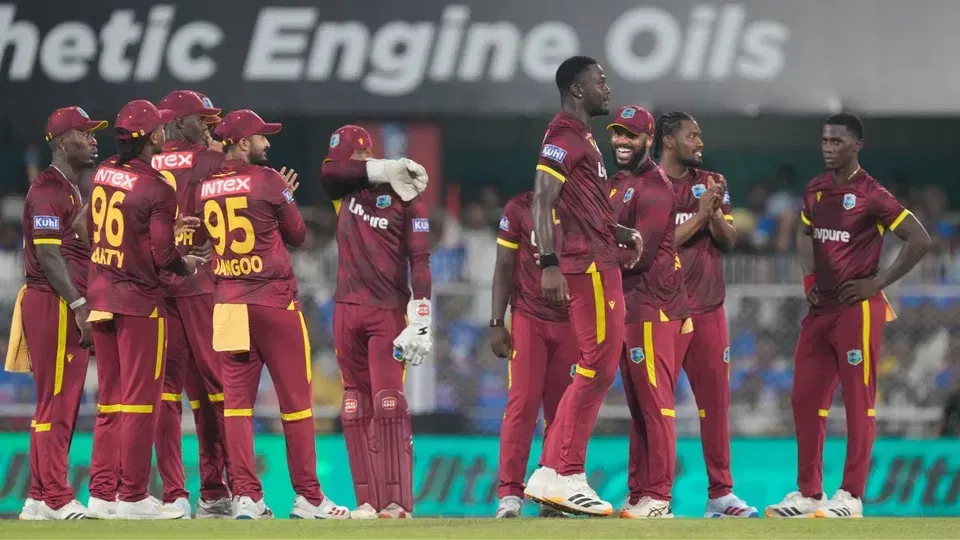
India's pace backups are far from developed. Image Credits: APIn Guwahati, Gurnoor Brar started the 39th over with a half-volley on the leg stump, with fine leg in the circle and only one fielder at square leg. Amir Jangoo casually shuffled inside the line and flicked over that very fielder at short fine leg for a boundary. Brar immediately pushed him back by bringing mid-on inside, only to bowl another half-volley outside off stump, which was whacked for another four down the ground.After missing his yorker by pitching the previous delivery too full, he strayed even further on the next delivery, bowling a near no-ball-height full toss while attempting an off-cutter. India had point and short third man inside the ring, with only one fielder in the deep on the off side. Jangoo crouched a tad low and worked with the angle over those two men in the circle for a third consecutive boundary.And just when everyone thought the yorker experiment was over, Gurnoor tried another on the fifth delivery of the same set, this time to Shai Hope. Again, a fielder inside the ring at fine leg and no one patrolling the square region on the leg side. Again, a boundary off a full toss, the fourth in the over, which took Hope to his 20th ODI century and eventually gave the West Indies 19 runs in the over.This over was a textbook example of how not to construct a defensive over in white-ball cricket. There was little control over the lengths and variations; the lines were often the exact opposite of the field placement. India offered several such examples throughout the rubber.India’s defensive bowling under the scanner in ODIsLength breakdown of Indian pacers in the final 15 overs against West IndiesTwo of India’s biggest issues in the ODI series against the West Indies were wayward and predictable bowling. In terms of attributes, India had some of the most promising bowlers, with plenty of potential.Gurnoor Brar, for instance, brings the highest release point of any Indian pacer in the last two decades, while Auqib Nabi and Anshul Kamboj can extract movement and nip the ball around. Prasidh Krishna can move the ball at pace while also generating the kind of steep bounce Brar does. Nitish Kumar Reddy, meanwhile, is the second-best bet after Hardik Pandya among fast-bowling all-rounders.They are all attacking options capable of producing magic balls and bowling aggressive lengths, either side of good length. But on the out-and-out flat pitches this series was played on, their lack of defensive skills proved costly, to the point where they had almost run out of answers by the end of it all in New Chandigarh. At times, their lengths became far too predictable.Also Read: Shubman Gill Gets 9 Out Of 10: India Players' Rating After ODI Series vs West IndiesTake the 43rd over in Thiruvananthapuram, for instance. Perhaps unsurprisingly, Prasidh Krishna went full first up with mid-off inside the circle, and Jangoo simply lofted him over the fielder for an early boundary. When he came back on strike later in the over, the batter had every reason to expect Krishna to go shorter after being punished for pitching up.And that is exactly what happened. Jangoo was already setting himself for the pull before the ball had even left Krishna's hand, then hammered it in front of square for another boundary. Predictably, Krishna went back to the yorker next, but missed it and served up a full toss, which Jangoo simply opened the bat face to steer past short third man.Attempting yorkers again and again with little success was a recurring theme for India’s pacers. In the final 15 overs, they went for the blockhole 35.92% of the time but landed it in the right area only 23.33% of the time. Around 48.33% of those deliveries became half-volleys, while another 28.34% turned into full tosses.In two of the three games, India bowled first and had the better bowling conditions, with no dew to make gripping the ball or hitting the right lengths more difficult under the lights. Even then, their control was surprisingly low. The flat pitches and lush outfields in this series also offered little help in scuffing up the ball and generating reverse swing, so going for yorkers with such low control didn’t really make sense.They also did not use the in-between hard lengths enough, with just 11.37% of their deliveries landing in the back-of-a-length region. Yet these were their most economical lengths after yorkers, leaking only 6.32 runs per over.Their short balls into the pitch were often wayward too, with around 28.57% going down leg and making it relatively easy for the batters to free their arms. In all three games, the square boundaries were significantly small on either side of the wicket, so even mistimed shots travel easily from those lines. Gudakesh Motie, for instance, didn’t even have his eyes on the ball and still managed to swing with the angle over backward square leg against Anshul Kamboj in the final game.Lack of variations% balls bowled by pacers in the final 15 overs against West IndiesBeing an attacking pacer can come with its own downsides, especially on flat pitches where playing through the line is relatively easy. Fast bowlers cannot keep pushing batters under pressure with sheer pace. Without enough variation in pace and angles, they can become as hittable as any other bowler.In that sense, India’s speedsters were far from smart or proactive. In the first game, they attempted slower balls only 11.11% of the time in the final 15 overs. That figure rose to only 16.98% in the second game, while they didn’t try a single off-pace delivery in the final game, even as the batters launched a full-scale assault.CREX @Crex_live What a win for the West Indies! 🔥 Captain Shai Hope's unbeaten 162 off 143 balls helped them win the final ODI. 👏 #INDvsWI #ShaiHope Oct 3, 2026, 11:01 PM By the 47th over of the third ODI, Shai Hope was struggling with cramps across much of his lower body. His movement was severely restricted, and he could barely run after a marathon knock. He had already kept wickets for the full 50 overs before returning to open the innings for the West Indies.India had the opportunity to take the pace off, bowl into the pitch and force him to generate his own power while struggling with his movement. Instead, Gurnoor started with two pace-on deliveries, to which Hope used the pace to loft the ball over the infield, with only four fielders on the boundary. Gurnoor continued to rely on pace and finished the over with another boundary.Also Read: Indian Players Who Can Be Dropped For New Zealand ODIs After Poor Series vs West IndiesAt least Kamboj was expected to make the necessary amendments after watching Gurnoor go for runs. Instead, he doubled down on pace-on deliveries, conceding two boundaries, including one off a no-ball. He continued the same way to Motie, whose limited power made him the ideal batter to deny easy pace.That allowed Motie to take 10 runs off the final two deliveries and effectively ended India's hopes of a comeback in an already daunting chase. When pace-on deliveries were being dispatched so easily, taking the pace off should have been an obvious adjustment, even for inexperienced pacers."I feel sometimes we are not really clear whether we are attacking or we are defending, especially when we are bowling in the death overs. One-day[er] is such a game; if the opposition is five or six down, you are never really sure what fields to take, whether we are going for the death too early or we are still, you know, bowling kind of like middle overs." "I think these are some areas which definitely we need to be better at,” Gill rued after the defeat in New Chandigarh.In the final 15 overs, Indian pacers took just four wickets at 58.25 runs apiece in the series. They leaked 8.37 runs per over and a boundary every 5.57 deliveries.India’s pace issues resurface in the absence of premium bowlersIndia were without Jasprit Bumrah and Arshdeep Singh, both of whom were away in Japan to fulfil Asian Games 2026 commitments. They also kept Mohammed Siraj on the bench for the first two matches. All this was part of the experimentation ahead of the 2027 World Cup.But India are still heavily reliant on the likes of Bumrah and Siraj to do the job on better batting decks and against quality batting sides. When Bumrah was rested for the final ODI in England, India conceded 387/3 in the first innings at Lord’s. Several other below-par performances also surfaced during the New Zealand series in January earlier this year.The fringe options, then, are far from ready, at least for now. Despite all their encouraging attributes, their over composition and ability to stick to plans remain massively underdeveloped. They are simply too attacking in an era where such skills are rarely rewarded.Almost all the bowlers who featured against the West Indies need more defensive skills. Sure, they can bounce batters out or produce magic balls from time to time. But can they hold a particular length for an extended period? Can they bowl tightly and in line with the field placements?Star Sports @StarSportsIndia Duck, cover, and laugh it off! 😅 A throw from #GurnoorBrar had #MohammedSiraj taking evasive action on the ground, leaving #RohitSharma and #ViratKohli in splits! 🤭 #INDvWI 3rd ODI | LIVE NOW 👉 Oct 3, 2026, 7:44 PM Those issues could become even more pronounced overseas. Even on pitches that offer plenty to fast bowlers, the challenge will be to find the right lengths, something that will be a new exposure for some of them, and then resist getting carried away by the conditions. The wickets may favour pace, but they still need to bowl in the right areas for long periods.Defensive skills are almost invariably necessary in the modern game. White-ball pitches rarely stay helpful for long, and the focus quickly shifts towards finding ways to control the flow of runs. India’s current backup options look one-dimensional in that aspect.That is ultimately what these series are meant to establish: the ideal backups, along with the third and fourth seamers, for next year's mega event in South Africa. There is still time for these pacers to grow and evolve, but there is also plenty of catching up to do before India can feel comfortable with their depth.Also Read: West Indies Players Who Can Give India A Run For Their Money In T20I Series