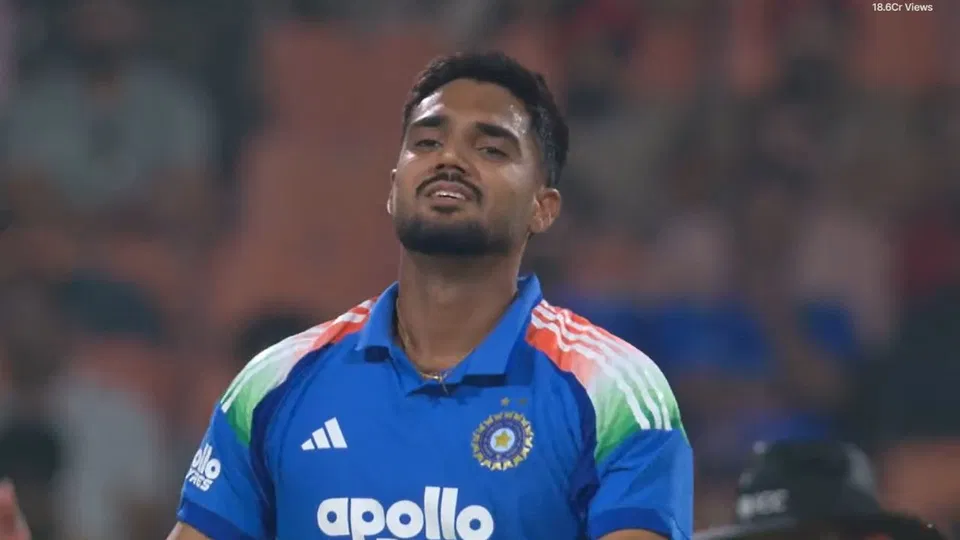
Abhishek Sharma has more methods to his madness in T20s now. Image Credits: APIndia’s T20I setup has so much firepower that the individual talent of most players gets overlooked almost every time. Abhishek Sharma is a prime example. He’s so explosive that his ability to adapt to different pitches often gets overlooked.Since becoming a regular Indian player, Abhishek has added more and more dimensions to his game. He is now more open to adapting to conditions and overcoming challenges that have troubled him in the past. He overcame one of the struggles he had faced in Zimbabwe during the Asian Games 2026 final.How Abhishek Sharma aced a slow surface in the Asian Games 2026 finalAbhishek Sharma's foot split in Asian Games 2026 finalIshan Kishan had his own methods in the semifinal, focusing on staying on the front foot and going back only to rotate the strike. Abhishek Sharma, however, used a completely contrasting method against Pakistan in the Asian Games 2026 final. For context, the pitch was similar to the one in the previous game.Also Read: Ishan Kishan Flexes His Evolved Mastery on Sluggish Pitches AgainAbhishek mostly stayed on the back foot, waited for the ball to do its thing, then imparted maximum power into his shots. He played around 85% of the spin deliveries from the back foot, striking at 211.76 and hitting a boundary every 2.83 deliveries. The other Indian batters collectively struck at 106.98 and took around 8.60 balls for every boundary from the back foot.Abhishek also never looked to remain static on the front foot on a gripping pitch. It was a surface that turned and gripped, while also being on the slower side at times. Staying on the back foot allowed him to create his own power, widen his bat swing and delay his wrist snap.Sony Sports Network @SonySportsNetwk Extreme Powerplay Mode: 🔛 ⚡ Abhishek Sharma went all-in from Ball 1 to set the tone for a high score! 🔥 Watch Pakistan vs India in the 20th Asian Games Gold Medal Match, LIVE NOW on Sony Sports Network TV channels & Sony LIV. #SonySportsNetwork #SonyLIV #AsianGames Oct 3, 2026, 10:53 AM Take his first maximum off Saad Masood in the second over, for instance. The delivery was just a tad shorter than good length, prompting Abhishek to go back and wait until the very end before whacking it over long-on for a huge maximum. It was a googly that turned a bit but was slower through the air, giving him enough time to hit it all the way through.At times, his back-foot method also allowed him to turn reasonably good lengths into slightly shorter ones. On the final ball of the next over, Saim Ayub bowled a hard length to cramp Abhishek for room, but he has so much power in his wrists that he still somehow powered it over the bowler for another boundary. This shot showed not just the power he possesses, but the supreme skill behind it.Playing straighter and in front of squareWhile going on the back foot, Abhishek Sharma also made a conscious effort to play either down the ground or in front of square with a vertical bat. This helped eliminate the risk of leading edges while allowing him to smother the uneven bounce by extending his arms fully.The fifth delivery of the third over demonstrated why it was such an effective method. Ayub made one turn and grip sharply from a shorter length, but Abhishek played with a straight bat and somehow cleared the fielder at mid-on. Even though he didn’t get the timing quite right, he ensured the ball went just left of the midwicket fielder.Had he tried to play the same shot any squarer, there was every chance of a top edge carrying to a fielder inside the ring. That is precisely what happened in the very next over when Abhishek top-edged a pull, although Pakistan couldn’t hold on. Similarly, Usman Khan spilled one when Abhishek cut hard with a horizontal bat in the seventh over.Abhishek Sharma played straight and in front of square against spin in Asian Games 2026 finalThere were, therefore, certain risks involved in playing behind square or with a horizontal bat, and Abhishek did his best to stay away from them. He is among the best players on both sides of the wicket, but still resisted the temptation. The only time he played a pull slightly square of the wicket was against Arafat Minhas, and even then, he ensured to work with the turn on a leg-side delivery.Around 52.38% of his runs against spin came down the ground, towards long-on and long-off. Another 33.33% came in front of square on either side, from cover to midwicket. He transferred his bat smartly and delayed his bat swing with flexible wrists, allowing him to play as straight as possible throughout his stay.Abhishek keeps adding to his evolved T20 gameOn slow, sluggish surfaces in Zimbabwe, Abhishek Sharma struggled against Blessing Muzarabani with the new ball. Before that, Jofra Archer had troubled him with searing hard lengths and bouncers. During that series, Abhishek was repeatedly challenged by extra bounce and high pace.He struggled to control the bounce in both series, particularly when deliveries angled away from him from slightly shorter lengths and bounced unevenly. At times, he resorted to playing with a horizontal bat, only to get dismissed in similar fashion.That prompted him to add a more controlled pull shot to his arsenal, rolling his wrists over the ball to keep it down. This allowed Abhishek to negate the risk of getting caught in the deep when uneven bounce came into play. Glimpses of this adjustment were visible against Afghanistan in New Delhi last month.Also Read: Tilak Varma Equals Virat Kohli, Abhishek Sharma For Most 50-Plus Scores In T20I FinalsEven during his magnificent knock in the final T20I, Abhishek was conscious of when to keep the ball along the ground. In the seventh over, Abdullah Ahmadzai bowled a cutter into the pitch. Abhishek rolled his wrists over the ball and played it along the ground, still generating enough power to bisect the fielders at deep midwicket and deep square leg for a boundary.He had attempted a similar approach against Azmatullah Omarzai earlier in the rubber. The adjustment allowed him to avoid offering catches to fielders in the deep without compromising his scoring rate.Another challenge had been his struggles against off-spinners, particularly during the T20 World Cup 2026. Abhishek often premeditated his shots, leaving little room to delay his bat swing. As a result, he was vulnerable when bowlers dragged their lengths back slightly.He soon worked on that weakness, with noticeable improvements during IPL 2026 and, more recently, on a tricky Nisshin surface against several spinners. On a similarly gripping surface and against very similar lengths that Pakistan bowled in Nisshin, Abhishek was dismissed for a four-ball duck against the same opposition at the T20 World Cup 2026.Sony Sports Network @SonySportsNetwk STRAIGHT. CLEAN. MASSIVE. 🔥 Abhishek Sharma sending that one soaring into the Japanese skies! 🤯 Watch Pakistan vs India in the 20th Asian Games Gold Medal Match, LIVE NOW on Sony Sports Network TV channels & Sony LIV. #SonySportsNetwork #SonyLIV #AsianGames Oct 3, 2026, 11:28 AM In Japan, however, he turned those very lengths into boundary-scoring opportunities in the conditions arguably more challenging. His early assault was built around a method few other batters could execute, particularly at the start of an innings.Vaibhav Sooryavanshi's dismissal offered a clear contrast. He attempted an unorthodox reverse sweep and ended up edging the ball into the wicketkeeper's gloves.In trying to access the square region, he took that extra risk, which was somewhat justified. Abhishek was visibly agitated after watching the shot, gesturing that Vaibhav should have played straight instead.Later, Shreyas Iyer struggled to find any meaningful timing before falling after a difficult stay at the crease. Abhishek, meanwhile, ensured India maintained control and had momentum from at least one end. He did so while remaining in control of his own approach for most of the innings.One by one, Abhishek has been working through the weaknesses in his game as he continues to evolve. What stands out is the pace at which he is making these adjustments, particularly in an era when packed schedules leave batters little time to work on their technique. Many modern-day batters continue to carry the same weaknesses for extended periods.And that was more significant than the runs he scored. He is almost always among the runs; a 30-ball century came not too long ago. Not that he needed to, but Abhishek’s knock certainly pushed back against the flat-track bully tag again, a label often thrown around far too casually.Also Read: Indian PM Narendra Modi, HM Amit Shah Release Statement On India's Win vs Pakistan