






 Image Credits: BCCI
KL Rahul and Devdutt Padikkal have completely contrasting scoring methods to Yashasvi Jaiswal. The former two work around bowlers’ plans, maintaining a measured intent until they are forced to try something different. Jaiswal, meanwhile, takes more calculated risks, compelling bowlers to revisit their plans almost immediately.
Both approaches are effective in their own ways. Fittingly, both were on display at the Basin Reserve.
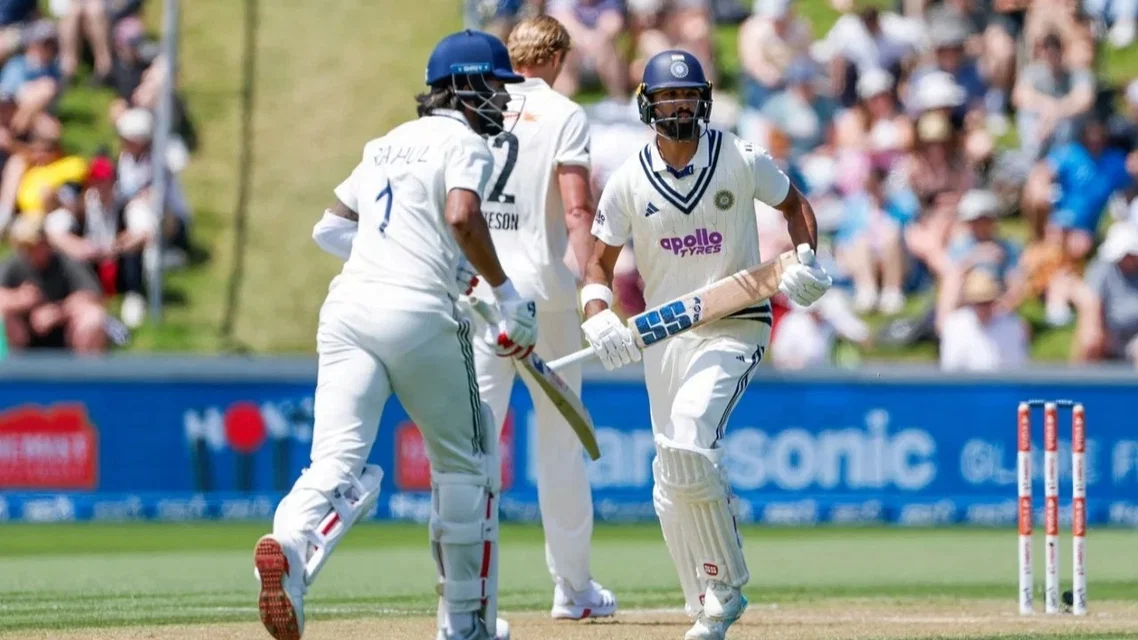
After Jaiswal had done his part, Rahul and Padikkal saw India through Friday without further hiccups. When they returned on Saturday, the duo delivered a masterclass in attrition.
How KL Rahul and Devdutt Padikkal patiently countered New Zealand's attack
The pitch at the Basin Reserve flattened out on Day 1 itself, leaving New Zealand with little assistance by Day 3. Unlike the usual trend, it didn't quicken enough, largely because it was quite dry underneath. And yet, fresh from the overnight break, the pacers returned with a plan to bowl straighter lines, with wicketkeeper Tom Blundell standing up to the stumps.
“I think it’s probably going into this game; we could see that after that new ball was pretty flat and probably on the low side as well. So for us, it was probably just how do we restrain the run rate and create pressure? So it’s a pretty simple formula,” Henry said before the start of Day 3.
They packed the field with almost everyone inside the ring, retaining two slips and a gully. Matt Henry and Nathan Smith also went wide of the crease to create an inward angle before getting the ball to straighten slightly.
But if the Kiwis were prepared to play the waiting game, so were the Indian batters. After three maidens, KL Rahul finally leaned into a cover drive on the third ball of the fourth over, sending it to the boundary. The reason was simple: the line was slightly wider for the first time, allowing him to extend his arms and reach a fuller delivery.
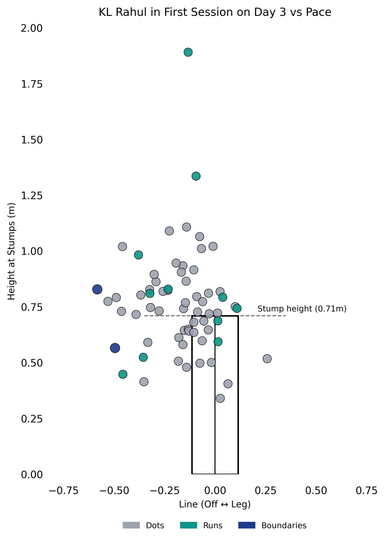 KL Rahul was cautious with his approach on straighter lines
Similarly, Devdutt Padikkal finally got going on his 21st delivery of the day, when Henry bowled his first loose delivery, wide outside off stump. Two overs later, Padikkal found the boundary again off Kyle Jamieson, who offered a similar line.
On both occasions, he went square of the wicket, staying beside the line and opening the face of his bat while getting on top of the bounce. In defence, however, Padikkal was well behind the line, showing the full face of the bat and placing the ball in front of square.
After a tight start, the lines began to drift on either side of the stumps, and Blundell occasionally retreated to his original position. In the 51st over, for instance, Jacob Duffy offered some room, and Rahul punched off the back foot. Duffy then overcompensated by bowling a touch too straight, allowing Rahul to tuck the ball towards deep square leg. In the same over, Padikkal picked up two more runs behind square on a couple of occasions after Duffy again missed his line marginally.
Whenever there was room on either side, the two seized every opportunity to manoeuvre the field. Usually, the waiting game leaves little room for error on modern-day pitches that offer plenty to bowlers, and this approach doesn't work in the long run. But the Indian batters could afford to be patient on this occasion because the pitch posed no significant threat.
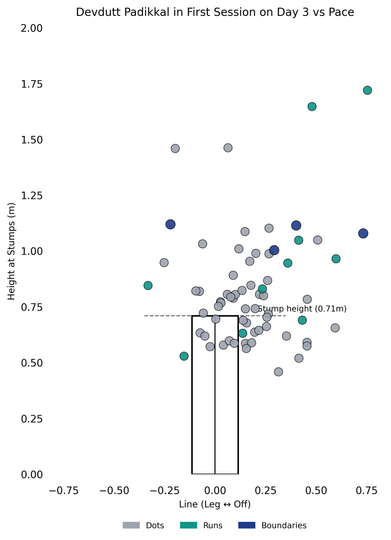 Devdutt Padikkal pounced on every run-scoring opportunity on either side of the wicket
There were a couple of deliveries that jagged back sharply from Nathan Smith and Jacob Duffy, but neither was enough to force the Karnataka duo to alter their approach. Their patience had two major benefits: the New Zealand pacers tired quickly and began offering loose deliveries more frequently in the latter half of the first session.
Soon, Glenn Phillips was introduced into the attack as the Kiwi pacers visibly began to run out of patience. Rahul and Padikkal responded by taking a more proactive approach, plundering 28 runs off his five overs. New Zealand even tried to bring the outside edge into play by placing a fielder at silly mid-on, thereby blocking the on-side scoring area.
But both batters are quality players of spin, and on a surface like this, they were unlikely to have too many problems. Overall, the two collectively played just 4.47% false shots. They scored at around three runs per over but negotiated the session without losing a wicket.
The handling of short balls
With their initial plans yielding little, New Zealand came into the second session with a short-ball plan straight away. They stationed a deep square leg, a halfway deep square leg and a forward short leg for the two batters. Their quickest seamer, Jacob Duffy, opened the session.
However, Rahul, who had largely relied on his play-and-leave game until then, showed that he could also ride the bounce. He first went on the back foot, rising onto his toes to defend in front of his body. Two balls later, he got on top of the bounce and cleverly rolled his wrists down to work the ball towards square leg.
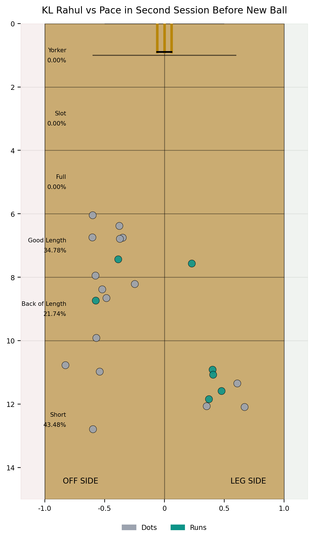 KL Rahul showed exceptional ability to ride the bounce with the first old ball
Padikkal, meanwhile, had the advantage of good height and was well behind the line. This was also a pitch where the bounce was getting progressively lower as the game wore on, so he didn't encounter many deliveries that climbed awkwardly. He also focused more on leaving the ball against Duffy, who can extract reasonable bounce because of his height.
Padikkal failed to keep the ball down only once, when Duffy got one to climb sharply in the 69th over. Trying to guide it towards point, he sent it straight to Henry Nicholls at gully. However, Nicholls couldn't hold on, and that remained New Zealand’s only chance.
Padikkal faced around 70.96% of pace deliveries shorter than eight metres before the second new ball in the second session. The corresponding figure for KL Rahul was 65.21%. The seamers also tried to angle the ball across both batters, with Duffy using around the wicket angle to Rahul, but the two played with soft hands, nudging it into the square regions for singles and doubles.
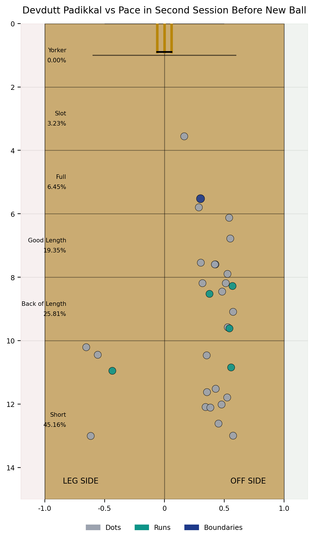 Devdutt Padikkal's height came in handy after New Zealand trialled him with short balls
Even that failed to work for New Zealand. And just as they had done in the first session, they turned to spin shortly before the second new ball, bringing on both Phillips and Rachin Ravindra. That once again allowed India to pick up some quick runs.
Eventually, Padikkal was unfortunate to face an unplayable delivery soon after the second new ball. But by then, he and Rahul had done enough to tire out the opposition and give India a platform to build on for the rest of the day. In doing so, the duo had won the waiting game that New Zealand had set out to play.
.jpg?type=mq "David Warner & Usman Khawaja Taken Off Air By Fox Cricket")
.jpg?type=mq "PCB announce central contract")