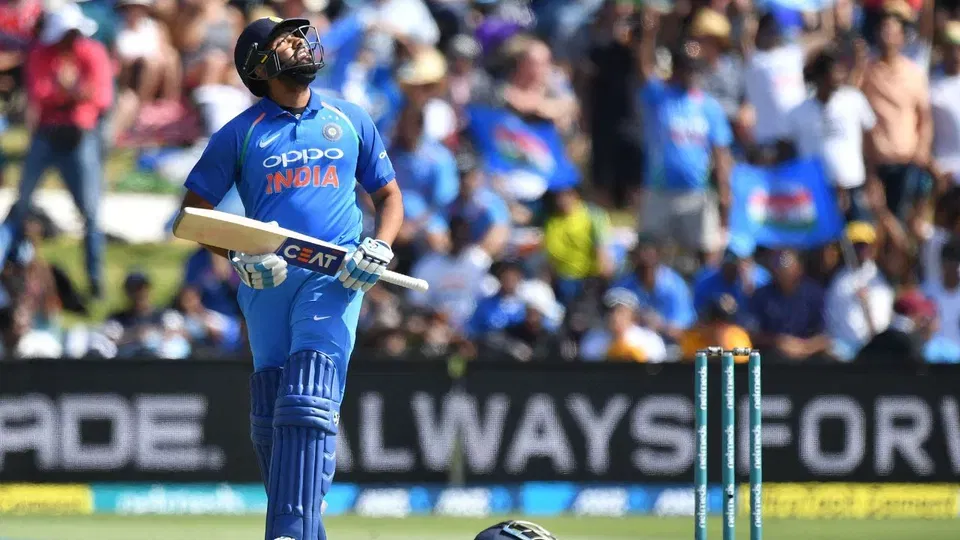
Rohit Sharma was majestic at Lord's. Image Credits: AFP
Rohit Sharma's knock at Lord's invited two readings. One, that he still has plenty left in the tank. The other, that few Indian batters can offer what he does in ODIs.
Either way, it should finally give Rohit some much-needed breathing space. Not that he has anything left to prove, but this innings served as a gentle reminder of just how good his skills still are.
Rohit Sharma’s mastery at Lord’s
Rohit Sharma has returned to his old method since last year, taking his time early on and looking to weave those big knocks. At Lord’s, he again followed the same pattern.
Shubman Gill had played a few quality shots in the powerplay, but the dot balls still kept coming, and he couldn’t score as quickly as he would have wanted. The deck, for the record, wasn’t out-and-out flat, even if the scorecard suggests otherwise.
Also Read: Gautam Gambhir, Rohit Sharma's Argument At Lord's Creates New Headache For BCCI
So, although Rohit himself struggled for timing early on, he still found occasional boundaries during the powerplay. Later, he was also quick to put Sam Curran under pressure immediately after the English seamer came into the attack.
Rohit Sharma’s ability to find gaps on a tricky deck with calculated risks came to the fore again. He hit two consecutive boundaries off Gus Atkinson via scoop shots towards fine leg before using slog sweeps over midwicket against spin in the no-man's region.

If the former showed his ability to manufacture boundaries, the latter was a pure display of brute power. Precisely the two qualities a batter needed to succeed on a deck that rarely allowed fluent stroke-making.
How Rohit smartly constructed his innings
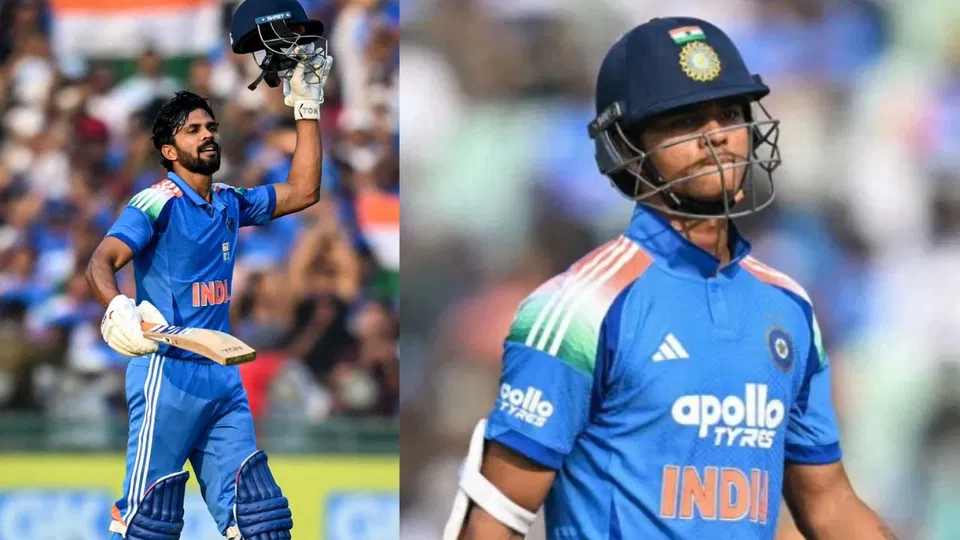
There’s an argument that Rohit Sharma could have been more proactive in the powerplay, but it’s worth noting that the deck wasn’t easy to bat on by any means. For a new batter, the challenge was even steeper, as evidenced by the knocks from Harry Brook, Ishan Kishan, and Shreyas Iyer’s innings.
Hence, the idea was to follow template England followed: the top three batters batting deep and seeing what could be done later. On that front, the Indian opener targeted his lengths precisely against pace, hitting anything on the fuller and shorter sides while playing out good-length balls.
Against pace, Rohit Sharma was devastating on both ends of the length spectrum. He struck at 233.33 and hit a boundary every 2.50 balls against deliveries pitched between 4 and 6 metres, while scoring at 141.37 with a boundary every 4.14 deliveries against lengths of 8 metres or shorter.
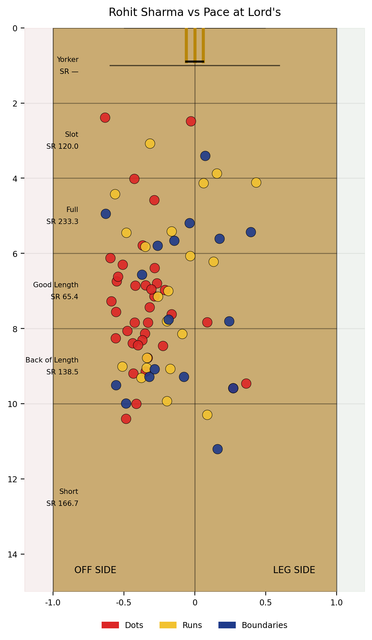 Rohit Sharma was severe on anything full or short
It was only on good lengths between 6 and 8 metres that he dialled back his aggression, striking at 65.38 and taking 8.66 balls per boundary. Against spin, Rohit hit at 121.05 on good lengths between 4 and 6 meters.
England had a far superior attack and a definite idea of the conditions, but they were still forced to alter their lengths at times. That’s where the veteran batter was quick enough to pounce on almost every loose delivery, particularly after settling in.
The off-pace challenge and Rohit's response
Rohit Sharma showed different shades throughout his stay, but perhaps the most defining part was how he tackled off-pace deliveries. On Lord’s pitch, the slower ones were the toughest to hit for either side.
Sam Curran’s moon balls fetched him ample success, while Prince Yadav also bowled well on slower deliveries. Almost every Indian batter struggled to power them away, but that’s where Rohit’s superior capabilities came to the fore.
On slower deliveries, Rohit had a strike rate of 193.75 and found the fence every 3.20 balls. Additionally, he played just 18.75% false shots.
All other batters from India combined struck at just 77.27 and hit a solitary boundary against off-pace deliveries. Collectively, they played 54.54% false shots and lost a wicket every 5.50 balls.
Rewind to the 34th over, when Sam Curran had already troubled Virat Kohli, who was losing his shape in an attempt to power the delivery away, multiple times. Rohit just let the ball come to him and creamed it through the extra cover region to bisect the two fielders with pinpoint precision.
It was the very shot Kohli had attempted a couple of deliveries earlier, only Rohit executed it to perfection. On the next delivery after hitting this boundary, he stayed back and generated immense power off the back foot to whip it over the backward square leg for another four.
The best, however, came three overs later. When Curran tried to angle a slower one across on the first ball of the 38th set, Rohit made space and slashed over the cover-point region, generating immense power off the back foot to evade a flying Joe Root.
Later, the left-arm pacer attempted his moon ball, but Rohit waited and waited for it before lofting neatly over the mid-off region without losing any shape. He consistently moved in his crease, using the depth and advancing in front, as he put on a masterclass on how to play slower deliveries on a gripping pitch.
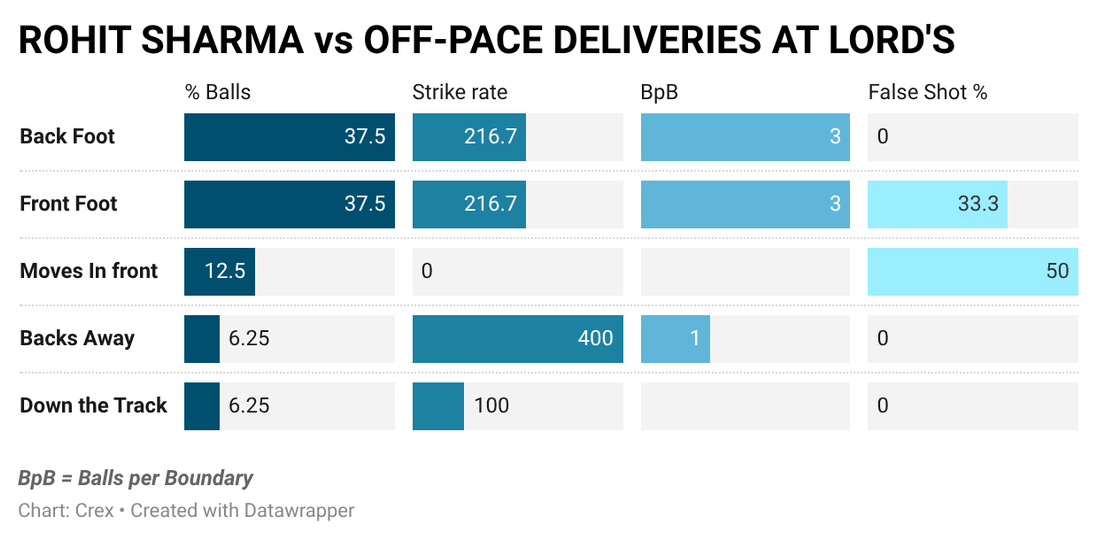 Rohit Sharma was exceptional against off-pace deliveries
Lately, Rohit has been sensational on such surfaces, finding ways to score runs when few batters could. From Sri Lanka in 2024 to the Champions Trophy final in 2025 and now at Lord's, he has repeatedly found ways to score runs on surfaces where stroke-making has been anything but straightforward.
That ability could prove invaluable in the 2027 World Cup. The pitches at venues like Paarl and Durban might be slow, while the decks in Zimbabwe and Namibia will also offer some grip and turn. Given how India’s batters have responded on these tracks lately, including at Lord’s, there are more than enough reasons to bank on Rohit.
He has that extra split second to intercept the ball and has a vast range to unleash without trying too much. There’s a reason he found so much success when he changed his approach altogether between 2022 and 2025.
The result didn't go India's way, but Rohit Sharma's masterclass was a timely reminder that while his methods may have evolved, his value in ODI cricket remains undiminished. As for the timing, it couldn't have been better.
Also Read: Rohit Sharma Demands Virat Kohli Alongside Himself For 2027 World Cup Citing Special Bond