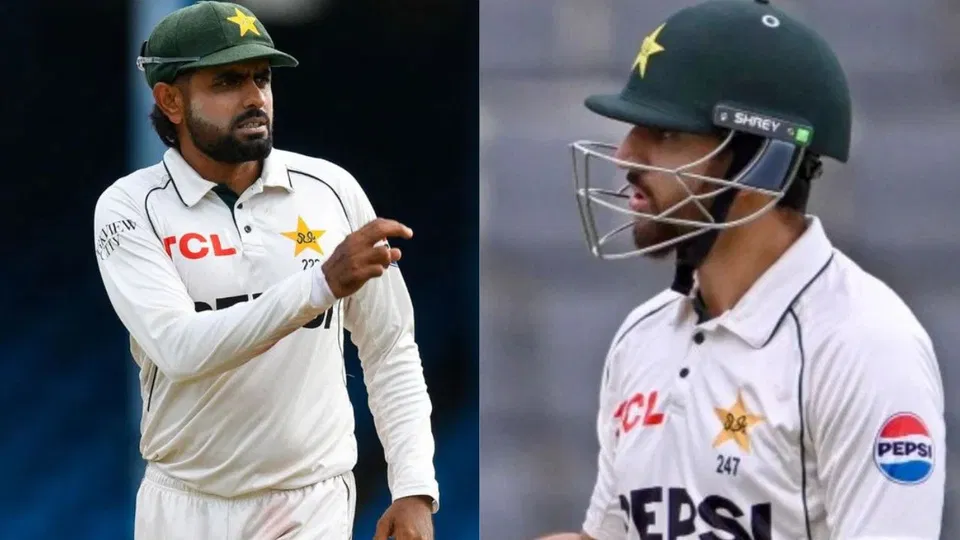
Imam Ul Haq for Pakistan [Source: AFP]Pakistan's first Test against England at Headingley turned into a nightmare almost from the moment the visitors walked out to bat. Pakistan were bowled out for just 171 in their first innings, despite Abdullah Shafique's 61 and Imam-ul-Haq's 42. England then piled up 409, with Jordan Cox scoring 73, Joe Root making 66, Harry Brook falling nine short of a hundred and Dan Lawrence adding 51. Pakistan needed a vastly different response in the second innings but instead collapsed to 135, losing the match by an innings and 103 runs. For Pakistan, however, the damage from such a defeat is not restricted to the scoreline. A heavy Test loss can change the conversation around individual players, particularly those whose places are already under scrutiny or whose positions were supposed to represent either the future or a proven option for the present. 1. Azan AwaisAzan Awais arrived in England as one of the newer faces in Pakistan's Test setup, and the opportunity was significant. A fresh talent being introduced into Test cricket is normally given some room to grow, particularly when the team is trying to build its next generation. But Headingley offered Awais almost no chance to make a positive first impression.He managed only nine runs across two innings. His first innings lasted just one ball, as Ollie Robinson trapped him lbw without scoring. His second opportunity was only marginally better: Awais made nine from 14 balls before Jofra Archer removed him. The series statistics supplied for Pakistan show that he finished the Test with nine runs from two innings, a highest score of nine, an average of 4.50 and one duck.The problem is not simply that Awais failed. Young players can fail in their first Test and still build careers. The bigger issue is the manner and timing of the failure. Awais was handed the responsibility of opening the innings at a venue where England's seamers were able to make the new ball talk, and he was unable to survive even long enough to settle into the contest.Also Read- Updated WTC Table After ENG vs PAK 1st Test 2026, World Test Championship Points TableThere is, however, an important piece of context in his favour. Before Headingley, Azan Awais had shown that he was not selected without reason. His first four Tests in 2026 had produced 228 runs at an average of 28.50, including a century and a fifty. His career was therefore not built entirely on promise without evidence; there had already been glimpses of the player Pakistan believed could develop into a long-term option.That makes the Headingley failure more of a warning than an immediate verdict. But it has undeniably put pressure on his position. Pakistan cannot afford to carry an opener who looks overwhelmed in English conditions if the team is searching for immediate stability. 2. Imam-ul-HaqIf Awais' problem is that he failed at the beginning of his Test journey, Imam-ul-Haq's problem is almost the opposite. He has had years to establish himself, numerous opportunities to solve his problems and enough experience to be expected to provide security at the top of Pakistan's order.Yet Headingley produced another disappointing chapter. Imam made 42 in the first innings before Josh Tongue had him caught behind the bat, and then disappeared for a five-ball duck in the second innings when Archer dismissed him. Across the Test, he scored 42 runs from two innings, with a highest score of 42 and a batting average of 21. The wider series figures provided for Pakistan show that he was their second-highest run-scorer with 42 runs, but that number looks far less impressive when viewed against the demands placed on an established Test opener.The more uncomfortable statistic is what his recent Test record has become. Imam's numbers show a player whose career has repeatedly moved between promise and prolonged inconsistency. He averaged 55.80 in 2022, a year that demonstrated exactly why Pakistan continued to invest in him. But that peak has not been sustained. His average fell to 30.75 in 2023, 29.75 in 2025 and now 25.43 in 2026. His 2026 record includes 178 runs from seven innings, with just one fifty and no hundred.That downward pattern changes the interpretation of another low-scoring Test. His Headingley failure also came at precisely the wrong time. Pakistan were already desperate for their senior batters to absorb pressure and protect a fragile middle order. Imam's career is therefore arguably at its most delicate point. Pakistan may still believe in his ability, but the margin for another opportunity has become significantly thinner. 3. Mohammad AliMohammad Ali's case is perhaps the most damaging of the three because Pakistan need their fast bowlers to make an impact in England. Instead, Ali finished the Test with figures that made it extremely difficult to defend his place in the attack.He bowled 19 overs, conceded 89 runs and took only one wicket. His economy rate was 4.68 and his bowling average for the match was 89, while his strike rate stood at 114. He also went wicketless through long stretches of England's innings before eventually dismissing Emilio Gay.The contrast with his teammates made the performance even more conspicuous. Ali Usman claimed five wickets, while Khurram Shahzad took three. Mohammad Abbas also picked up a wicket despite conceding fewer runs than Ali. England's 409 meant Pakistan needed every bowler to contribute, but Ali's 1/89 became one of the weaker returns in an attack that had already struggled to contain England's middle order.Mohammad Ali has now played seven Tests and taken 16 wickets at an overall average of 43.44. His best series came against West Indies in 2026, when he collected nine wickets at 22.22. That suggested he could still develop into a reliable Test bowler. But his earlier series against England in 2022-23 brought only four wickets at 65.25, while his 2024 series against Bangladesh produced just two wickets at 72.50. His latest England outing has now pushed his series average to 89.00.Pakistan can forgive a bowler for one expensive spell. They can forgive a bad Test. What becomes harder to overlook is a pattern in which the bowler has not consistently translated opportunities into wickets, particularly outside favourable conditions.The England tour was supposed to be one of the clearest examinations of Pakistan's pace resources. Instead, Mohammad Ali finished the first Test looking like the bowler most vulnerable to losing his place. If Pakistan decide to refresh their attack for the next Test, Mohammad Ali could be the obvious casualty.Other Names Who Are Not Yet At The Exit DoorThere were other Pakistan players who struggled badly enough to attract criticism. Shan Masood scored 34 runs across the two innings, while Saud Shakeel managed only 19. Neither produced the kind of contribution expected from experienced members of the batting group.Yet their situations are different. Both are established Test cricketers and have enough experience, credibility and previous performances to make a comeback plausible. Their Headingley numbers dented their stocks, but they did not necessarily threaten their entire Test futures in the same way as Awais, Imam and Mohammad Ali.Also Read- Watch- Salman Agha, Rizwan's Comedy Of Errors Saves Dan Lawrence In PAK vs ENG 1st Test