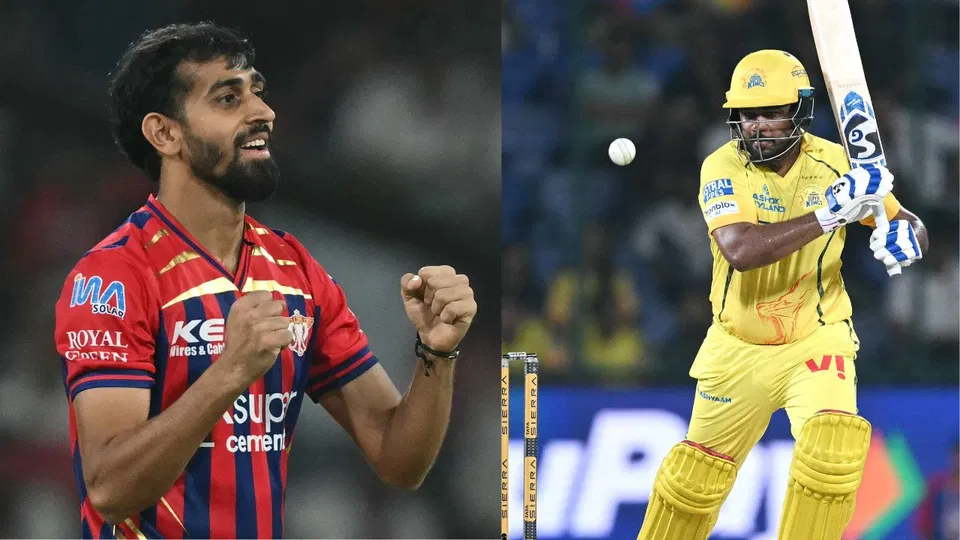
India have preferred Dhruv Jurel over Rishabh Pant for ODIs. Image Credits: AFPRishabh Pant is no longer in India’s white-ball plans. He hasn’t really had an extended run in ODIs since his return, with KL Rahul remaining the primary wicketkeeper-batter. Now, management has preferred Dhruv Jurel as Rahul’s backup.The thinking behind the selection is understandable. Pant hasn’t shown enough improvement in his white-ball game, while Jurel brings a set of skills that are difficult to replicate. More importantly, he has been more consistent than Pant at every level across white-ball cricket.Making sense of Dhruv Jurel’s ODI selectionDhruv Jurel vs pace in IPL 2026Dhruv Jurel is among the finest pace-hitters, with superior skills against the old ball and on hard lengths. In IPL 2026, he averaged 39.67 and struck at 166.82 against pace, hitting a boundary every 4.03 deliveries.More importantly, Jurel was sublime against back-of-a-length and shorter deliveries, an area that could trouble most Indian batters. He struck at 141.67 and hit a boundary every five deliveries on lengths between 8 and 10 metres. His numbers are even more striking on deliveries beyond 10 metres, where his strike rate jumps to 259.26, with a boundary every 2.70 deliveries. He also played just 11.11% dot balls and had a false-shot percentage of only 26.92%.Also Read: India's Strongest ODI XI vs West Indies: Shubman Gill To Include Auqib Nabi?That pace game was a major reason India chose him as KL Rahul’s backup. If he gets an opportunity, Jurel is likely to bat at No.5 or below, where he will face more pace in the final phase of the innings. With a single ball now being used from the 35th over onwards, pace is likely to come into play more often, with reverse swing also remaining a factor.That makes pace specialists even more valuable for India, particularly with the World Cup being played in Africa. South Africa offers contrasting conditions, from high bounce and zip to slower, low-skidding decks, while venues in Zimbabwe and Namibia are likely to be slower by nature.India will therefore need two types of pace hitters: those who can handle genuine pace and bounce, and those who can generate power against slower deliveries. Jurel has the stable base and power to counter both effectively.India’s current setup lacks genuine pace-hitters in the middle and lower middle order. Hardik Pandya, Axar Patel and Ravindra Jadeja have all shown signs of regression in this aspect, while Shreyas Iyer can also struggle on non-flat decks against deliveries shorter than a good length. Those concerns could become more pronounced with only one ball being used in the latter stages of the innings.Jurel, therefore, fits naturally into that role. He can provide the pace-hitting India need in the middle order even if he is picked as a specialist batter. He is also a safe wicketkeeper, giving India the option to use him behind the stumps and potentially allow Rahul to focus entirely on his batting.Rishabh Pant’s unevolved white-ball skillsRishabh Pant in IPL since 2025Despite all the talent in the world, Rishabh Pant hasn’t managed to turn it into consistent white-ball performances. His IPL returns have continued to decline, and he is no longer even in contention for T20Is. More importantly, his skill set hasn’t evolved enough to keep him as effective as the modern game demands.His technique remains a bigger concern. Teams still target his body because he struggles to get the bat face square on those deliveries, while his grip can leave him unstable at contact. His off-balance hitting is difficult to sustain in white-ball cricket because he has to generate considerable power from an imperfect base, often coming at the expense of timing.In IPL 2025, he played false shots against 39.39% of deliveries from pacers, rising further to 44.30% in 2026. His off-side range also remains limited, with Pant still looking to score predominantly through the leg side. That makes deliveries angled across him particularly difficult to negotiate.Those numbers came on some of the flattest pitches in the world. In ODIs, the challenge could become even greater, especially when reverse swing enters the equation. At this stage, that makes it hard for India to accommodate him in the lower middle order.There have also been reports that India’s management was unhappy with his game awareness and wanted him to take greater responsibility as a batter. So, he certainly isn’t the flavour of the season at the moment. If anything, his IPL performances have only weakened his case.It is therefore unsurprising that Pant has been named captain of the Rest of India side for the Irani Cup 2026. The selectors appear keen for him to focus on developing his red-ball game, which remains his strongest format. That indicates he is unlikely to feature prominently in the upcoming white-ball assignments, even though his left-hand batting offers a different dimension to the line-up.The backup wicketkeeper role still wide openSanju Samson's ODI performances by batting positionDhruv Jurel’s selection indicates that he could be on India’s radar as one of the options for next year’s World Cup. But that doesn’t mean he is a permanent lock for the tournament yet. For now, he is simply being trialled.That is understandable given his attributes and natural skill set, which could make him particularly suited to South African conditions. India have several other options, including Ishan Kishan, Sanju Samson and Rishabh Pant, so they will want as much clarity as possible before settling on their second wicketkeeper.Kishan, for instance, offers greater flexibility because he can open the innings or bat in the middle order. However, he did show some issues against quality pace bowling on surfaces that weren’t outright flat in England. So, despite the improvements he has made, Kishan still needs to find ways to score against better attacks away from home.Samson, meanwhile, also has a strong case because of his flexibility, particularly in ODIs. In fact, he has been excellent in the middle order in a limited sample. At No.5 and 6, Samson averages 59.20 at a strike rate of 101.36 in 10 ODI innings, including two fifties.Like Jurel, he can power off-pace deliveries and handle shorter lengths well. Recently, he has shown some issues against good-length deliveries moving away from him early in the innings. Those problems are likely to be less relevant if he bats in the middle order. So, Samson cannot be ruled out altogether, even if he hasn’t been considered for this format recently.Then there is Pant, who could put himself back in contention with a strong IPL season. His case, along with Kishan’s, is strengthened by the fact that both are left-handers in an otherwise right-hand-dominated batting line-up. The current management’s preference for left-handers is hardly a secret, and India’s full-strength XI doesn’t offer much variety in that regard.With the main batting unit dominated by right-handers, India could benefit from having a left-hander among their backups. Pant, therefore, needs to improve his technique and show greater consistency in the next IPL to bring himself back into the conversation. He was, after all, India’s backup wicketkeeper at last year’s Champions Trophy.All in all, the second wicketkeeper slot remains wide open, even if Jurel gets the opportunity for now. The World Cup is still a year away, and India will have plenty of games to test different combinations before settling on their squad. They have also not shied away from making late calls for major tournaments, as Varun Chakaravarthy’s selection for the 2025 Champions Trophy and Ishan Kishan’s for the 2026 T20 World Cup demonstrated.Also Read: No Place For Yashasvi Jaiswal? Indian Players Who Might Not Play A Single Match In ODIs Vs West Indies