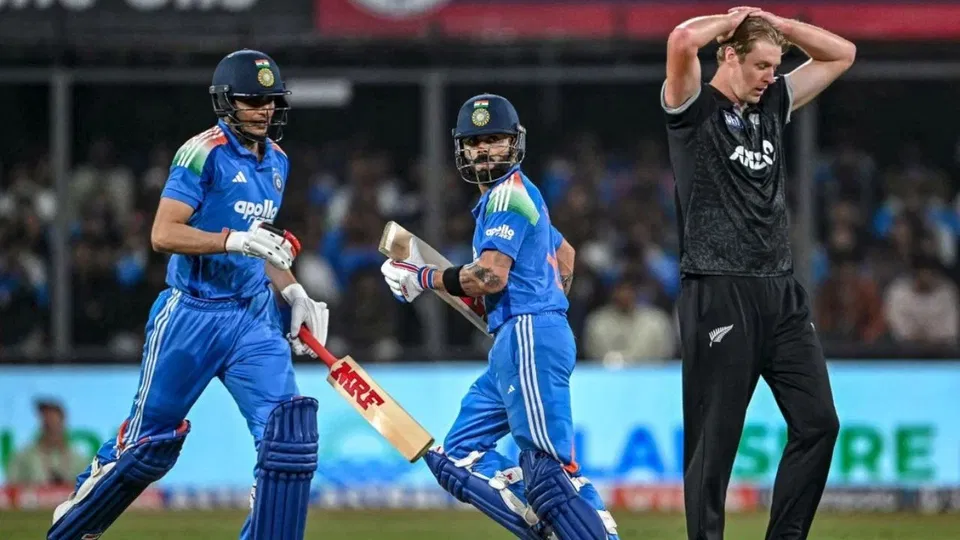





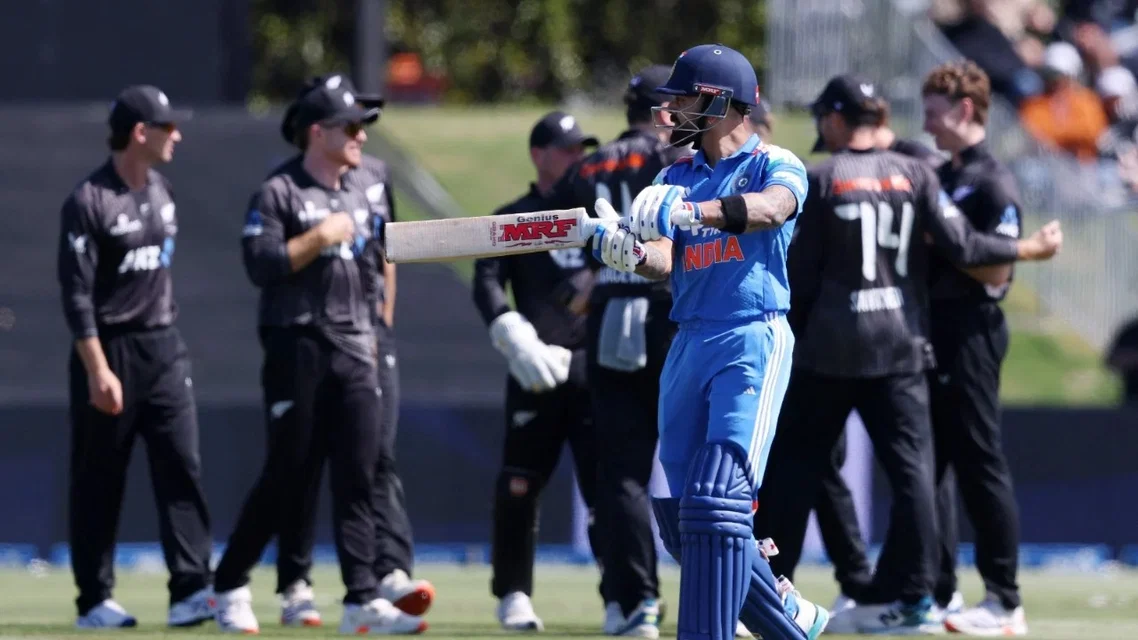
 India have struggled in overseas conditions. Image Credits: AFP
At a time when Indian bowlers enjoyed the New Zealand conditions, batters, some of whom are among the finest ODI batters ever, were far from impressive. Almost all of them looked at sea throughout the rubber and collectively put on one of the worst performances ever. The pitches obviously didn’t help them, but they weren’t out-and-out unplayable either.
Had the bowlers not churned out magnificent bowling performances in the first two games, the series scoreline could well have been different. In the wider context, the batting struggles should concern India ahead of the 2027 World Cup, especially in slightly challenging conditions. And it’s not a one-off either.
India’s struggles away from home in ODIs
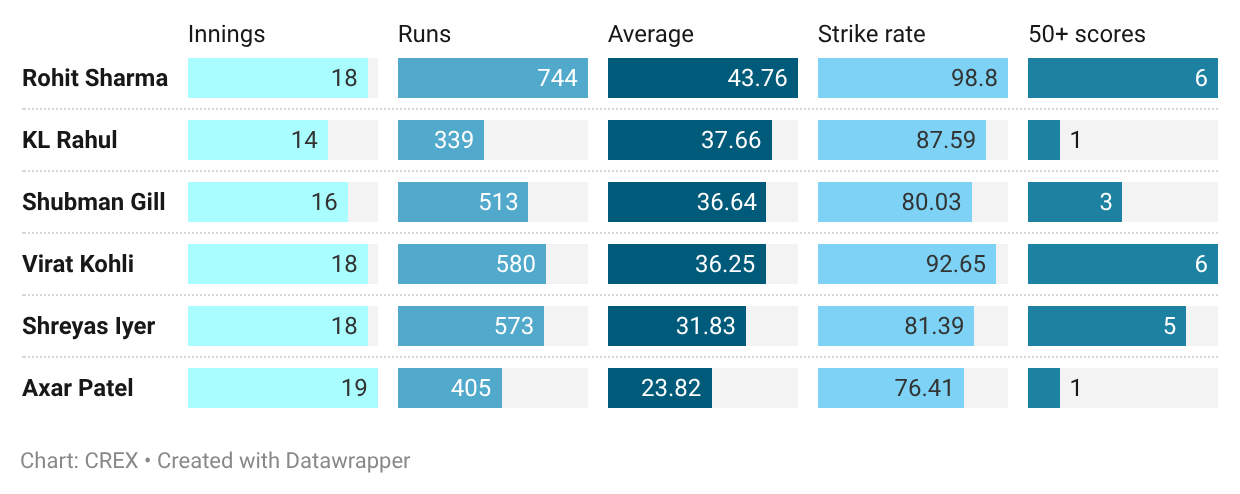 Indian batters away from home since World Cup 2023 (minimum 5 innings)
Since the end of the 2023 World Cup, Indian batters have averaged just 28.36 and struck at 85.16 in ODIs away from home. Outside Asia, those numbers fall further to 25.18 and 85.07, respectively.
Immediately after the World Cup, India travelled to South Africa for a three-match series without most of their key players. They averaged 29.35 collectively and somehow came out on top, largely thanks to occasional individual brilliance.
A trial by spin in Sri Lanka proved too difficult for most of them. India lost a wicket every 18.40 runs and managed just two half-centuries, both scored by Rohit Sharma. They also lost the series.
A sense of normalcy returned when the mainstays rediscovered their form at the 2025 Champions Trophy, where India played all their games in Dubai. However, they were still operating in the easiest conditions they had encountered outside home in recent times, while most opposition bowling attacks were far from full strength. Since then, things have only got worse for India as a batting unit.
.jpg)
On their subsequent away tour against Australia, India's issues against the moving ball became more pronounced. They collapsed completely in Perth and lost a few early wickets again in Adelaide. India averaged 31.68 across the series and lost once more.
There were a few improvements in England, but their inability to handle movement remained evident throughout the series. In Cardiff, for instance, England's seamers used pace to stifle the Indian batters and bundled them out for 233. They were also in trouble in Birmingham before Axar Patel and Washington Sundar bailed them out.
Now, in New Zealand, India have produced their worst batting performance since the previous World Cup. In seaming conditions, they averaged just 16.31, with Virat Kohli's solitary fifty being the only individual half-century. These were arguably the most challenging conditions they had encountered, but most of these batters are highly experienced and were expected to put up a better fight.

Not many showed the appetite to dig in and bat deep, particularly in the top order. In the final game, for instance, India got the best of the conditions but still ended up losing too many wickets to soft dismissals. Rohit Sharma and Virat Kohli were among those who threw their wickets away.
Who have been the worst performers?
Overall, almost every batter has seen a dip in performance. Away from home, they have been consistently vulnerable, particularly in conditions outside the subcontinent.
For instance, Virat Kohli averages 85.22 at home, compared to 36.25 away, while KL Rahul's average drops from 85.22 to 37.66. Meanwhile, Shubman Gill has averaged 107.33 at home but only 36.64 away.
Only Rohit Sharma has experienced a relatively mild dip, from 46.46 to 43.76. He has also been India's best batter overseas, being the only one to score multiple centuries. However, he has shown signs of regression too, with his issues against movement becoming increasingly visible.
The same applies to Virat Kohli, who has clearly regressed against movement and deviation, despite his recent gung-ho approach. Iyer, meanwhile, continues to struggle against short balls and has hardly looked comfortable on the New Zealand tour.
Gill looked good in patches and showed some improvement against incoming deliveries, playing the ball under his eyes and trying to eliminate the gap between bat and pad. However, he played just three games, making it difficult to conclude whether he could have suffered the same fate as the other batters.
KL Rahul, despite his middling numbers, is the only batter who has looked comfortable against quality bowling in both home and away conditions. The others have technical or tactical issues that become far more prominent outside their comfort zones.
It will be interesting to see whether India take any drastic measures and make significant changes, or whether the series win allows them to sweep these concerns under the carpet. Either way, the problems have become too obvious to ignore. India will want solutions before the World Cup, or at least suitable alternatives who can address some of these issues.
.jpg)