










 Image Source: AFP & Web
Cricket is referred to as the Gentlemen’s Game. However, in its long history, the sport has seen its fair share of foul play and the phrase ‘ball tampering’ conjures all manner of unpleasant images.
For the unversed, ball tampering means altering the condition of the ball in an attempt to change how the match ball behaves in the air, usually to swing more. The act is strictly against the laws of cricket.
Altering the condition of the ball falls under ‘Law 41: Unfair play’, which states that players are permitted to polish the ball on their clothing, remove mud from it and, should it become wet, dry it with ‘a piece of cloth that has been approved by the umpires’.
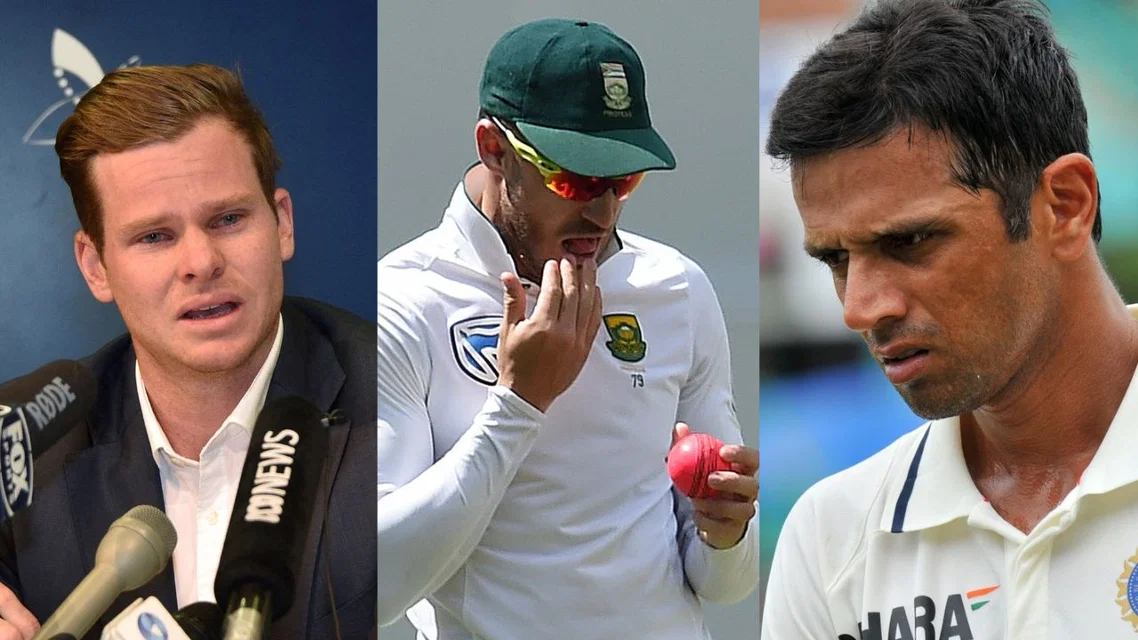
Despite the rules, over the years, cricket has seen a number of people commit the act, from Rahul Dravid to the Australian trio at the centre of 'Sandpapergate'.
That being said, in this article, we have prepared the list of players who have been reprimanded, fined or suspended for ball tampering in international cricket.
Michael Atherton - 1994
Back in 1994, the then England captain Michael Atherton was seen taking dirt from his pocket and rubbing it on the ball during a Test against South Africa at Lord's.
He was later fined 2000 pounds for failing to disclose the dirt to the match referee but remained as England captain despite calls for his resignation.
Waqar Younis, Azhar Mahmood, Moin Khan - 2000
During an ODI against South Africa on July 8, 2000, television footage showed Waqar Younis and Azhar Mahmood altering the condition of the ball.
Waqar Younis was fined 50% of his match fee and given a one-ODI match suspension with immediate effect. Azhar Mahmood has been fined 30% of his match fee.
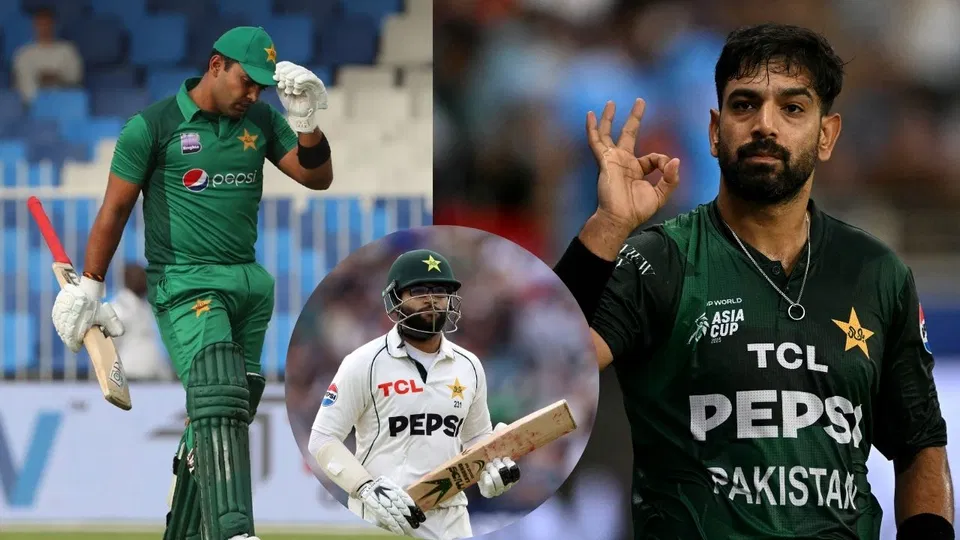
Meanwhile, Moin Khan, who did not physically tamper with the ball himself, was sanctioned as the team captain for failing to prevent his player’s actions and allowing the game to be brought into disrepute.
Shoaib Akhtar - 2002 & 2003
Former Pakistan pacer Shoaib Akhtar was penalised twice in his career for ball tampering. First, he received a severe reprimand in November 2002.
Later, in an ODI vs New Zealand, he was caught scratching the ball’s surface and quartering the seam on TV replays. Third umpire Gamini Silva flagged TV replay footage. Akhtar was thus handed a two-ODI ban, which ruled him out of the Bank Alfalah Cup final and a 75% match-fee fine in May 2003.
Moreover, in November 2026, the legendary pacer reiterated his earlier remarks, acknowledging that not only had he been involved in the foul play, but his former Pakistan teammates had also been part of the plan, using bottle caps.
Sachin Tendulkar - 2001 (Ban overturned and cleared)
In a Test match against South Africa, Sachin Tendulkar, who is revered as a god of cricket in India, was seen cleaning the ball seam without notifying the umpire, Mike Denness.
After the match, he was accused of ball tampering and given a suspended one-match ban by English umpire Denness.
However, in November 2001, the International Cricket Council (ICC) cleared Sachin Tendulkar of the charges and overturned his suspended one-match ban after reviewing match referee Mike Denness's ruling from the second Test against South Africa in Port Elizabeth.
Notably, the Indian Board refused to accept Denness as the match referee for the upcoming Test against South Africa, which the ICC then declared unofficial. The incident caused an uproar in India and the political row, which put the coming week's Test against England under threat.
Rahul Dravid - 2004
Known for his modesty, Rahul Dravid was fined 50% of his match fee in January 2004 after being found guilty of ball-tampering during India's 24-run victory over Zimbabwe at Brisbane.
Shahid Afridi - 2010
On January 31, 2010, former Pakistan captain Shahid Afridi was caught on television cameras biting the cricket ball during an ODI against Australia at the WACA in Perth, resulting in a two-match T20I ban.

Faf du Plessis - 2013 & 2016
South African batter Faf du Plessis was found guilty of ball tampering twice in his Test career - first in 2013 against Pakistan in Dubai, and in 2016 against Australia in Hobart. For his acts, he received match-fee fines in both instances, but wasn’t banned by the ICC.
Vernon Philander - 2014
In July 2014, former South African bowler Vernon Philander was fined 75% of his match fee by the ICC for ball tampering during the first Test against Sri Lanka in Galle.
Dasun Shanaka - 2017
Sri Lanka all-rounder Dasun Shanaka was fined 75 per cent of his match fee for "changing the condition of the ball" during a Test against India in November 2017.
Shanaka also received three demerit points on his disciplinary record after he was caught on TV picking near the seam of the ball.
Cameron Bancroft, Steve Smith, David Warner - 2018
Arguably the biggest ball-tampering scandal, Sandpapergate, occurred in March 2018 during the third Test played between Australia and South Africa in Cape Town.
Cameron Bancroft was caught on camera using sandpaper on the ball, leading to bans for Bancroft, the then captain Steve Smith, and vice-captain David Warner.
Dinesh Chandimal - 2018
Former Sri Lankan captain Dinesh Chandimal seemed to apply saliva containing the residue of something he had in his mouth to the ball in a Test against West Indies in 2018.
Chandimal, who pleaded not guilty, was banned by the International Cricket Council for the final Test in Bridgetown. He was also handed two suspension points and fined 100% of his match fee.
Nicholas Pooran - 2019
In November 2019, West Indies batter Nicholas Pooran was banned for four Twenty20 Internationals (T20Is) and given five demerit points after admitting to ball-tampering during the third ODI against Afghanistan.
Vivian Kingma - 2022
Netherlands fast bowler Vivian Kingma was found "changing the condition of the ball by scratching it with his nails" in a Men's Super League match against Afghanistan in 2022.
Kingma was found to have breached Article 2.14 of the ICC Code of Conduct for Players and Player Support Personnel and thus was banned by the ICC for four ODIs/T20Is for ball-tampering.
Marcus Trescothick - 2005 (later confessed)
In his 2008 autobiography Coming Back to Me, former England opener Marcus Trescothick admitted he sucked on ‘Murray Mints’ to generate sugary saliva to shine the cricket ball during the 2005 Ashes series.
Acting as England's designated ball-shiner, he used this saliva to preserve the shine on one side of the ball and help England's pacers - such as Andrew Flintoff and Simon Jones - generate swing and reverse swing in England's 2–1 series victory.
Because the admission came years after the series ended, Trescothick received no ban.