![India vs New Zealand, ODI in Rajkot [Source: X]](https://onecricketnews.akamaized.net/parth-editor/oc-dashboard/news-images-prod/1768646088016_1.jpg?type=hq) India vs New Zealand, ODI in Rajkot [Source: X]
India vs New Zealand, ODI in Rajkot [Source: X]
In the current era, much of the attention in international cricket inclines towards Test Cricket, recognised for its traditional mastery and rich history, and T20 Internationals, celebrated as the most fun version of the game, especially for the multiple franchise leagues across the globe.
Amidst this, One-day Internationals often seem to lose relevance and context. However, with time and a fast-moving world, ODIs are also witnessing significant transformation, prompting teams to adapt to new dynamics.
The changing nature of One Day Internationals and India’s struggle
ODI cricket, especially on subcontinental grounds, has become increasingly high-scoring. In recent years, even scores around 350 looked below par. Drawing inspiration from the T20 format, several teams have adopted ultra-aggressive batting strategies in ODIs. Batters at No 8 to 10 are also expected to possess the ability for explosive power hitting, further intensifying the competition.
The Indian team, despite their recent struggles in Test cricket, remains a strong force in the white-ball game. Their T20 setup is phenomenal. With youngsters like Abhishek Sharma and Tilak Varma coming in place of legends like Rohit Sharma and Virat Kohli, the team seems set for continued success in recent times as well as the long run.
In ODIs as well, India have demonstrated their strength, as evidenced by their Champions Trophy victory in 2025. However, a pressing concern has emerged in recent months- the lack of firepower during the slog overs in ODIs. This limitation has had a tangible impact on match outcomes.
A notable example occurred during the home ODI series against South Africa in December. In the second ODI, India posted a formidable total of 358 for 5. Although this appeared to be a massive and defendable target, the team missed an opportunity to maximise their advantage. After reaching 284 for 3 in the 39th over, maintaining a run rate well above 7, India managed to add only 74 runs in the final 11 overs, with the run rate dropping below 7.
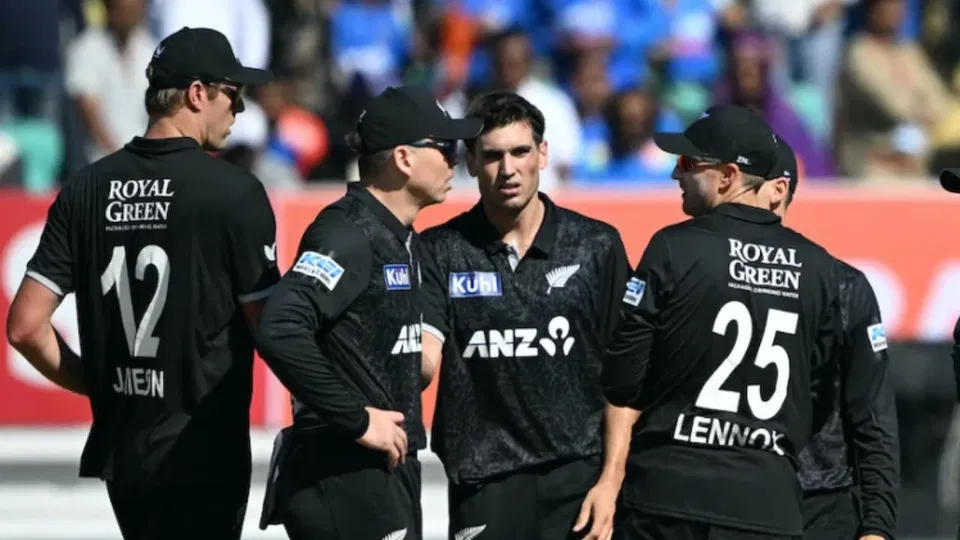
Ideally, the team should have added more than 100 runs in those overs, pushing the total beyond 380. This shortfall of approximately 25 runs ultimately proved costly while defending the target. A similar scenario unfolded during the second ODI against New Zealand last Wednesday, further highlighting the recurring issue of insufficient acceleration in the closing overs.
Star-studded top-order followed by a struggling middle and lower-order
India can boast of a very strong top five in ODIs, with both Rohit Sharma and Virat Kohli continuing to play the format. The captain, Shubman Gill, with four other senior players in Rohit, Kohli, Shreyas Iyer, and KL Rahul, forms the top five for India in ODIs. The consistency at the top provides India with a solid foundation in ODIs, as shown in recent matches.
Curious case of Jadeja: The unsolved puzzle
The problem starts after that. For a long time, Ravindra Jadeja’s struggle in ODIs has been evident. Even in the last match, he could score only 27 off 44 deliveries with an underwhelming strike rate of 61.36.
His struggle against the spin has been obvious in recent years. Moreover, his inability to push the scoring rate in the middle and late overs has left India short on firepower. Over the last two years, despite batting at five and below in all the matches, he could not even maintain a strike rate of 100 in a span of 12 games.
Even the same problem is observed in youngsters like Washington Sundar and Nitish Kumar Reddy. Sundar’s overall career strike rate is below Jadeja’s career strike rate. In the last two years, he has maintained a strike rate of just 75.88, batting at all positions between four and nine. It is evident that the team management is looking to use him as a floater, but his strike rate is not impressive for modern standards.
Reddy, on the other hand, got limited opportunities but batted with a strike rate below 100 in two of his three innings in ODIs, indicating his difficulty in accelerating the scoring rate when required. In the last match, despite being set at the crease, he could not launch in the slog overs and ended with a 21-ball 20, which did not provide the push India needed.
Meanwhile, Axar Patel could be a like-for-like replacement for Jadeja. However, India’s vice-captain of the T20I side is not even part of the ODI squad for the home series against South Africa and New Zealand. With news of recent injuries, this seems to be a precautionary measure, but post the T20 World Cup, Axar's regularity in the ODI setup could be beneficial for India.
There are other out-of-the-box choices like Rinku Singh and Ramandeep Singh, who have done well in their limited opportunities in white-ball cricket.
India's hunt for next power-hitter
The lack of impactful contributions from these positions not only hampers the team’s ability to capitalise on strong starts but also puts additional pressure on the top order. Therefore, India’s search for dependable finishers continues for those who can consistently push the team's total to competitive heights.
As far as Reddy is concerned, he should get more chances. The team management is looking to nurture Reddy as a seam bowling all-rounder in international cricket, a role traditionally played by Hardik Pandya in ODIs for India.
Pandya last played an ODI during the Champions Trophy last year, maintaining a career strike rate nearing 111 in the format. Due to his fitness concerns, he has been concentrating only on T20s recently, especially with the T20 World Cup starting in less than a month.
With Reddy developing the skills and potentially filling the void left by Pandya whenever required, India could possess greater flexibility and depth, both in batting and bowling, strengthening the lower-middle order and finishing options.
It is a must for the team management to assess Pandya’s ODI fitness later this year to determine his availability during the 2027 World Cup as an X-factor for India. Considering his significance as a seam bowling all-rounder, Pandya’s physical condition and readiness for the format will have a direct impact on India’s overall strategy and squad composition.
With the ever-changing nature of the game, India need to buckle up and look to set up a batting lineup much ahead of the World Cup 2027. To build a resilient squad for 2027, India must diversify its finishing options. They must identify and nurture the right finishers without depending on the individual brilliance of a select few to provide lower-order flexibility.
.jpg?type=mq "Harbhajan Singh's five best Test spells")