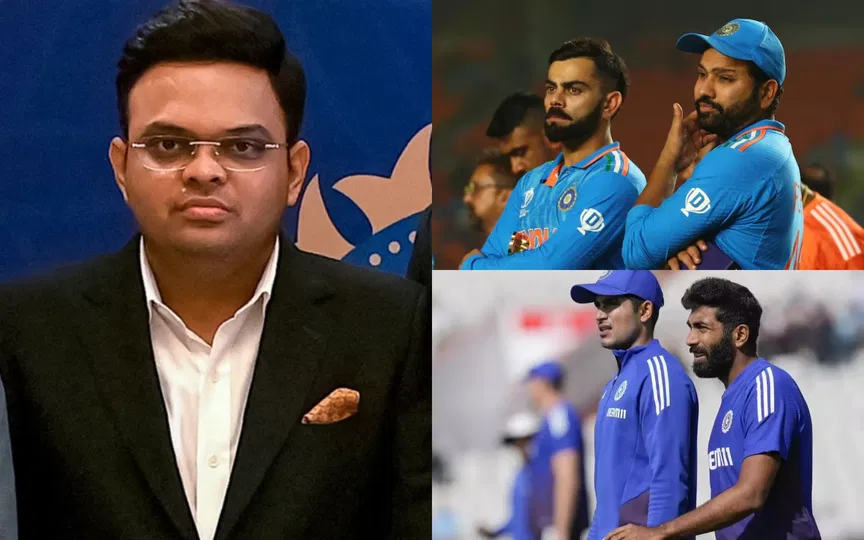
andSecretaryDevajitSaikia(R)(SourceAFP).jpg?type=hq) Ex-BCCI Secretary Jay Shah (L) and Secretary Devajit Saikia (R) (Source: AFP)
Ex-BCCI Secretary Jay Shah (L) and Secretary Devajit Saikia (R) (Source: AFP)
In a significant development, the BCCI on Saturday, asked KKR to release Bangladesh pacer Mustafizur Rahman ahead of the IPL 2026. The decision has been taken in the light of the current India-Bangladesh geopolitical tensions and subsequent threats against Rahman by political outfits.
In the same vein, the BCCI secretary also said that the board will allow KKR to rope in a replacement for Mustafizur Rahman. The BCCI’s decision on this particular issue has arrived quite late after a lot of outrage from the Indian cricket fans.
The decision-making pattern visible in the ‘Mustafizur in IPL’ fiasco reflects BCCI’s poorly-managed administrative dynamics. A string of such decisions have been quite common at the BCCI’s end since the departure of former secretary Jay Shah.
That said, here’s a look at some instances which showcase the imbalances, lack of coordination, and ‘lack of strong stance’ in the BCCI since Jay Shah left.
The Champions Trophy 2025 hybrid model controversy involving PCB and BCCI
After Jay Shah left the BCCI Secretary post, the ICC Champions Trophy 2025 was the first event when the board felt his absence. The then newly appointed Secretary, Devajit Saikia, replaced Shah and took charge on January 12, 2025, after being elected at the Special General Meeting (SGM).
The marquee international tournament was scheduled to be played in Pakistan, but the controversy erupted when India refused to tour Pakistan, citing the ‘security reasons’.
“We have officially informed the ICC about our inability to participate in games in Pakistan. We have made our stance clear that we will prefer a hybrid model, with the tournament split in two countries,” a BCCI source close to the developments told The Hindu.
The BCCI remained adamant on its stance, which led to a deadlock, and the ICC had to step in to resolve the issue. In their argument, the BCCI stated that Pakistan could travel to India for ICC events as there is no ‘security concern’ in the country. But the Pakistan Cricket Board refused to agree on the same.
A moral debacle for BCCI after PCB’s terms accepted
Subsequently, the deadlock ended only after PCB’s terms were accepted, as they demanded the same kind of hybrid model for ICC events in India.
“Cricket should win, that’s most important, but with respect for all. We are going to do what’s best for cricket. Whichever formula we go for, it would be on equal terms,” said PCB chief Mohsin Naqvi while answering a question about whether Pakistan accepted the hybrid model and considered not travelling to India for ICC events in future.
“My effort is to ensure that there is no one-sided system. It shouldn’t be that we travel to India and they don’t travel to our country. The idea is to settle it once and for all on equal terms,” he added later.
Eventually, the BCCI's acceptance of Pakistan’s terms after India’s refusal to travel to Pakistan for the Champions Trophy was considered a moral debacle, despite the BCCI being a considerable cricketing power.
The dispute over the Asia Cup Trophy remains unresolved
Following the Champions Trophy hybrid model fiasco, the subsequent controversy was the Trophy fiasco in the Asia Cup 2025. It all started after team India said ‘no’ to accepting the trophy from PCB and ACC chief Mohsin Naqvi. BCCI’s call came in the aftermath of the cross-border rifts with Pakistan following the Pahalgam Terror attack on April 22, 2025.
Furthermore, Naqvi took the trophy to his own hotel room, then locked it in the Dubai-based ACC office. Naqvi’s step fuelled the controversy and drew a reaction from the BCCI secretary Devajit Saikia after the game.
“India is fighting a war with a country, and a leader belonging to that country was supposed to hand over the trophy to us... We cannot accept a trophy from a person who represents a country that is waging a war against our country. So we have refused to take that trophy, but that does not mean that the gentleman will take the trophy and the medals, which are to be given to our country, to his own hotel room,” Said Saikia to ANI in a post-match conversation.
“That is totally unexpected, and we hope that his good sense will prevail, and he will send back the trophy to India as soon as possible, which will restore some semblance of morality. At least we are expecting that from him,” he added later.
Subsequently, ICC had to form a panel after several comments from ACC chief Mohsin Naqvi on the trophy and controversies, and India’s rebuttal during an ICC board meeting in Dubai earlier on November 7, 2025.
“BCCI has raised the Asia Cup trophy row with ICC. ICC has asked India and Pakistan to amicably resolve the issue. ICC stated that both India and Pakistan are important for world cricket and has formed a committee to look into this,” sources close to developments in Dubai told India Today.
But the standstill deadlock on the trophy controversy seems to expose the ‘lack of strengthened decision-making’ in the BCCI for almost the last year. It also reflects the impact of Jay Shah’s absence as a key authority known for maintaining the BCCI’s strong position.
Sluggish approach in managing rifts with Bangladesh
On Friday, January 2, the Bangladesh Cricket Board unilaterally announced the home series against India in their 2026-27 season. BCB’s official schedule read that India will tour Bangladesh for a three-match ODI series and a three-match T20I series in August 2026.
“The series that was postponed earlier between Bangladesh and India has been rescheduled,” Shahriar Nafees, BCB cricket operations in-charge, told Cricbuzz.
Notably, the BCB made this announcement despite BCCI’s decision to postpone the Bangladesh tour of both men’s and women’s teams last year. An official clarification from the BCCI on the series against Bangladesh is still awaited.
The news reports based on sources sometimes lead to the situation of rumour-mongering in the Indian diaspora. It also reflects the sluggish approach of the board in handling the rifts with Bangladesh and putting the rumours to rest.
But the case was not similar during Jay Shah’s tenure, as he made the board's position quite strong on the issue of Pakistan’s visit to India for the ODI World Cup 2023.
Initially, Pakistan were reluctant to send their team to India due to the security issues. But it was the Jay Shah-led BCCI that assured PCB’s security assessment team about players’ safety in India. It was further translated into Pakistan’s India visit for the prestigious cricket quadrennial after seven years since the T20 World Cup 2016.
So, it clearly shows the difference in decision-making and willpower between Jay Shah’s regime and the current BCCI administration.
 .jpg?type=mq "Usman Khawaja's controversial cricketing moments")
-min.jpg?type=mq "Impact of SEA Games in Region")